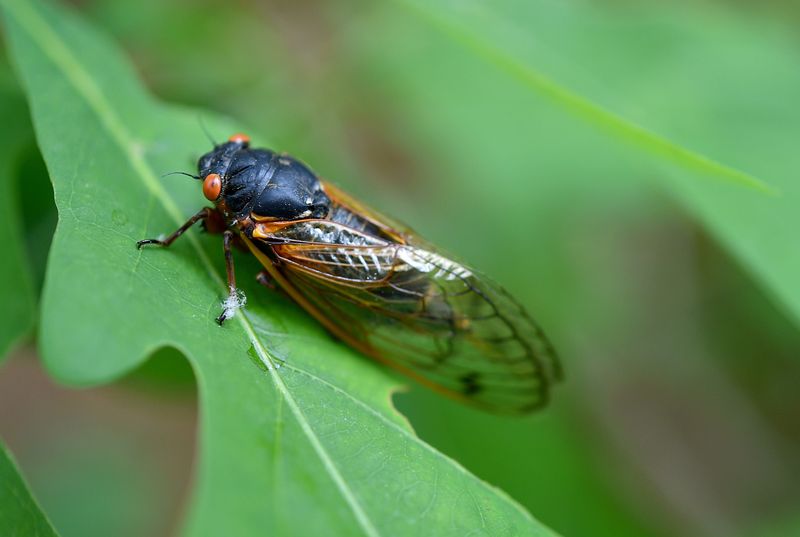
They have been around for weeks, eerily and loudly calling out, making a mess and peeing on everything.
Millions if not billions of 17-year cicadas have emerged in Cincinnati and Southwest Ohio. So, is the invasion by Brood XIV is almost over? Are the cicadas about to go away?

These cicadas are only around for a few weeks, according to the Ohio Department of Natural Resources, as they seek mates and lay eggs for the next generation. And since they started to emerge in mid-May, their time is nearly up, right?
Here’s what you need to know as cicadas peak and die off, and what you can do with the dead bugs left behind.
How long are cicadas around for? When will cicadas go away?
Gene Kritsky, professor emeritus of biology with Mount St. Joseph University in Cincinnati, said cicadas are still approaching their peak in many areas. Kritsky, founder of Cicada Safari, an app that crowdsources and reviews data on cicadas, attributed it to the cooler, rainy days in May.
“People should notice the loud singing declining over the next over the next two weeks, and the singing should be over in early July,” he said in an email on June 10.
Brood XIV is one of 15 recognized broods of periodical cicadas that emerge every 13 or 17 years, and one of four that appear in the Buckeye State, according to ODNR. They emerge when the soil temperature reaches 64 degrees, which typically happens in the second half of May.
They are active for three to four weeks as they focus on mating and reproduction, per ODNR. Male periodical cicadas produce a deafening chorus of calls to attract females. Once mated, female cicadas deposit their eggs into the branches of trees and shrubs.
Annual cicadas emerge worldwide each year, but periodical cicadas are found only in eastern North America. They live underground as nymphs for either 13 or 17 years before emerging above ground in massive numbers. Different populations of periodical cicadas are called “broods” and are numbered with Roman numerals.
Dead cicadas smell like rotting meat. How best to clean up and dispose of them
Scotts, the lawn-care company, says you’ll want to work quickly to get rid of cicadas once they die, because “big quantities of decaying cicadas can smell like a meat market during a power outage.”
However, dead cicadas can be fertilizer gold for your yard or garden. The company offers a few tips:
More tips on getting rid of dead cicadas around the house
USA TODAY offers some additional tips on cleaning up after cicadas. Those include:
Cicadas attract a nearly invisible pest that can bite and cause a rash
Dealing with the dead bugs isn’t the only problem cicadas leave behind. Their eggs can attract a pest. One that can bite you and cause a rash.
According to WebMD, the oak leaf itch mite is nearly invisible to the naked eye, being about 0.2 mm long. They commonly feed on larvae of an oak gall midge, a type of fly, that lives on pin oak leaves. Starting in late July, these mites drop from the tree or are blown on the wind, landing on animals and humans. Their bites can cause an itchy rash of small red bumps that can be painful to scratch. The rashes can be intense.
They’re also known to feed on cicada eggs, per WebMD, and were linked to a 2007 outbreak of rashes in Chicago, according to the Illinois Department of Public Health, where the mites were feeding on 17-year cicada eggs. In 2021, the University of Maryland Extension found it likely that Brood X cicada eggs were likely the mite’s food source for an outbreak of rashes in the Washington D.C. area, as reported by the Washington Post.
Where in Ohio have Brood XIV cicadas emerged? See the map
Brood XIV cicadas will stretch from northern Georgia to Massachusetts. In Ohio, they were expected to emerge in a more than dozen counties, per ODNR, mostly in Southwest Ohio:
Some of the edge counties will not see as heavy an emergence as others.
What’s the difference between periodical vs. annual cicadas?
The cicadas that emerge every 13 or 17 years are different from the ones seen every summer, and it’s not just the amount of time.
Kritsky told WKRN in Nashville that periodical cicadas emerge in May or June, while annual cicadas show up later, in late June and July, and through the rest of summer.
The two types also look different from each other. Periodical cicadas have black bodies with red eyes and red-orange wings and can be anywhere from three-quarters of an inch to an inch and one-quarter in length. Annual cicadas have dark green to black bodies with green-veined wings and black eyes and are larger. They can grow to an inch and one-third in length.
Are cicadas harmful to dogs? What animals eat cicadas?
Any animal that can eat insects will eat cicadas, according to the Purdue University Extension. Those include fish, bears, birds, raccoons and even other insects, like parasitic wasps.
They’re also safe for your dog to eat, to a point.
According to the American Kennel Club, a dog that eats the occasional cicada should be fine. However, dogs that gorge on cicadas will find their exoskeletons difficult to digest, resulting in an upset stomach, abdominal pain, vomiting and bloody diarrhea. Some dogs that overconsume cicadas may require a trip to the vet for IV fluids, or pain and anti-nausea medications.
Cicadas vs. locusts, what’s the difference?
Cicadas, like locusts, show up suddenly and in large numbers, and are sometimes called “locusts,” according to the Xerces Society for Invertebrate Conservation.
However, cicadas are not locusts.
Locusts are grasshoppers, and the two species are not closely related, according to the Xerces Society. Locusts also swarm for different reasons.
This article originally appeared on Cincinnati Enquirer: When do cicadas go away? Here’s when 17-year brood will peak in Cincinnati. See the map
Reporting by Chad Murphy, Cincinnati Enquirer / Cincinnati Enquirer
USA TODAY Network via Reuters Connect