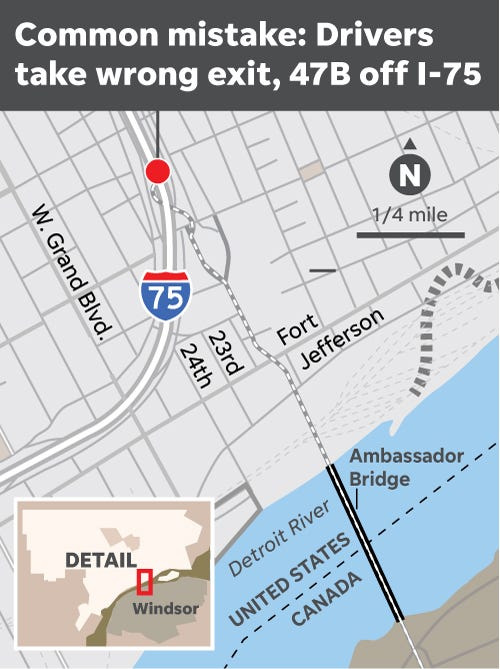
A viral tweet from a self-proclaimed “lifelong Detroiter” in 2022 seemed newly relevant in recent days in the fallout from some disturbing wrong-turn-to-Canada stories involving immigrants and the Ambassador Bridge.
Candice Fortman’s post on what’s now known as X with a photo of a “Bridge to Canada” sign, featuring the iconic red and white maple leaf flag and the words “No Re-Entry to USA” prompted an outpouring of responses, and, as of this week, 113,000 likes. Folks were all-too familiar with the worry and then relief of avoiding “one of the most detrimental Detroit mistakes,” as she described it then.

Fortman, who was formerly the executive director at Outlier Media in Detroit but is now taking part in a fellowship at Stanford University in California, told the Free Press on Friday she had posted that image and comment to be funny.
“Because I know that anyone who’s been in metro Detroit will recognize that moment of panic when you really need to make sure you’re going the right way on 75 and … clearly, a lot of folks understood what we were saying,” she said.
That sense of panic suggests that once a driver takes Exit 47B off Interstate 75 toward the bridge, there’s no way back. The Free Press, however, found an option to avoid heading through the toll booths and onto the bridge. But it’s not an obvious one, and Fortman indicated she was as surprised as the Free Press reporter had been to learn about it.
On Thursday, a reporter headed south on I-75 toward the bridge to scope out highway signage, perhaps drive across, to get a better sense of what drivers experience around the Ambassador Bridge. Signs for the bridge exit were marked with a Canadian flag. A sign for the 47C Vernor Highway exit, for instance, included an American flag.
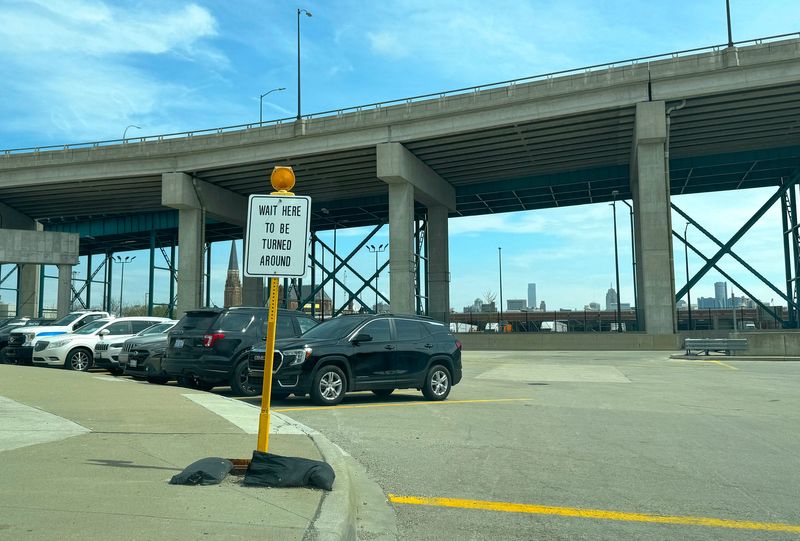
‘Wait here to be turned around’
The reporter, who is by no means a regular cross-border traveler but lives in the Detroit area, took the exit and drove through the toll booths and onto the bridge. Once he was in Windsor, he turned around and came back across.
He’d been wondering why there didn’t appear to be a way to turn around on the U.S. side before entering the toll booths and asked a U.S. border agent about it when he was handing over his passport card. Turns out, there is a way. Or at least there was this past week.
After a slight holdup getting redirected to have his car X-rayed, the reporter drove back toward the bridge and entered the bridge plaza from Fort Street in Detroit. Following the explanation from the agent, the reporter stopped at the Duty Free Shop, walked inside to a cashier and said he wanted to turn around.
The reporter was given a slip of paper on which he printed and signed his name (he was also certifying that he hadn’t bought anything at the shop), walked back to his car and drove a short distance to an area with a small sign reading “Wait here to be turned around.”
After a few minutes, a man came and took the slip of paper, jotted down the reporter’s license plate and some other information and had the reporter follow him as he walked toward a separate travel lane with a gate. After another few moments, the reporter drove away from the bridge area, avoiding a second trip over the bridge.
On Friday, a Free Press photographer tried the same thing from I-75, stopping at the Duty Free Shop and getting a slip to fill out. But he said he had to wait 17 minutes before someone came to direct him out of the bridge plaza area.
‘A wrong turn should not lead to a disappearance’
While that demonstrates an option for avoiding an unintended trip to Canada, it clearly isn’t a possibility that most people are aware of and it’s not a speedy turnaround.
U.S. Rep. Rashida Tlaib, D-Detroit, on Thursday explained during a news conference that it has been “an ongoing struggle” to get the private bridge owner to have some sort of wraparound. “… We used to have it where right where when you got to the toll, if you accidentally made that wrong turn … they would allow you to make like a U-turn. I’ve done it as a young person.”
Earlier in the discussion, she noted that “a wrong turn should not lead to a disappearance and an erosion of someone’s due process or being treated with human rights. For years, we have been saying it is too easy for someone to end up in the toll plaza. We’ve had to lobby for more signage and warnings. It’s in the backyard of a community that has 20 different ethnicities.”
The consequences of a wrong turn on the Ambassador Bridge have been fairly serious for some immigrants in recent months. Ricardo Prada Vasquez made a wrong turn delivering a food order and was deported, and a family heading to Costco was directed by GPS to a location in Windsor, rather than on the U.S. side of the border, and was detained for days, according to recent Free Press reports.
Bridge operator: Don’t blame us or the signs
“About 90% of the 213 immigrants detained from Jan. 20 to March 21 were people who accidentally took the wrong lane in southwest Detroit onto the Ambassador Bridge, which connects the U.S. to Canada,” according to Christine Sauvé, manager of policy and communication at the Michigan Immigrant Rights Center, in a Free Press article Thursday.
The Free Press reached out to officials with the Ambassador Bridge about the issue of wrong turns that end up at the bridge, and Kenneth Dobson, vice president of the Detroit International Bridge Co., pointed to federal government policy as the central issue at play now.
“Detention of undocumented immigrants by the United States Customs and Border Protection Agency is not an issue about signage or the Ambassador Bridge. This is an issue about how federal immigration policy is enforced. The prior federal administration did not detain undocumented immigrants who unintentionally turned onto the Ambassador Bridge. The current federal administration has enacted policies such that undocumented immigrants who unintentionally turn onto the Ambassador Bridge are detained,” Dobson said in an email.
He noted that “MDOT’s signage and roadway markings clearly identify ramps and roads leading to the Ambassador Bridge as an international crossing to Canada and include clear language such as ‘Bridge to Canada,’ ‘To Canada Only’ or ‘No Re-Entry to USA’ to provide advance notice to travelers. Once a traveler enters Ambassador Bridge property in the United States, CBP has sole jurisdiction over the traveler.”
The Free Press sent a message to a CBP spokesman seeking comment.
Regarding signage on the approaches to the Ambassador Bridge, the Michigan Department of Transportation noted improvements to signs and pavement markings in recent years.
‘It happens a fair amount’
“Improvements included adding the USA and Canada flags to the signing leading into the interchange, adding ‘Canada Only’ and ‘no reentry’ plaques to existing signs, and adding CANADA ONLY pavement markings in advance of lane drops where applicable,” according to a response from MDOT’s Metro Region traffic and safety group provided by spokeswoman Diane Cross. “The thought behind the flags was that even if a driver cannot read English, they could associate the flag pictograph with Canada. Similar changes were made at the Blue Water Bridge and, to a lesser extent, at the tunnel.“
Tal Czudner, CEO of the Windsor-Detroit Tunnel Corp., which is the operator on the Canadian side for another key Detroit River crossing, deferred on questions about the Ambassador Bridge or U.S. border policy to other entities. However, he did note that the issue of wrong turns at the border isn’t new.
“Historically, people have made a wrong turn, and if you make a wrong turn and don’t have proper ID you generally run into challenges. That really hasn’t changed,” he said. “It does happen. It happens a fair amount.”
Czudner said there’s a duty free shop for the tunnel on the Canadian side that gets lots of traffic but that there’s no process there to go right back to Windsor. Drivers instead have to proceed through to the tunnel.
The Free Press reached out to spokespeople for numerous public officials as well, including Detroit Mayor Mike Duggan and Detroit City Council Member Gabriela Santiago-Romero, whose district includes the approach to the bridge. Neither provided comment, with a spokesperson for the council member deferring to federal officials.
U.S. Rep. Shri Thanedar, D-Detroit, in a statement noted that “no one should face detention or deportation for simply making a wrong turn. Yet families and children have been held in inhumane conditions, denied access to legal representation, and in some cases, vanished without explanation. It’s unacceptable that people can be locked away without contact with their loved ones or attorneys. We must take immediate action to fix this — starting with clearer signage, but there should never be a scenario where missing a sign means you’ll suddenly go missing yourself.”
Contact Eric D. Lawrence: elawrence@freepress.com. Become a subscriber. Submit a letter to the editor at freep.com/letters.
This article originally appeared on Detroit Free Press: Although wrong turns at Ambassador Bridge pose issues for immigrants, a workaround exists
Reporting by Eric D. Lawrence, Detroit Free Press / Detroit Free Press
USA TODAY Network via Reuters Connect