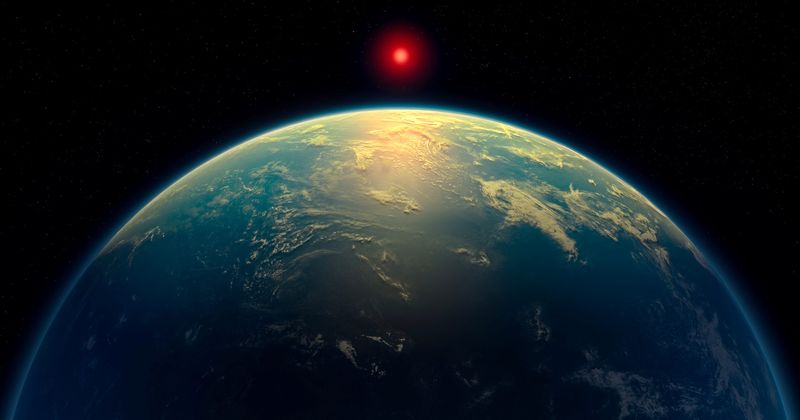
Astronomers at the University of Cambridge in England announced on April 17 that they had found the strongest evidence yet that life may exist somewhere besides Earth.
Using data from NASA’s James Webb Space Telescope, the researchers detected atmospheric clues hinting that microbial organisms could be living on the surface of K2-18b, visible in the constellation Leo.

And although the first sign of possible extraterrestrials detected in the cosmos didn’t come in the form of little green aliens flying around in saucer-shaped spacecrafts, it doesn’t make the recent discovery any less exciting.
In fact, the life that could be — thriving on a distant ocean-covered planet named K2-18b is likely not intelligent at all.
Here’s everything to know about the discovery, the exoplanet and the search for life in the cosmos.
Is there alien life on K2-18b?
A strong possibility exists that extraterrestrial life can be found on a distant exoplanet known as K2-18b.
Using observations from NASA’s James Webb Space Telescope, the researchers were able to find possible hints of molecules and gases that, on Earth, are signs of life.
If anything is indeed living on the planet, it likely would be microorganisms akin to Earth’s phytoplankton.
What is an exoplanet?
Exoplanets are planets that orbit stars outside of Earth’s own solar system. For that reason, the celestial bodies are sometimes also referred to as extrasolar planets.
Some, called rogue planets, don’t even orbit a star, but are floating through the cosmos untethered.
Astronomers have confirmed the existence of more than 5,800 exoplanets, but billions are thought to exist, according to NASA.
Why are astronomers interested in K2-18b?
K2-18b is considered a Hycean exoplanet — as opposed to a rocky planet — due to its potential to possess a hydrogen-rich atmosphere and surface covered in ocean water.
Since it was discovered in 2015, K2-18b, which orbits a red dwarf star more than 120 light-years from Earth, has captivated scientists who have considered it among the best potential life-harboring ocean worlds.
The first observations in 2019 confirming the possible presence of water were made with the Hubble Space Telescope.
In September 2023, another investigation with Webb — an advanced telescope launched in 2021 outfitted with powerful infrared instruments — revealed something more: traces of carbon-bearing molecules in K2-18b’s atmosphere, including methane and carbon dioxide.
What is a ‘habitable zone?’
These conditions classify the exoplanet as being in what astronomers refer to as the habitable zone — where planets have the right conditions for water, providing a key ingredient for life to flourish.
Astronomers even refer to planets with such conditions as “Goldilocks” zones because conditions have to be just right — neither too hot nor too cold — for water to remain in liquid form and pool on surfaces.
How big is exoplanet K2-18b?
K2-18b is 8.6 times bigger than Earth.
The planet’s large size — with a radius 2.6 times that of Earth — means the planet’s interior likely contains a large mantle of high-pressure ice, like Neptune, according to astronomers.
K2-18b is also smaller than Neptune, making it what astronomers refers to as a “sub-Neptune” planet that, while not present in our solar system, is what NASA says is among “the most common type of planet known so far in the galaxy.”
How did astronomers make the recent discovery?
For the most recent discovery, a team of researchers used a different instrument outfitted to Webb to study the light from K2-18b’s parent star as the planet passed in front of it from Earth’s vantage.
As starlight passed through the planet’s atmosphere, the clues left behind allowed for astronomers to piece together the gases in the atmosphere and detect a possible biosignature. On Earth, the sulfur-based gases they detected are only produced by life, primarily microbial life.
The observations could have occurred by chance or could be the result of previously unknown chemical processes at work on K2-18b, according to the researchers. The team hopes to make follow-up analysis with Webb to reach a more definitive conclusion.
Where else are astronomers searching for life?
In our solar system, Earth is one of only three planets, along with Mars and Venus, that fall within the habitable zone.
On Mars, two of NASA’s robotic rovers are in the process of searching the now-barren planet for clues that life could have existed on its surface.
As of October, NASA has also sent its uncrewed Europa Clipper spacecraft on a far-reaching journey to one of Jupiter’s many moons where water is believed to exist beneath an icy surface. Once the orbiter reaches the icy moon Europa in 2030, it will begin scouring the surface from above to look for signs that life could thrive.
Otherwise, NASA, the world’s space agencies and other astronomers believe the best opportunity to discover life beyond Earth may exist outside our solar system.
What other ways are scientists looking for life?
Organizations like the Search for Extraterrestrial Intelligence Institute are dedicated to exploring the cosmos for extraterrestrial neighbors. SETI even harnessed technology to expand its search beyond our own galaxy.
The Institute conducts activities in three arenas: (1) astrobiology, the efforts to find and understand the prevalence of life in general (for example, microbial life under the parched landscapes of Mars or the icy crust of the jovian moon Europa); (2) SETI, experiments designed to detect radio or light signals that would reveal the presence of technically sophisticated beings; and (3) education and outreach projects that inform the public about our research, encourage young people to become more proficient in science, engage the general public in science research, and train teachers in STEM subject areas.
Have aliens visited Earth?
There’s no proof any alien civilization has visited Earth. That hasn’t stopped thousands of people from reporting UFOs, UAPs and other unusual phenomena.
Historically, Michigan ranks 10th in the U.S. for reports of “unidentified aerial phenomena” (UAP) to NUFORC with 3,794 since an incident in 1936. That’s just 24 behind North Carolina for ninth place. California ranks first, with 16,735. That is almost twice as many as the second-place state, Florida, which has 8,624 reported sightings.
This article originally appeared on Detroit Free Press: Could life thrive on K2-18b? What to know about the distant exoplanet
Reporting by Eric Lagatta and Jalen Williams, Detroit Free Press / Detroit Free Press
USA TODAY Network via Reuters Connect