In March of 2020, the COVID-19 pandemic forced the closure of businesses, government offices, schools and more.
Many businesses and organizations were forced to adapt quickly to offer remote programs — including those in the world of arts and culture.

Organizations that typically rely on in-person experiences including art and live performances were thrown into turmoil by federal, state and local directives to shut their doors indefinitely.
The nonprofit Americans for the Arts tracked the economic impact of COVID-19 on the arts and culture sector from March 13, 2020, to Feb. 15, 2021, and found that the U.S. lost an estimated $15.2 billion during that time, and Florida lost nearly $150 million. In that survey, the group estimated that throughout the U.S., 488 million people who would have gone to a live performance instead stayed home.
Local arts organizations did not escape the effects, and many quickly pivoted to serve an at-home audience, offering outdoor and socially distanced events; virtual programming; and live performances streamed into peoples’ homes.
Now those programs and others developed to meet changing needs continue to offer new ways to reach audiences in a continuing legacy of the COVID-19 pandemic.
“I think the biggest thing that arts organizations learned is the art of the pivot,” said Dave Lawrence, chief executive of the Cultural Council for Palm Beach County, the local arts agency.
Groups had to quickly change programs or events to respond to ever-evolving conditions, forcing them to be more nimble and think creatively about engagement and presentation, he said.
“It caused organizations to really think on their feet, because even as they were making plans and following all the protocols, something could change again,” Lawrence said.
March 2020: Turmoil for arts groups
Most museums and performing arts venues in the area closed on March 12 or 13, according to a survey of groups, Palm Beach Daily News and Palm Beach Post archives.
When the Society of the Four Arts in Palm Beach postponed its season on March 12, 2020, the organization began planning for the following season with online programs for members and library patrons, along with reduced-capacity concerts and lectures, a Four Arts spokesperson said. King Library book discussions were the first programs to be offered virtually, along with the Esther B. O’Keeffe Speakers Series, they said.
While there were challenges — including the tragic loss of some members and patrons to complications caused by the illness and a loss of fundraising because some events were canceled — there were successes as well, including the increased popularity of the Philip Hulitar Sculpture Garden and Demonstration gardens, the spokesperson said.
The Norton Museum of Art in West Palm Beach faced a major hurdle with the closure of its museum on March 13, 2020: How to share its collection and exhibitions with people at home.
Virtual programming at the Norton began a week later with the launch of the Norton from Home initiative, a museum spokesperson said. The Norton offered an art-making activity, and curator Wanda Corn hosted a YouTube video about Georgia O’Keeffe.
The Norton worked to make as much of its programming available online as possible, the spokesperson said. Some of the museum’s most popular offerings — lectures, Book + Art programs, Art After Dark performances and Spotlight Talks — quickly gained virtual followers. The museum’s arts outreach team created hundreds of do-it-yourself art projects for students each month, then delivered them to schools and other sites, the spokesperson said.
While there were many unknowns in those early days of the pandemic, the Norton team came together to find creative solutions to continue to reach the community, the spokesperson said.
“The Norton’s goal was to make as much programming as possible virtual and to continue to be a hub of creativity, fostering community, connection and collaboration,” said Ghislain d’Humieres, director and CEO of the Norton.
The Kravis Center for the Performing Arts in West Palm Beach stopped all performances on March 12, 2020, a spokesperson said.
The venue immediately began working to produce and present what would become a hugely popular feature for children at home because of the pandemic: the Learn and Play virtual storytelling series.
In August of 2020, the Kravis Center released on social media its virtually produced video of the song “Somewhere Over Rainbow” introduced by the Kravis’ Michael Feinstein, with Broadway performer Talia Suskauer in the lead role alongside students from the Broadway Artist Intensive, the Young Singers of The Palm Beaches and musicians from the Palm Beach Opera Orchestra.
Here’s some musical inspiration and hope for a better tomorrow from the Kravis Center and some of Palm Beach County’s most talented students! Master showman & Kravis Center frequent performer Michael Feinstein kicks-off this special music video SOMEWHERE OVER THE RAINBOW featuring the Young Singers Palm Beaches, students from the Kravis Center’s De George Academy for Performing Arts, The Broadway Artists Intensive and Dreyfoos School of the Arts alumni Talia Suskauer, who is starring as Elphaba in the WICKED MUNCHKINLAND National Tour. The students are joined by members of the Kravis Center Pops Orchestra.
The Kravis offered virtual weeklong summer camp programs and audition coaching, then launched the Kravis Classroom Connection Series for students, the spokesperson said.
Live, in-person performances returned to the Kravis Center on Oct. 30, 2021.
Overcoming fundraising challenges
While many organizations took major fundraising hits, local advocates rallied to their defense.
Funding continues to be an issue for many organizations, Lawrence said.
“The contributions to cultural organizations have been slow to get back, and organizations are still finding that to be the case even today several years on from the end of the pandemic,” he said.
The Cultural Council quickly realized the effect that pandemic-prompted closures would have on arts and culture organizations — and the artists themselves.
On March 23, 2020, the Cultural Council launched the Palm Beach County Artist Relief Fund, an online fundraiser that offered grants of $250 to $500 to artists affected by COVID-19. Within three months, the group had collected about $45,000 and provided grants to 79 Palm Beach County artists, Cultural Council officials said at the time.
The Cultural Council also partnered with Palm Beach County to start the Palm Beach County Cultural Resiliency Fund, which in 2021 provided a total of more than $186,000 in grants to 15 organizations, according to a 2022 report on the effects of the pandemic on cultural organizations in the county done by research group Surale Phillips.
That same study documented the stark effects of the pandemic on the arts and culture economy in Palm Beach County: economic activity from the sector dropped from about $590 million in 2019 to about $362 million in 2020, then down to about $228 million in 2021.
Taking lessons learned from the pandemic
While some groups have continued limited virtual programming that began during the pandemic, many resumed in-person events, activities, performances and classes as quickly as possible, arts leaders said.
There was burnout after the pandemic, and people were eager to be in the same room with others again, Lawrence said.
“People really saw the opportunity to engage in person, and clearly, cultural organizations really preferred to have people there in their theaters, in their galleries, to experience the work in person,” he said.
Armory Art Center in West Palm Beach learned from the pandemic that the community had different needs than what the center was providing, said CEO Jill Brown.
“They needed more flexible scheduling,” she said. “We were probably not offering as much programming for the workforce, and we’re doing that more now.”
Armory now stays open later in the evening and offers more programs for young children and teenagers, Brown said.
The center also took a look at its events to find ways to reach a broader audience, she said. “We’re making sure to take the time to develop the events before we launch them so that they are as good as possibly can make them,” Brown said.
Groups found new ways to reach people who aren’t mobile and can’t leave their homes, Lawrence said. “If there was a glimmer of a silver lining for the pandemic, it was the cultural community’s ability to reach and survey a population that either they hadn’t been engaging with before, or not the extent that they are now.”
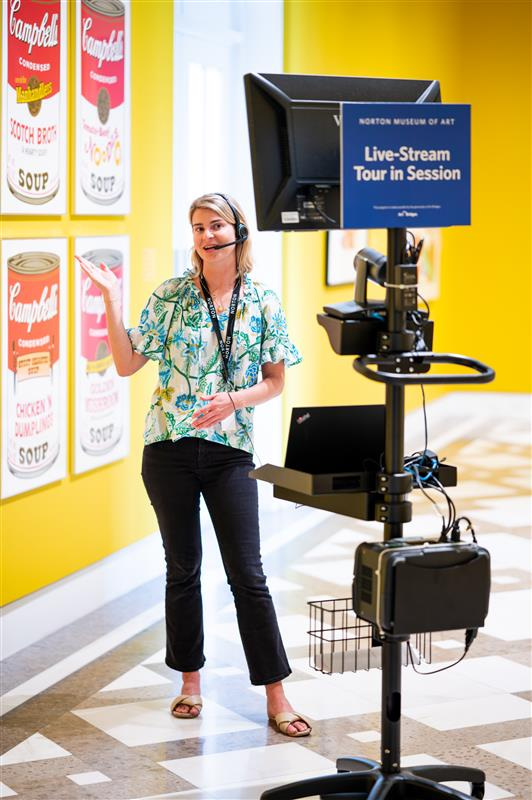
Many of the Norton’s virtual programs have continued and grown, with the museum now offering distance learning and virtual guided tours, the spokesperson said.
Meredith Gregory, the Norton’s director of school and teacher programs, worked with other Norton team members to create virtual tours for school groups. “This program is still in use today and remains a valuable new tool to welcome audiences who can’t come in person,” the spokesperson said.
Through the pandemic, the museum also found an audience hungry for more outdoor programming — for example, an audio tour for the Pamela and Robert B. Goergen Garden was created during the pandemic and is still available — as well as a need to bring the Norton into the community, the spokesperson said.
At the Four Arts, the demand has grown for events to be livestreamed. A plan to expand and renovate the organization’s Esther B. O’Keeffe Building was recently approved by the Town Council and includes updates to the audio-visual system and a modern air conditioning system that will help the broadcast quality of events in the Four Arts’ Gubelmann Auditorium, the society’s officials previously told the Daily News.
The financial effects of the pandemic were “devastating” to the arts and culture industry, according to research done by Americans for the Arts. Local arts officials have described the pandemic as revealing the fragility of the arts and culture industry, with many arts venues and organizations waiting nearly three years before reopening at full capacity because of financial constraints and concerns about safety because of variants of the disease.
Organizations remain optimistic, though many are still working their way back to where they were before the pandemic. In June of 2024, Palm Beach Dramaworks told the Daily News that ticket sales were about 70% of what they had been before the pandemic.
“In the face of great biological adversity, The Society of the Four Arts and the spirit of the Palm Beach community prevailed,” said Philip Rylands, the organization’s president and CEO.
Kristina Webb is a reporter for Palm Beach Daily News, part of the USA TODAY Florida Network. You can reach her at kwebb@pbdailynews.com. Subscribe today to support our journalism.
This article originally appeared on Palm Beach Daily News: Five years later: Palm Beach County arts groups take lessons from pandemic challenges
Reporting by Kristina Webb, Palm Beach Daily News / Palm Beach Daily News
USA TODAY Network via Reuters Connect