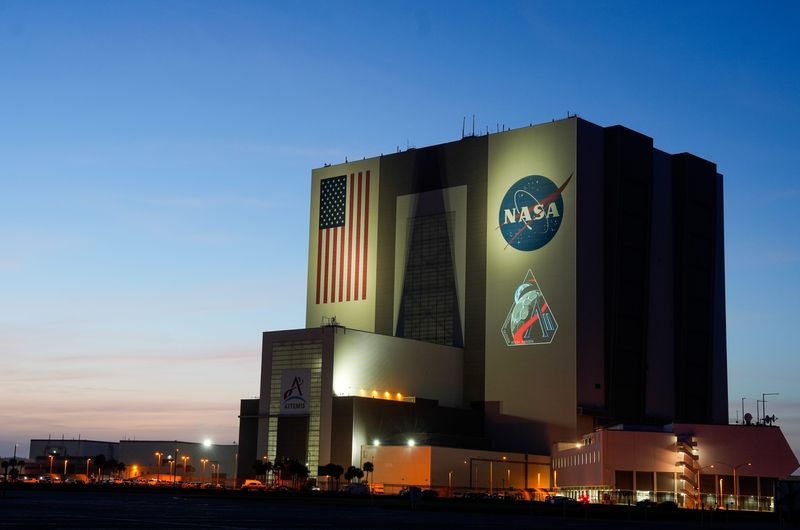
NASA displayed the Artemis II mission patch design on the walls of the giant Vehicle Assembly Building at Kennedy Space Center Thursday night — just days before a new administrator is expected to be confirmed to lead the space agency and, perhaps, usher in significant change.
President Trump’s pick of NASA Administrator, Jared Isaacman — a businessman and private astronaut closely aligned with SpaceX CEO Elon Musk — is set to be confirmed during a U.S. Senate hearing on Wednesday. This comes at a time when rumors are swirling that the Artemis Program could face cancellation. Artemis is NASA’s effort to return U.S. astronauts to the moon.

Artemis II, which will send astronauts around the moon, is set for launch no earlier than 2026.
The Artemis II crew consists of NASA astronauts Reid Wiseman, who will serve as commander, Victor Glover, mission pilot, and Christina Koch, mission specialist. Joining them will be Jeremy Hansen from CSA (Canadian Space Agency), who will serve as the second mission specialist.
When the four launch in the Orion spacecraft atop NASA’s SLS rocket, they will be the first humans to venture around the moon since Apollo 17 in 1972.
The Artemis II crew explained the mission patch in the following NASA statement:
“The Artemis II test flight begins when a mighty team launches the first crew of the Artemis generation. This patch designates the mission as “AII,” signifying not only the second major flight of the Artemis campaign, but also an endeavor of discovery that seeks to explore for all and by all.
Framed in Apollo 8’s famous Earthrise photo, the scene of the Earth and the Moon represents the dual nature of human spaceflight, both equally compelling: The Moon represents our exploration destination, focused on discovery of the unknown. The Earth represents home, focused on the perspective we gain when we look back at our shared planet and learn what it is to be uniquely human.
The orbit around Earth highlights the ongoing exploration missions that have enabled Artemis to set sights on a long-term presence on the Moon and soon, Mars.”
The journey around the moon will last 10 days.
Jared Isaacman as NASA Administrator
As for Isaacman, he has extensive spaceflight experience and has worked alongside SpaceX. Isaacman is the Shift4 founder and businessman who purchased and commanded the first two SpaceX private spaceflights: Inspiration4, which was the first all civilian mission to orbit, and Polaris Dawn, which saw the first spacewalk by a private company. It was Isaacman who performed the first SpaceX spacewalk. Both missions fundraised millions of dollars for St. Jude Children’s Research Hospital.
Previous interview with Isaacman: Polaris Dawn spacewalk pushing SpaceX into unchartered territory
Isaacman is an advocate of Musk’s Starship, which is being built not only to serve as a human lander on the moon for Artemis III, but for SpaceX’s goal of sending a crew to Mars in the coming years. When Isaacman founded the Polaris Program, the plan called for three spaceflights with Polaris Dawn being the first. The third was projected to be the first crew to fly on Starship.
“After Inspiration4, I felt like we accomplished all of our objectives and set the bar high for future missions. I was not planning to go back until after visiting Elon at Starbase in October of 2021,” Isaacman stated in an email to FLORIDA TODAY prior to the Polaris Dawn mission in September 2024. “At that point, we discussed possibilities for test and development missions that would help move the needle on SpaceX’s bigger vision to make life multi-planetary.”
When is the next Florida launch? Is there a launch today? Upcoming SpaceX, NASA rocket launch schedule at Cape Canaveral
Artemis I and Trump Administration
As for the new administration, it was back in 2017 that the Trump administration called for sending astronauts, including the first woman, to the moon. The date of the Artemis II launch has since slipped by two-years, originally set for 2024.
The uncrewed Artemis I launched in 2022. However, the Orion spacecraft’s heat shield performed in unexpected ways, including showing erosion upon reentry. What was found to have happened was heat accumulated in the heat shield’s outer layer, which caused gas to be trapped and resulted in cracking. With this knowledge, NASA and Lockheed Martin, which is contracted to work on Orion, have come up with a modified reentry plan that will reduce heat inflicted on the spacecraft.
The rocket for the upcoming crewed Artemis II mission is currently stacked inside the VAB, and if all goes well, it will see testing at launch Pad 39B later this year. Should all remain on track, the launch will be sometime next year.
Assuming Artemis II goes ahead successfully, Artemis III would see astronauts return to the moon’s surface. That mission is currently set for no earlier than mid-2027.
But questions remain whether that will continue to be the plan under the Trump administration. Trump has pushed for sending astronauts to Mars. Musk, who is currently serving as the leader of the Department of Government Efficiency under President Trump, has mentioned the goal of Mars on multiple occasions, with Trump echoing that view.
Meanwhile, former NASA administrator, Bill Nelson had said it was critical for to land NASA astronauts on the moon’s south pole ahead of the Chinese government, which plans to land a crew on the moon in 2030.
With Isaacman coming into NASA leadership, it’s unknown if the moon landing will continue to be the plan, or if efforts will shift toward Mars.
Brooke Edwards is a Space Reporter for Florida Today. Contact her at bedwards@floridatoday.com or on X: @brookeofstars.
This article originally appeared on Florida Today: Ahead of new administrator, NASA unveils Artemis II return-to-moon mission patch
Reporting by Brooke Edwards, Florida Today / Florida Today
USA TODAY Network via Reuters Connect