(Refiles to fix hyperlink in paragraph 6; no changes to text)
By Alex Lefkowitz

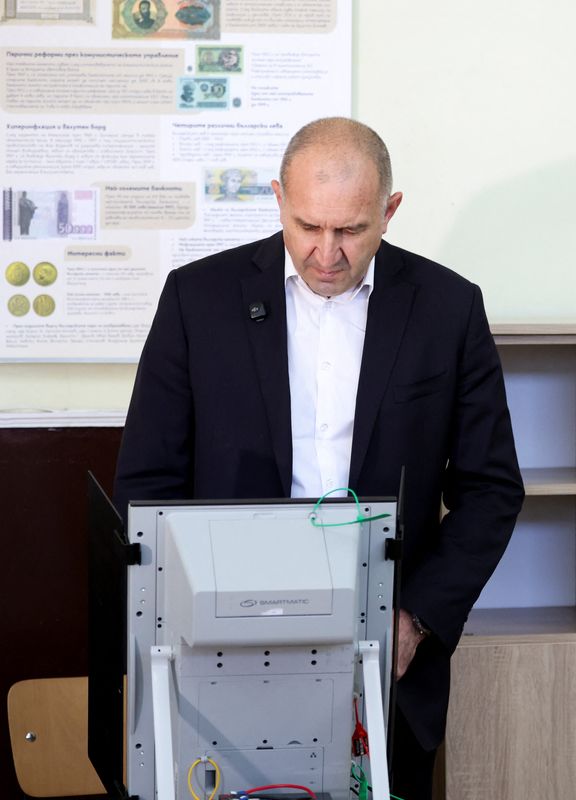
SOFIA, April 20 (Reuters) – Pro-Russian former President Rumen Radev has won Bulgaria’s election by a landslide, official results showed on Monday, sidelining long-dominant political forces and potentially pushing the EU and NATO member state closer to Moscow.
The performance, exceeding opinion poll forecasts, is one of the strongest results for a single party in a generation and may end, for now, the chronic instability that led to eight elections in five years.
Radev’s Progressive Bulgaria party had 44.7% of the vote after 91.7% of ballots were counted, suggesting it could rule alone, but he has not ruled out a coalition with a pro-European group or a smaller party.
Progressive Bulgaria’s tally put it far ahead of the pro-European We Continue the Change-Democratic Bulgaria (PP-DB) coalition with 13.2%, and the long-dominant GERB party, led by former Prime Minister Boyko Borissov, at 13.4%.
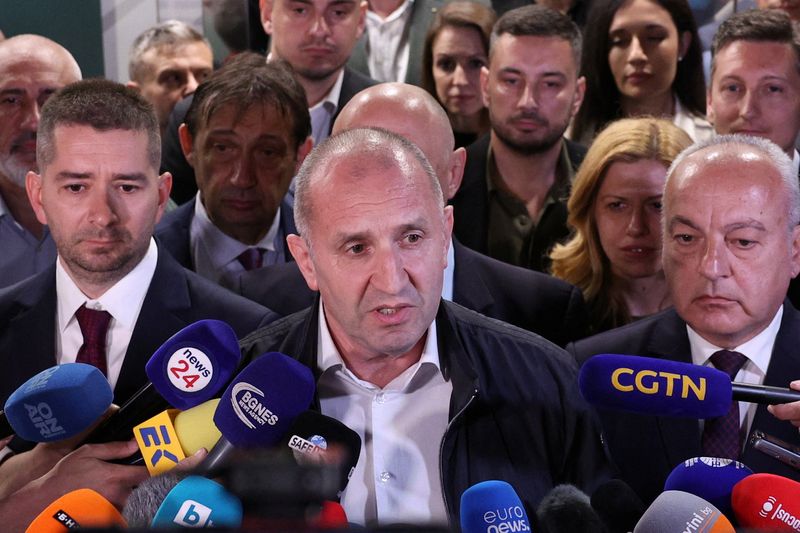
“This is a victory of hope over distrust, a victory of freedom over fear, and finally, if you will, a victory of morality,” Radev told a press conference late on Sunday.
A eurosceptic and former fighter pilot opposed to military support for Ukraine’s war effort against Moscow, Radev stepped down from Bulgaria’s largely ceremonial presidency in January to run in the parliamentary election after mass protests forced out the previous government in December.
He rode a wave of frustration with political instability in the Balkan nation of 6.5 million, where voters are sick of corruption and veteran parties that have dominated politics for decades.
“There is now an opportunity for the things people have been hoping to see change to actually become visible,” Evelina Koleva, a manager at digital marketing company in Sofia, the capital, told Reuters.
QUESTIONS OVER FOREIGN POLICY
Radev’s campaign drew comparisons with Hungary’s pro-Kremlin former Prime Minister Viktor Orban when he talked about improving ties with Moscow and resuming the free flow of Russian oil and gas into Europe.
He also criticised the European Union for relying too heavily on renewable energy.
However, Radev has been vague on policy and it is not yet clear how much he will change foreign policy in Bulgaria, a Black Sea nation on the EU’s southeastern flank which joined the euro zone in January — a move Radev has criticised.
Analysts do not expect him to try to reverse Bulgaria’s adoption of the euro or to block wider EU aid packages to Ukraine.
On Sunday Radev said he would be willing to work on judicial reform with PP-DB and that Bulgaria would “make efforts to continue on its European path”.
Some voters were wary.
“I don’t know whether to believe there will be a change in the political class,” said Venelin Spasov, a 31-year-old real estate broker from Sofia. “But I hope it’s for the best because, after all, it is high time we had some kind of change.”
COST OF LIVING CONCERNS
Bulgaria has developed rapidly since the fall of communism in 1989 and joined the EU in 2007. Life expectancy has risen sharply, unemployment is the lowest in the EU, and the economy has greater safeguards since adopting the euro.
But it lags EU countries in other metrics.
The cost of living has become a particular issue since Bulgaria joined the euro. The previous government fell amid protests against a new budget proposing tax increases and higher social security contributions.
“The country’s main challenge is the economic crisis and the demographic crisis,” said Tihomir Bezlov, a senior fellow at the Centre for the Study of Democracy in Sofia.
“There do not seem to be many ideas in the winning camp on either of these issues.”
(Reporting by Edward McAllisterEditing by Clarence Fernandez and Gareth Jones)