Massive, windowless rectangular buildings that hold rows of computer servers and demand huge cooling systems.
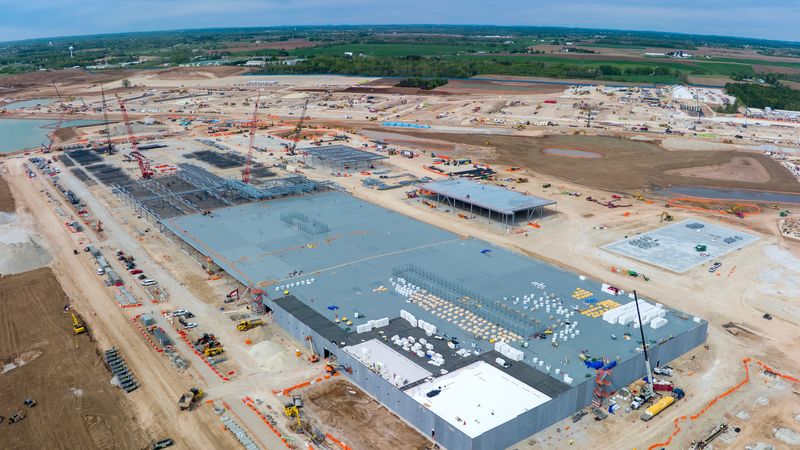
That image is what typically comes to mind for data centers, easily the most talked-about developments in the country these days. Often called hyperscale because of their sheer size, they accommodate the staggering needs of the burgeoning field of artificial intelligence. In Southeast Wisconsin, the construction of two such data centers by tech giants — Microsoft’s in Mount Pleasant and OpenAI and Oracle’s in Port Washington — has prompted widespread protests.

The subject is so politically radioactive that in Milwaukee, four Common Council members have introduced a one-year moratorium on any data center construction. And city officials recently called a redevelopment proposed for Midtown a “computational research facility,” claiming it was not a data center even though it checked all the boxes. Neighborhood uproar ultimately forced a change; the city approved the redevelopment, but only after the developer dropped the data research center from the proposal.
But not all data centers are hyperscale, and they certainly aren’t anything new.
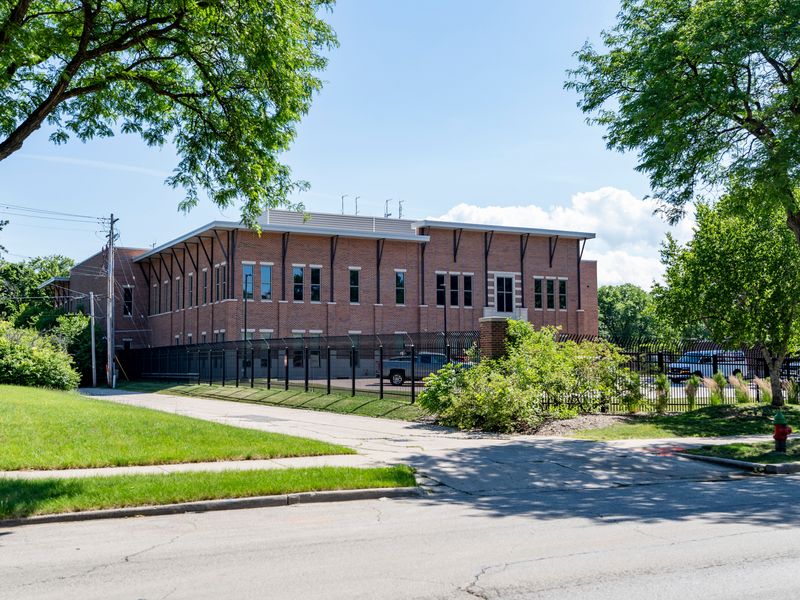
Data Holdings, a 46,000 square-foot, Potawatomi-owned data center, has stood at 3135 W. Highland Blvd. since 2013. It has quietly provided services for more than 70 clients, including dozens of local businesses and the State of Wisconsin.
“This is part of the neighborhood. It’s part of Milwaukee. It’s no different than any other piece of important infrastructure that’s part of the community,” said Ryan Brooks, a Milwaukee native and the general manager of Data Holdings. “We’re not someone coming in as an opportunist. We’ve been doing this before it was cool, for lack of a better term.”
Milwaukee has at least three other small-scale data centers: a Verizon-owned center at 1234 N. Broadway; a 1547 Critical Systems Realty center at the Wells Building, 324 E. Wisconsin Ave.; and a Tierpoint center at 3701 W. Burnham St.
These kinds of data centers, mostly small-scale, appeared in the early 2000s when services like Gmail became widespread, and more emerged when many companies realized the need to store servers in a secure place outside of an in-house room, Michael Zimmer, the director of Marquette University’s Center for Data Ethics, told the Journal Sentinel.
What Data Holdings does
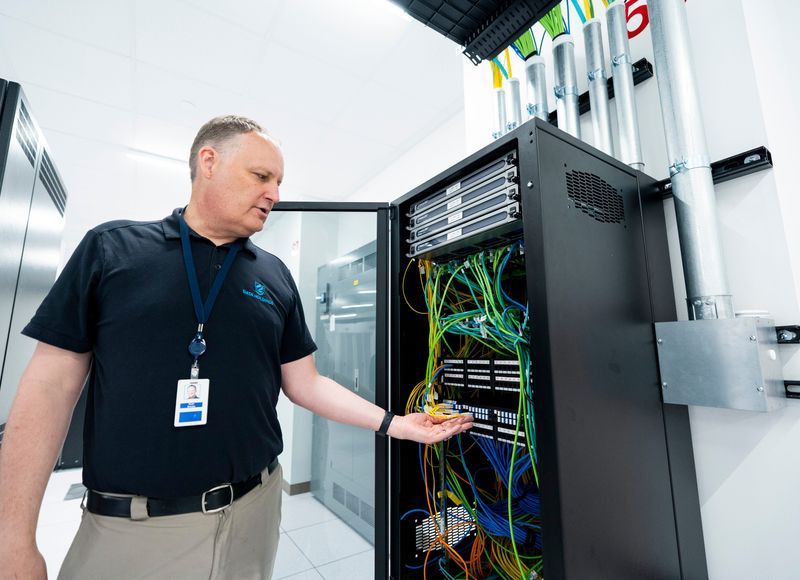
As a co-location data center – the term for a center that serves multiple clients – Data Holdings rents cabinets of servers across seven “suites” to its 70 to 80 clients, around 80% of which are local, said Brooks, the general manager.
The center’s clients, which include companies in finance, gaming and healthcare, are all “people who have some need to be online all the time” and who need a place that can withstand extreme weather, power outages and even civil unrest, Brooks said.
Data Holdings’ claim to fame is its 100% up-time, Brooks said. The center’s servers have not turned off — even for a second — since its opening 13 years ago.
That stability requires a special kind of infrastructure.
Data Holdings’ custom concrete roof cap can withstand an F5 tornado, and the center has indoor diesel generators to back up the power grid, as well as battery-filled rooms that can each run the building for 22 minutes, Brooks said.
The server suites also have smoke detection apparatus that monitors the air for chemicals related to fire and would, according to Brooks, detect a fire five hours before it starts. The location on high land makes it secure from flooding as as well.
Being local is especially important because users spend less time — in units of milliseconds — conducting transactions, Brooks said.
“It wouldn’t seem like it, but light speed is finite,” he said. “So if you’re closer to where your servers are, it’s a better experience for the users.”
Blending into the community
Brooks is a veteran of the telecommunications and data center industry. But he said he would never work at a hyperscale data center.
Small data centers like Data Holdings are more “tightly coupled to real economic activity” than hyperscale data centers for AI training, he said.
“These hyperscalers are more about capturing market share, moreso than even profitability … and every other thing’s a secondary concern,” he said. “They’re more, ‘We’re trying to make AI happen.’”
On the other hand, he said, Data Holdings is simply a piece of infrastructure that eases transactions for companies.
Albeit behind a security fence, the building is finished with conventional brown bricks and stands between the old Concordia College campus and a nursing home in a residential neighborhood. Only one of its many windows is real, something not noticeable to passersby.
“Most people just think it’s a school administration building,” Brooks said.
That’s intentional, he said. “You don’t want to do something offensive that doesn’t fit in – drop a giant, shiny, stainless steel thing in here, be an eyesore. The community was here first.”
‘Completely different’ environmental impacts
Above all, Brooks said, what makes Data Holdings stand out most from hyperscale data centers are its efforts towards sustainability.
The energy usage of new hyperscale data centers dwarfs that of small-scale data centers.
While Data Holdings can use 17 megawatts of electricity, the first phase of Microsoft’s data center in Mount Pleasant can use 450 megawatts, and Oracle and OpenAI’s site in Port Washington has a maximum capacity of 1.3 gigawatts, or 1,300 megawatts.
“There’s no comparison possible,” João Ferreira, the acting director of the University of Virginia’s Center for Economic and Policy Studies, told the Journal Sentinel. “It’s comparing the electricity of three or four houses to the electricity of a small town.”
Solar panels in the back of the center provide all the power needed to run Data Holdings’ office, Brooks said, and since its founding, the data center has used a closed-loop system, which means that the same water — 10,050 gallons of it — is largely reused in rotation to cool down servers instead of using new water every day.
“The only water we use is washing our hands, toilet, sink, stuff like that,” Brooks said, adding that sustainable water use is important to the Potawotami tribe.
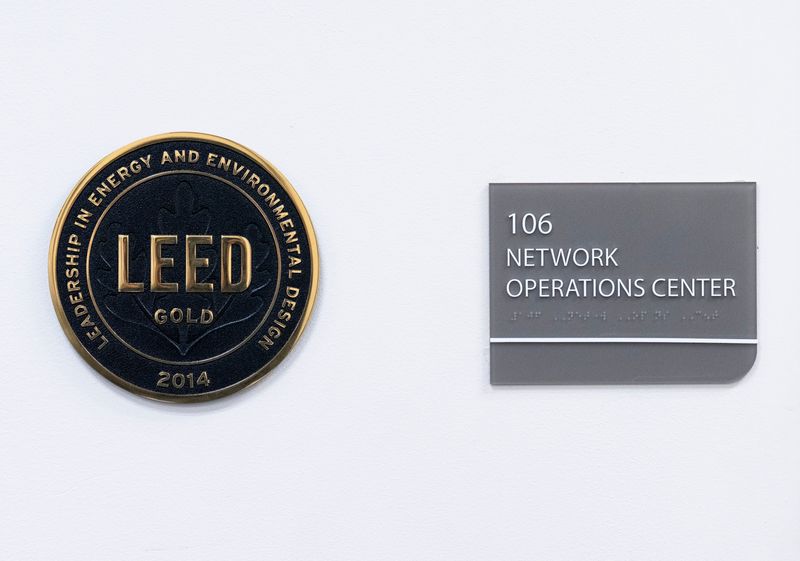
The Data Holdings also is certified LEED Gold by the U.S. Green Building Council, which Brooks said is “very unusual” for a data center. Even the office carpets, he said, are made of recycled water bottles.
In contrast to the minimal environmental impact of small data centers, Ferreira said, hyperscale data centers pose a more serious threat to the environment.
Wisconsin’s energy demand is set to increase by 40% in the next six years, largely due to new hyperscale data centers, a June assessment by the Public Service Commission found. Under increased energy demand, the federal government has recently announced millions to support coal and natural gas plants in the region. Coal and natural gas are fossil fuels that release greenhouse gases and toxic air pollution when burned.
Hyperscalers are giving data centers a bad name
For small data centers like Data Holdings, the rise of hyperscale data centers has presented an unprecedented scarcity in industry materials.
The costs of memory chips have quadrupled in recent months, Brooks said, and the lead time for many materials has increased from 30 days to a year, since big companies like Microsoft have pre-ordered manufacturers’ products set to be made over time.
But the biggest impact goes beyond the cost of materials: the data center has entered the public consciousness for the first time — and not in a good way.
“I think for a long time, we were just thought of as a piece of infrastructure, the place where people work, the place where businesses do their actual transactions, and no one really thought much about it,” Brooks said. “Where do you put a bunch of computers? It’s a data center. No big deal.”
But all of a sudden, hyperscale data centers are “everything that’s in the news right now,” he said — and the nuance between small, longtime data centers like Data Holdings and the new hyperscalers is getting lost.
“If you drive past that construction site at Port Washington, it’s almost ridiculous how big it is,” he said. “People suddenly now have a much more physical understanding of the scale of some of these operations, and they’re worried about water and power.”
Data centers also have become a symbol, he said, of big tech, AI and many of the concerns Americans have about the job market and the environment.
“With these large AI data centers, a lot of people right now aren’t convinced that there’s going to be much good coming from those,” said Zimmer, the Marquette professor. “These data centers are the most tangible target of that criticism. It’s hard to critique an algorithm that OpenAI is creating, but a construction site down the road that might be impacting your community is certainly something that will get citizens more involved and thinking about those kinds of issues.”
If there’s a silver lining to the heightened attention, Brooks said, it’s that communities, especially those most impacted by data centers, are becoming more informed.
Zimmer, whose work focuses on the ethics of big data and artificial intelligence, also said it’s gratifying to see ordinary people come to understand the implications of these developments. He also emphasized the need for the public to gain a nuanced understanding of data centers and distinguish between hyperscale ones and small ones.
“I think because there’s so much over what they see on these large-scale data centers, there’s sort of an automatic negative response to anything that might look or sound like that,” he said. “And I think there’s a need for some better way to better educate communities and neighborhoods to what’s happening.’”
(This article was revised to correct the Wells Building address.)
This article originally appeared on Milwaukee Journal Sentinel: Not all data centers are created equal. One might be in your neighborhood.
Reporting by Jaeha Jang, Milwaukee Journal Sentinel / Milwaukee Journal Sentinel
USA TODAY Network via Reuters Connect
By Jaeha Jang, Milwaukee Journal Sentinel | USA TODAY Network