Don Nelson, who led the Milwaukee Bucks on a run of sustained success in the 1980s and retired as the NBA’s all-time winningest basketball coach, has died at age 86, according to a statement from his family.
Nelson’s 1,335 career wins as a head coach remained the top mark in NBA history for 12 years, only surpassed by San Antonio Spurs legend Gregg Popovich in 2022. Nelson coached the Golden State Warriors, New York Knicks and Dallas Mavericks after his time with the Bucks, a tenure that ran from 1976-87 when he brought “Nellie Ball” to the mainstream.

“On Sunday morning our beloved husband, dad, grandfather and great-grandfather Don Nelson peacefully went to be with the Lord, surrounded by his loving family,” the family statement read. “Throughout his last week, friends and family encircled him with love, sharing the blessing of his friendship and revisiting treasured memories.”
The Bucks said the organization was “deeply saddened” by Nelson’s death, noting that the Hall of Fame coach “established himself as one of the most innovative and visionary leaders in basketball history pioneering the concept of the point forward.”
“He helped define one of the greatest eras in franchise history and built a standard of excellence that endured long after his tenure,” the team’s statement said.
The statement recognized that Nelson was known not only for “his basketball brilliance” but also for “his authenticity and larger than life personality,” often seen by his trademark fish ties.
“He will always be a treasured part of Bucks history and one of the most influential figures the game has ever known,” the statement said.
The Warriors released a statement, as well, saying “Don Nelson was one of the most innovative and influential coaches in the history of the NBA and an iconic figure in Warriors history. During two memorable stints as head coach, ‘Nellie’ left an indelible mark on our franchise with his approach to the game. From the Run TMC era to the ‘We Believe’ team in 2007, his teams captivated Bay Area basketball fans and created some of the most memorable moments in Warriors history.”
Arrangements, announced by the Nelson family, include a celebration of life Aug. 13 in Dallas and an ashes ceremony in Maui for family and friends.
Credited with the innovative insistence on a faster run-and-gun style of play, Nelson missed the playoffs only twice in his 10 full seasons as the leader of the Bucks, with three appearances in the Eastern Conference finals (though never farther).
He was named the league’s coach of the year in 1983 and 1985, then again in 1992 with the Warriors. He passed Lenny Wilkens for the all-time NBA wins list in 2010 and was inducted into the Naismith Basketball Hall of Fame in 2012.
“Nellie knew the type of players that would fit his system,” Bucks star Sidney Moncrief once said. “It was like a machine. The right players, right system and right coach.”
Nelson introduced the “point forward” concept – first with 6-foot-7 standout Marques Johnson and then more prominently with 6-5 Paul Pressey – a maneuver that allowed him to fill the floor with shooters while using his “center” to draw shot-blocking defenders outside the paint, as opposed to relying on the center to post up on offense. Variations of his position-less design helped several teams win NBA championships, most prominently the Warriors of the late 2010s.
Del Harris, who was an assistant under Nelson for four seasons in Milwaukee and later became head coach in Milwaukee, pointed out in 2012 that there were two phases to Nelson’s coaching career.
“One was the Milwaukee-defensive phase during which he established himself as the top defensive coach in the league and was named coach of the year three times in the ’80s,” Harris said.
“That was primarily because of the innovative stuff he did defensively, particularly in terms of rotations and so forth. He was pretty much an NBA pioneer in that area.”
Harris also became part of Nelson’s staff in Dallas.
“The second phase of Nellie was more oriented toward offense. He kind of pioneered the small-ball attack at Golden State. And then in Dallas, we had a heck of a run.”
Nelson replaced a legend to become Bucks second head coach
A Muskegon, Michigan, native, Nelson played basketball in an Illinois high school and then college ball at Iowa before getting drafted in 1962 by the Chicago Zephyrs (today the Washington Wizards). That kicked off a 14-year playing career that included a short stint with the Lakers and 11 seasons with the Boston Celtics. He averaged 10.3 points in his career and 4.9 rebounds, and he was hired immediately after the conclusion of his playing career to serve as an assistant under Bucks coach Larry Costello, a man who also transitioned quickly from playing to coaching and led the Bucks to the 1971 NBA championship.
But Costello – the only head coach the organization had known since its 1968 inception – resigned under pressure after the Bucks lost 15 of their first 18 games in the 1976-77 season.
Nelson didn’t want the job, feeling he was unprepared. He pushed for the Bucks to hire Celtics assistant John Killilea as head coach (and later brought Killilea onboard the Bucks staff as an assistant). But on Nov. 22, 1976, the 36-year-old Nelson was appointed Costello’s replacement – and not on an interim basis – as general manager Wayne Embry announced he’d be stepping down by the end of the season. Nelson would wind up filling that GM role, as well, in Embry’s stead.
“I really don’t know what to say,” Nelson said at the news conference announcing the news of Costello’s resignation. “Larry and I went into this season as a partnership. Truthfully, I’m embarrassed with the job as I told Jim (Fitzgerald, Bucks owner). I expected to be an assistant for at least two years. I certainly don’t know all the answers because I’m new, too.”
One of Nelson’s first missions was to change a culture that had soured on the strict methods employed by Costello. That included the claim that he wouldn’t be a disciplinarian as long as players were ready on game day.
“Basically, we’re going to try to give each individual the confidence and freedom to create things on his own,” Nelson said. “That’s the easiest basketball in the world to play, and it’s the most natural.”
Nelson emphasized full-court defense and initially gave veterans a nod over younger players, even as he transitioned to a style that demanded greater athleticism. He used isolation rules (some that he created as a chairman of the rules committee) to his advantage, creating mismatches and establishing the sixth man as a vital role, with players such as Junior Bridgeman and Ricky Pierce thriving.
After the Bucks finished 30-52 in 1976-77, Nelson immediately led the Bucks to 64 wins the following season in his first full year on the job. He wound up reaching 500 NBA head-coaching victories faster than anyone before and finished with a career Bucks mark of 540-344, with seven straight 50-win seasons and six straight Central Division titles.
A free-wheeling GM who rebuilt – and often rebuilt again – the Bucks
As a general manager, Nelson never shied away from making moves, for better and worse. He traded former No. 1 overall pick Kent Benson to the Pistons for aging star Bob Lanier, whose jersey now hangs in the Fiserv Forum rafters in Milwaukee. When he traded Swen Nater in 1977 for a draft pick, he used that selection to pick Marques Johnson, who became one of the organization’s all-time greats.
Nelson dealt Johnson, Junior Bridgeman and Harvey Catchings in exchange for Terry Cummings, Craig Hodges and Ricky Pierce, a deal that paid dividends when both Cummings and Pierce became all-stars. He also traded the franchise’s all-time blocks leader, Alton Lister for future Hall of Famer Jack Sikma, who played five reliable seasons in Milwaukee to close his career.
There were missteps, too, such as the move in 1982 to add his former Celtics teammate Dave Cowens, after Cowens had been out of basketball for two seasons. Cowens, now an NBA Hall of Famer, retired after one unremarkable season. Milwaukee traded franchise all-time steals leader Quinn Buckner to Boston as part of the deal to obtain Cowens’ rights.
It would become one of the hallmarks of the Nelson experience, a willingness to buck the status quo that helped him become a rebuilder at virtually every stop in his career.
Nelson proved to be a visible presence in Milwaukee
Nelson was a paradox as someone who preferred privacy but kept a visible presence in Milwaukee.
“I was a great fit for Milwaukee,” Nelson said in 2012. “I loved to drink beer and hang out and have fun, and I did a lot of that in Milwaukee. After practice, I used to go and have lunch and drink a few beers. Hang out in those establishments and then go back to work and watch more film.
“I met my wife, Joy, there and we’re happily married today and living on Maui. Those are great memories … a young kid getting out of the pros as a player and all of a sudden the next year he’s a head coach earning my way along.”
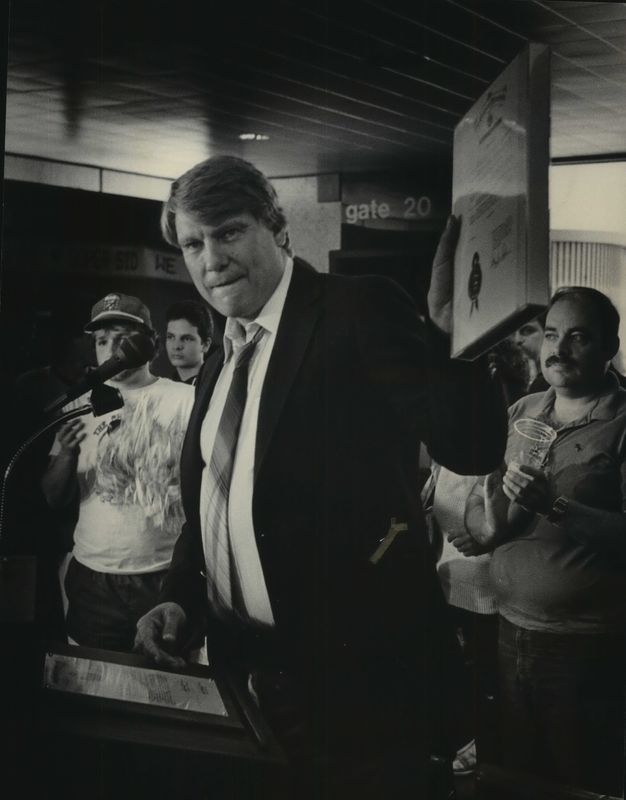
In 1986, Nelson hopped aboard a donated Case IH tractor and drove 250 miles around Wisconsin, with the goal to raise money for Nellie’s Farm Fund, established to assist struggling farmers. Nelson’s family had operated a hog farm in Illinois.
Popular Milwaukee sports bar Major Goolsby’s donated a giant piggy bank that was latched to a trailer and hooked up to the tractor that Nelson drove on Wisconsin roads to raise money for the cause.
Goolsby’s conducted a contest to the name the pig and the winning entry was “Barkley” a reference to NBA star and Milwaukee villain Charles Barkley. Barkley the pig is still on display at Goolsby’s where it hangs from the rafters.
The fund merged with another church charity after his departure from Milwaukee.
“I feel like an adopted son [in Milwaukee]. So many good things have happened to me in the decade I’ve been here. I’ve prospered in my sports and business ventures; I feel very comfortable here.”
Feud with Bucks owner Herb Kohl surrounds acrimonious departure
In 1987, Nelson became general manager of the Golden State Warriors, wooed by Fitzgerald – the former Bucks owner and now owner of the Warriors. By then, Nelson was publicly feuding with new Bucks owner Herb Kohl, who bought the team from Fitzgerald in 1985, and wanted out of Milwaukee even though he had three years left on his contract and a two-year no-compete clause if he resigned, barring him from becoming a coach or director of player personnel elsewhere in the NBA.
In May 1987, Nelson famously said, “I feel that I am the Milwaukee Bucks,” a declaration that likely didn’t help the sour relationship between the Bucks’ top-tier personnel.
“I’ve built the Bucks from a last-place team. I’ve kept it on top for many years,” Nelson said. “We’ve been near the top of the record book in many areas of excellence. I’m proud of what the Bucks have done in the last 11 years.”
Nelson accused Kohl of meddling, levying a series of examples in which he felt Kohl had questioned Nelson’s acumen. Kohl denied those accusations and insisted that Nelson apologize to Kohl as part of a compensation agreement that allowed Nelson to take a coaching job with Golden State before the expiration of the two-year non-compete clause. The Bucks also received a second-round pick in the deal, and after a season as a Warriors executive vice president, Nelson was permitted to return to the sideline as head coach the following year, in 1988-89.
Nelson later gave an interview with the Sporting News saying he regretted the apology.
During his year with the Golden State front office, the Warriors were coached by George Karl, the future Bucks coach and someone Nelson had recommended for the Warriors gig. Karl resigned during March of the 1988-89 season, opening the door for Nelson’s return as head coach for an organization into which he’d bought a 10% stake.
Just as he had done with the Bucks, Nelson took a franchise in disrepair and immediately turned the ship around. The 1987-88 Warriors went 20-62; the 1988-89 team went 43-39 and reached the Western Conference semifinals.
Nelson clashed at times with star Chris Webber and resigned in February 1995, with former Bucks star Lanier taking over on an interim basis. By June, Nelson was coaching the Knicks, though his style wasn’t a fit for Knicks personnel and he was fired later that season and replaced by Jeff Van Gundy.
He rebuilt Dallas, seemingly swindling Milwaukee in a memorable trade
In 1997, Nelson joined the Mavericks as head coach and GM, and he continued his free-wheeling ways by engineering an infamous trade that involved the Milwaukee Bucks. The Bucks traded the draft rights to future Hall of Famer Dirk Nowitzki – who was selected on Dallas’ behalf with the parameters of the deal in place – and Pat Garrity in exchange for Robert “Tractor” Traylor. NBA rules stipulated that picks couldn’t be traded until after the draft, leaving Milwaukee as the team that officially first brought Nowitzki into the league.
The raw German prospect turned into an MVP, NBA champion and one of the greatest European-born players in league history. Traylor, meanwhile, was gone in two years, making it look like an all-time terrible exchange on paper, even if Nowitzki was never going to play in Milwaukee.
If it makes Bucks fans feel better, Nelson turned around to trade the rights to Garrity for another future Hall of Famer, Steve Nash, who’d been a non-factor during his first two seasons in Phoenix. Nash became an all-star in Dallas before returning to the Suns and winning two MVP awards.
Yet again, the Mavericks transformed quickly. After going 20-62 in the 1997-98 season and 19-31 in a strike-shortened 1998-99 campaign, Dallas won 40 games in 1999 and then won 50 games for each of the next five seasons with Nelson at the helm (a streak that continued for 11 seasons total).
Nelson stepped down, however, midway through the 2005 season while remaining GM until the end of the season, when he then handed those reins to his son, Donnie.
Remarkably, the elder Nelson never coached in an NBA Finals, though his worlds collided in 2007 when he led the eighth-seeded Warriors to a stunning first-round series win over top-seeded Dallas, a 67-win team that had reached the previous season’s finals. That was Nelson’s only playoff appearance in his four-year second stint with the Warriors, running from 2006-2010.
After his coaching career, Nelson retired to Hawaii, where he grew his own marijuana (called Nellie Kush).
“One thing I’ve really enjoyed doing is building teams,” said Nelson. “I like building things from poor to good. Whether it’s property in Maui or a team.
“The most enjoyable part of my career was going to teams that weren’t very good and then being part of management and decisions and trades and then coaching those same players that you’re responsible for.”
Nelson, who did win five NBA titles as a player with the Celtics, saw his No. 19 jersey retired by the franchise.
This article originally appeared on Milwaukee Journal Sentinel: Legendary Bucks coach and innovator Don Nelson dies at age 86
Reporting by JR Radcliffe, Milwaukee Journal Sentinel / Milwaukee Journal Sentinel
USA TODAY Network via Reuters Connect
By JR Radcliffe, Milwaukee Journal Sentinel | USA TODAY Network