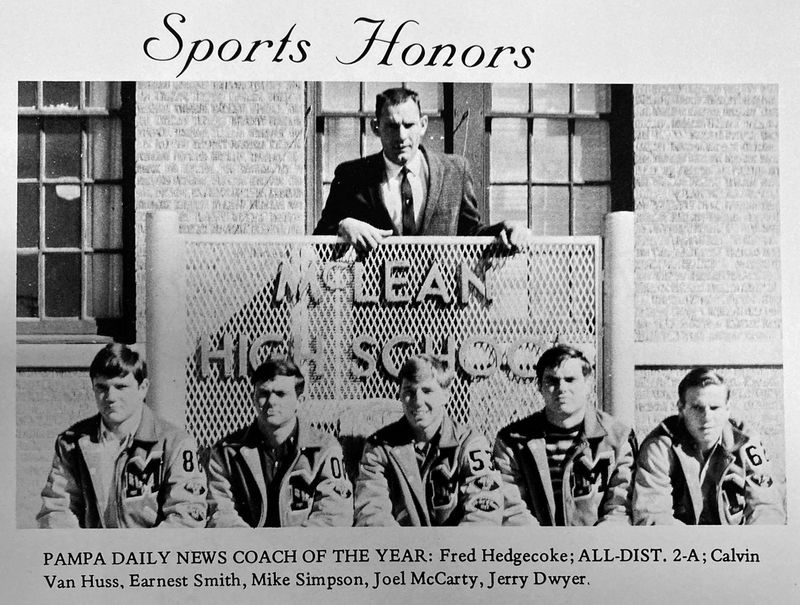
Fred Hedgecoke, a Stinnett High School graduate, coached at McLean for only five years and left for Muleshoe, a larger school, in 1969.
He later was the head football coach and then athletic director at DeSoto before retiring.

In the decades after 1969, he didn’t attend every one of McLean’s biennial all-school reunions, but he made it to the Panhandle for many of them. In the short time Hedgecoke led the McLean Tigers, a permanent bond had been created between him, his players and the community. He lived in Garland when he died this July 21 at age 86, but he had remained in touch with several of the men he had pushed to success when he was in his late 20s. While some of his players continued to address him as “Coach,” others became adult friends and called him “Fred.”
Someone asked me why this coach was so special. A few of my former teammates could answer that question better than I can. They kept in touch over the years; I saw him only at the school reunions, but he still remains one of my life influences.
I was in a group of about five guys who drove the 2½-hours to Muleshoe to see his Mules play during his first season there. Maybe it was just an hour for me, because I was a freshman at Texas Tech. But even then, we still thought of him as “our” coach.
The McLean 11-man football team didn’t have long playoff runs under Hedgecoke, but we made it to bidistrict when only one team from each district made the playoffs, and we lost a coin flip one year, tied with Clarendon and Wheeler. Our District 2-A at the time included some good teams, and the competition was fierce enough that someone called it “the Little Southwest Conference.”
Even while at other schools, Coach kept black-and-white game film of our games and showed some of it to us at my class’s 50th reunion. I had been an offensive and defensive lineman and not one of our outstanding players, but I was gratified to see on the film that I did make some blocks and tackles and appreciated Hedgecoke saying I had been a tough football player.
Alabama’s (and Texas A&M’s) Bear Bryant comes to mind when I think of Hedgecoke’s coaching style. It was decades ago, and “old school” was more acceptable than it is now. We worked out on the hottest days of August, taking yellow salt pills which apparently was that era’s Gatorade. Just a few years older than us, Coach was active. Wearing gray sweat pants ending at mid-calf and a black shirt, he would run backwards in front of the team, shouting “Come on!” as we huffed and puffed through windsprints.
His discipline extended to every area of our lives. Not only was alcohol banned, but so were carbonated drinks. I would order a “lime with plain water” at the Rexall drugstore. Not that it affected me at the time, but we were to stay away from girls during football season. No sideburns, and of course no facial hair. We wore white shirts and ties to pep rallies and to games.
Hedgecoke had two assistant coaches per year to help enforce the rules. At McLean, they included Jim Morgan, Bob Schneider (yes, the coach who later became legendary at Canyon and West Texas A&M), Jim Goss, Curtis Didway, Don Smith and Cam Shields.
Coach’s crew cut reminded me of movie Marine sergeants, and he didn’t hold back criticism or sometimes sarcasm. As eighth graders, my now freshman teammates and I had gone undefeated and unscored-on to win the junior high district championship. On our first workout of high school two-a-days, Hedgecoke called us the “Golden Boys” who were going to face much tougher challenges.
He set our goals high, encouraging us to still be playing football in December, when the state title games were scheduled. He still had that passion for excellence in 2018 when,
living in Garland, he posted this message to the McLean, Panhandle and West Texas High football teams, all of which were competing in the state playoffs:
“You and your teammates carry the pride and admiration of the Texas Panhandle. You are on a path that very few are blessed to walk. It is a road everyone knows about, but few ever win the right to travel. When you step on the field this weekend, you won’t be alone. All of West Texas will be there with you. Savor every moment. Make the most of your journey because you pass this way but one time. You will remember and cherish what you achieve for the rest of your life. Good luck and God speed.”
Players from his time at McLean, and I suspect at his other coaching stops, would say that encouragement is familiar. We heard speeches like that in more than one pregame locker room.
Hedgecoke knew those words from experience. As a high school player, his Stinnett Rattlers lost to Deer Park, 7-0, in the 1955 Class 1A state finals. In 1956, Stinnett bested Hondo, 35-13, for the Texas championship.
In 2018 McLean, playing six-man, went on to win its first state championship with Hedgecoke in the Cowboys Stadium stands to see it in person.
Coach had played collegiately at West Texas State from 1958 to 1960, leading the Buffaloes in receiving in 1959 in an era when most plays were runs.
Hedgecoke coached basketball like a football coach, emphasizing hustle and toughness more than Xs and Os. When a couple of our athletes went out for the tennis team (everybody tends to play everything in a small school), he mocked it as “fuzzy ball.”
He did know football well and kept up with current trends. He had studied a new version of the I-formation that a California university was running and incorporated it into our offensive scheme.
His knowledge wasn’t all football; in retirement, he became a writer. His first novel was 2018’s “Football, Fugitives & Fading Dreams.” The protagonist is a high school football player in a West Texas town reminiscent of Stinnett, but the book’s characters and plot explore the human condition beyond sports. He followed with five more novels.
Hedgecoke was preceded in death by his wife of 63 years, Connie Hedgecoke, and he is survived by his son Rob Hedgecoke and daughter Chi Lynn Nafe. A memorial service took place Aug. 8 in DeSoto.
My cousin Thacker Haynes, our outstanding running back in the 1960s and now the Methodist pastor at McLean, drew Coach to church every Sunday after the school reunions. Friends said that from Garland, he watched Thacker preach every week when the church services became available online, and he was a consistent supporter of the church – in a town where he had lived for five of his 86 years.
As a talented writer, McLean’s coaching patriarch might frown if I ended this column with an end-of-the-game cliché. So I won’t. Just thanks, and we’ll see you later.
Mike Haynes taught journalism at Amarillo College from 1991 to 2016 and has written for the Faith section since 1997. He can be reached at haynescolumn@gmail.com. Go to www.haynescolumn.blogspot.com or his Facebook page for more of his columns.
This article originally appeared on Amarillo Globe-News: Haynes reflects on Coach Hedgecoke’s lasting legacy at McLean
Reporting by By Mike Haynes, special for the Globe-News / Amarillo Globe-News
USA TODAY Network via Reuters Connect
By Mike Haynes, special for the Globe-News | USA TODAY Network