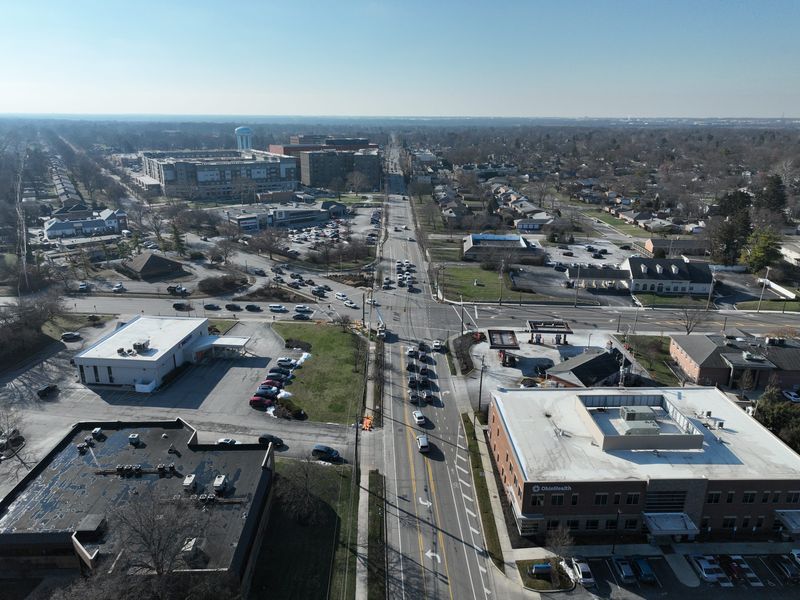
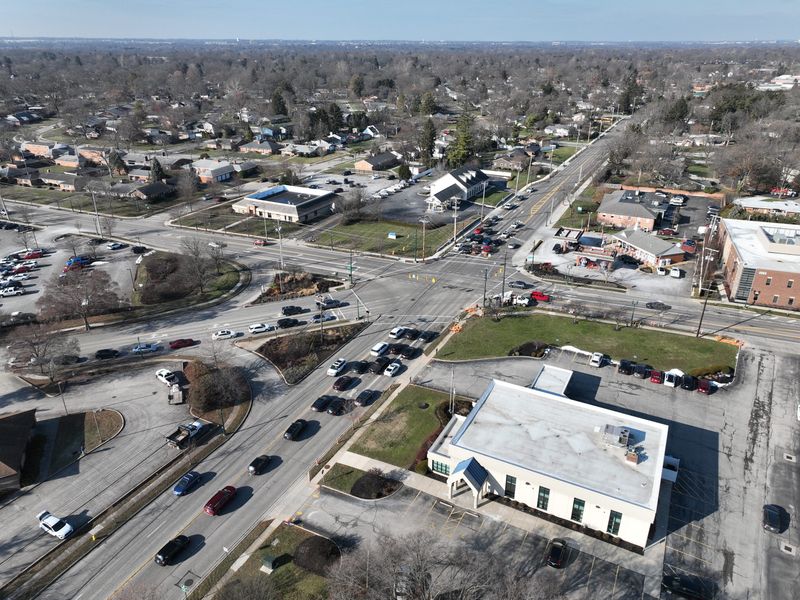
On any given day, up to 35,000 vehicles drive through one of the busiest and perhaps most notorious intersections in the city of Upper Arlington.
Located at the crossroads of Fishinger Road, Tremont Road and Northwest Boulevard, the Five Points intersection is one of Upper Arlington’s most critical connection points, city leaders say. But it’s also one of its most congested and dangerous. Between 2021 and 2024, the intersection saw 39 vehicle crashes, five of which resulted in injury, according to data from the city.

In the hopes of reducing traffic jams and improving safety, the city proposes three renovation options for the crossing: a signalized intersection, a circular roundabout or a noncircular roundabout. At a Feb. 10 meeting, some of the minds behind the project explained the three options to upwards of 100 Upper Arlington residents, stirring strong reactions across the community.
The speakers emphasized that no decisions will be finalized until the end of 2026 to give the project team time to gather community feedback and more formally analyze all options. Regardless of which alternate route the city chooses, construction isn’t slated to take place until 2028.
“Community feedback is really important to us,” City Engineer Aaron Scott told The Dispatch. “It’s going to feed into both the alternative that we end up choosing, but it’s also going to influence what that alternative will look like in the end.”
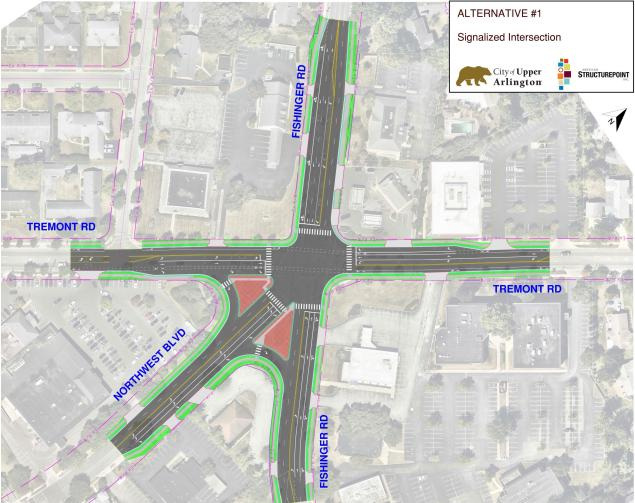
Option No. 1: A signalized intersection
A signalized intersection would involve lengthening the existing turn lanes by 150 to 200 feet and optimizing signal timing, according to Tony Lenhart, project manager for Indianapolis-based architecture and engineering firm American Structurepoint Inc., the project’s core design team.
Using existing traffic counts and crash data, plus population projections and land uses, project engineers created a model forecasting how each of the three alternate routes would affect delays at Five Points roughly 20 years after construction is complete.
With a signalized intersection, Lenhart said drivers would save roughly 6 seconds in the morning and 10 seconds in the evening by 2048.
Bicyclist and pedestrian crossings would remain the same as the current layout.
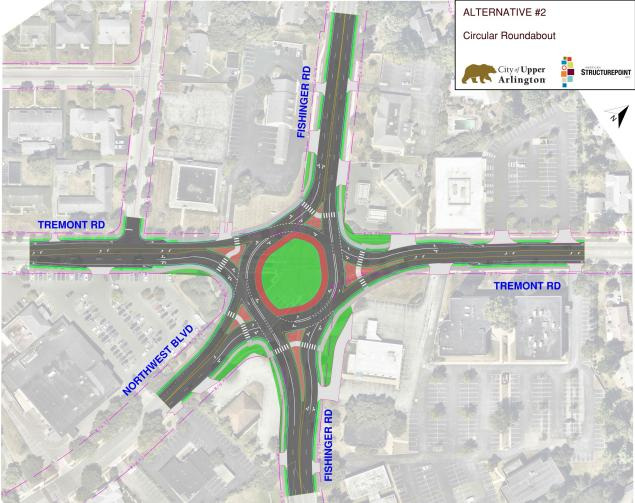
Option No. 2: A circular roundabout
With an inscribed diameter of 210 feet – or the distance from one outside curve line to the other – the circular roundabout would mostly fit in the existing intersection but would require a few corner sections of land to be bought and integrated into the design, Lenhart said.
Bicyclists would still have bike lanes on Tremont Road, with the option of riding in the traffic lane and navigating the roundabout like a vehicle would or taking an exit bike lane before the roundabout and re-entering after. Pedestrian approaches will be situated at each of the five points.
“One thing I want to mention about pedestrians at roundabouts: A lot of people are concerned because traffic doesn’t stop, right; it’s always moving?” Lenhart said. “Well, traffic’s moving at a much slower speed than it was in a signalized intersection.”
Lenhart said that pedestrians and bicyclists crossing at a roundabout only have to look for traffic in one direction, whereas a traditional intersection requires scanning multiple directions. Additional pedestrian safety features would be added, such as rapid-flashing beacons, which he said a Federal Highway Administration study found have a 98% compliance rate by motorists.
As compared to a signalized intersection, a roundabout also reduces fatal and injury crashes by 78%, Lenhart said.
The circular roundabout would save drivers 30 seconds in the morning and 30 seconds in the evening by 2048, according to the city’s forecasting model.
“That’s a minute a day. You go through it every day, that’s 360 minutes a year,” Lenhart said. “If you look at the 20 years that this is designed for, that’s five days of time saved not stopped at a signalized intersection.”
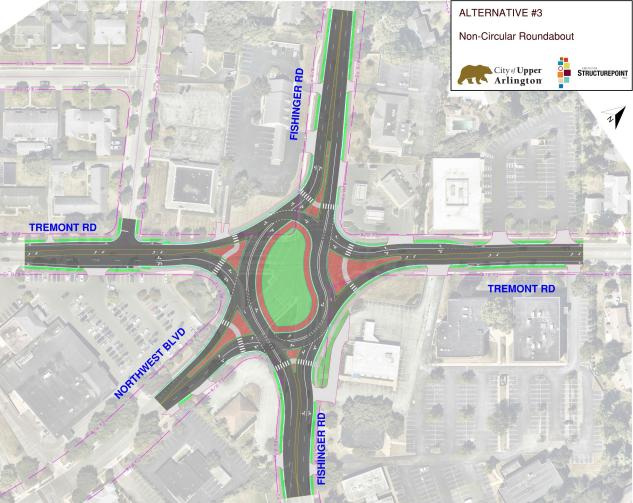
Option No. 3: A noncircular roundabout
By stretching out the traditional roundabout circle into more of an oval shape, Lenhart said vehicles tend to be able to drive slightly faster at its longer stretches, also allowing for more gap acceptance – or drivers deciding they have enough space and time to pull out of the intersection – due to the added space.
Bicyclist and pedestrian features would be similar to the circular roundabout, as would the amount of time saved by motorists at the intersection by 2048.
With either roundabout option, overhead lane assignment signs would be installed to help drivers navigate the intersection, Lenhart said. Additional safety features would include two lines instead of one to separate lanes and truck aprons.
Public feedback, cost and timeline
Many Upper Arlington residents at the Feb. 10 meeting commented about their take on the Five Points project during a Q&A segment.
Most expressed concern over roundabouts safety, sharing worries that they would not slow motorists and that the number of crashes would increase. Some said they thought congestion would actually worsen because cars would be slower to enter the intersection.
At least one resident said they preferred a roundabout, and a few others asked questions without sharing an opinion one way or the other.
Scott told The Dispatch that the city doesn’t have a strong preference among the three options. He said he couldn’t share cost estimates yet but that all three would be similar.
Construction would hope to start and finish in 2028, he said.
“It’s been some time since we’ve worked on the pavement or the curb there, and we’re also aware that the water line underground needs some work as well,” Scott said. “None of these options are really a big leap for us, considering we already have some work we need to do there.”
Scott encouraged all Upper Arlington residents to fill out the Five Points intersection survey to share their own thoughts on the project.
Reporter Emma Wozniak can be reached at ewozniak@dispatch.com or @emma_wozniak_ on X, formerly known as Twitter.
This article originally appeared on The Columbus Dispatch: Upper Arlington weighs 3 options for Five Points intersection makeover
Reporting by Emma Wozniak, Columbus Dispatch / The Columbus Dispatch
USA TODAY Network via Reuters Connect