Returning three starters from last year’s offensive line doesn’t guarantee success for the Cincinnati Bearcats, but it has given them reason for offensive optimism in 2026. Preseason All-American Evan Tengesdahl, Joe Cotton and Taran Tyo should get NFL looks next spring.
The heavily promoted veterans up front should give new quarterback JC French IV ample time to throw the ball downfield or hand it off to one of several running backs capable of making defenders miss.

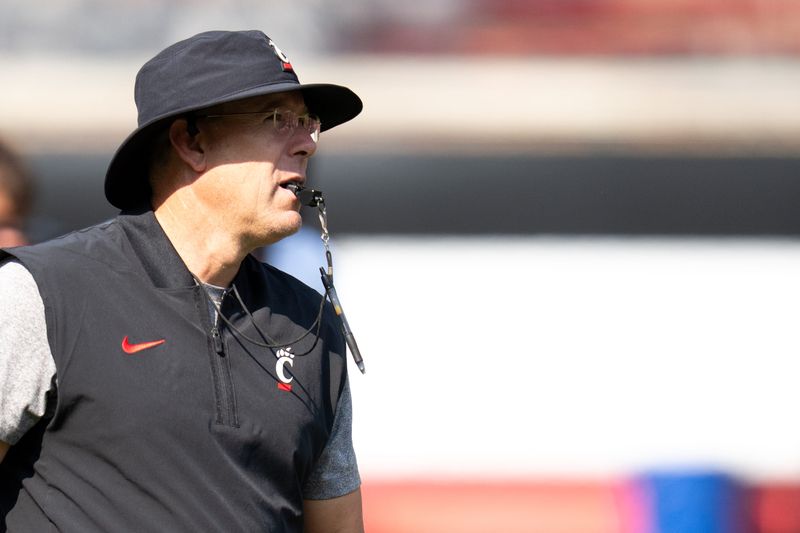
Does UC Bearcats coach Scott Satterfield run or pass more?
Historically, the answer has been in the run game with a mobile quarterback. Departed Brendan Sorsby ran for nearly twice the number of yards that French did at Georgia Southern. But the fifth-year player was far from a drop-back passer, running for 554 yards the past two seasons in addition to actually throwing for more yards than Sorsby.
How UC Bearcats’ line helps French
Logically, if the defense loads the box to stop the run, the pass is open. French has proven he can throw, and he did it last year despite being sacked 29 times, 21 more than Sorsby at UC.
Now, French feels safe behind the line led by Tengesdahl, who is listed among the top interior offensive linemen in the 2027 NFL Draft by many outlets.
“Our goal is to keep him clean all season,” Tengesdahl said of the goal of avoiding any sacks on French.
French says UC will be a threat running and passing the ball. Many receivers are new, but there’s an obvious connection with Oklahoma transfer JV Gibson. Gibson has drawn comparisons to Cyrus Allen, now of the Chiefs, in that both came from SEC schools where they were underutilized.
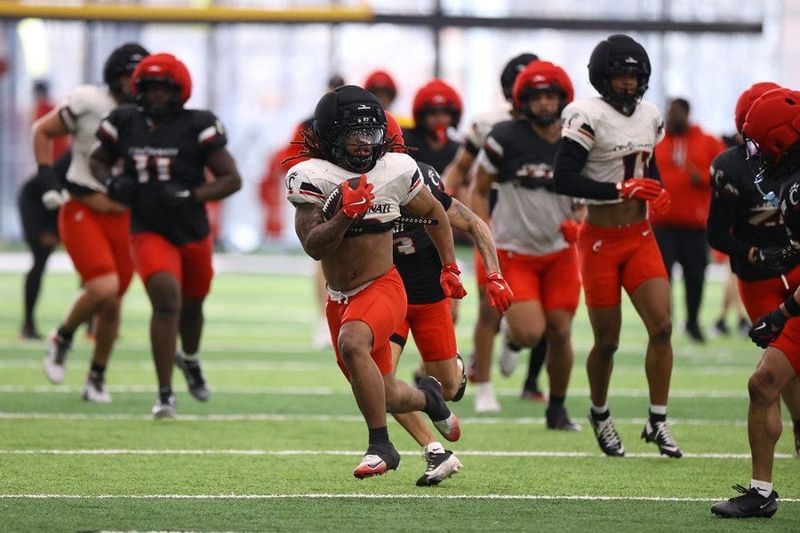
In the deep running back room, Payne from La Salle High School, was stuck behind a pair of first-round NFL picks at Notre Dame and could turn it on in front of the hometown fans.
“He’s excited to go out and perform,” Satterfield said. “Probably the last time he had over 10 carries was back in high school. He wants to prove he belongs, and he does that every single day.”
Past numbers support UC Bearcats’ ground game
Last season, UC was 5-2 in games where they outrushed their opponent.
Only twice did they win time of possession, against Kansas on the road and Baylor at Nippert. In the other 11 games, they had the ball substantially less, some due to the defense giving up yards. Running the ball effectively can change the possession results.
Offensive line coach/co-offensive coordinator Nic Cardwell, not shockingly, supports that theory.
“All the time, pound it!” Cardwell said. “Run the ball. That’s what we want to do. If you can establish the run, you can do a lot of things.”
UC last had a 1,000-yard rusher when Corey Kiner ran for 1,047 in 2023, then 1,153 in 2024. Last season, Tawee Walker reached 709 yards, Sorsby had 580 and Evan Pryor ran for 522 yards.
The current running back room features returning sophomore Zion Johnson, Notre Dame transfer Gi’Bran Payne, Stanford transfer Cole Tabb and Louisiana transfer Zylan Perry. Together, they accumulated 1,296 yards for their respective teams in 2025.
“I’d like to think that we could do both,” Satterfield said. “We want to be able to throw the ball down the field, but we certainly want to be able to run it. If you can run the football and they have a hard time stopping you, we’re going to have a good chance to win the game.”
Scott Satterfield offenses
2014, Appalachian State, 7-5 – In his first season, the Mountaineers averaged 219.8 yards through the air and 241 on the ground. They ran 60.9% of the time and passed 39.1%.
2015, Appalachian State, 11-2 – Satterfield ran the ball 67.1% of the time, averaging 271.5 yards, and threw 32.9% for 195.85 yards.
2016, Appalachian State, 10-3 – This was his lowest passing season as they averaged 179 yards throwing 36.6% of the time. They ran for 250.9 yards on average, rushing 63.4% of the time.
2017, Appalachian State, 9-4 – The offense ran 59.8% for 223.6 yards on average and passed for 216.23 average yards, throwing 40.2% of the time.
2018, Appalachian State, 10-2 – In his final season, the Mountaineers averaged 240.4 rushing yards, running 62.9% of the time, while passing 37.1% for 190.62 average yards.
2019, Louisville, 8-5 – Satterfield was run-heavy with the Cardinals, handing the ball off 65.4% of the time to average 213.2 yards. They averaged more passing yards at 234.55, throwing 34.6% of the time.
2020, Louisville, 4-7 – The Cards again averaged more throwing yards at 244.18 to 200 rushing yards, even though they ran 57.1% of the time and threw 42.9%.
2021, Louisville, 6-7 – Again, more throwing yards at 236.46 with 209.8 rushing yards. Runs were called 58.1% of the time, with passes called 41.9%.
2022, Louisville, 7-5 – For a fourth straight year, Louisville averaged more passing yards at 205.54 than running yards (201). Runs were called 58.5%, with passes dialed up 41.5%.
2023, Cincinnati, 3-9 – In his first Big 12 season, UC ran 59% of the time for 217.1 average yards and threw 41% for 209 average yards.
2024, Cincinnati, 5-7 – With Sorsby at quarterback, UC throws for more yards at 236.5 with passes being called 48.1%, the most in Satterfield history. They ran the ball 51.5% of the time, averaging 184.1 yards.
2025, Cincinnati, 7-6 – Again, more passing yards on average at 231.20 to 176.1 rushing yards, a Satterfield low. Run plays were called 52%, with passes at 47.6%.
Only three times has Satterfield’s team averaged more passing yards and been above .500 (2019 and 2022 Louisville and last year’s Bearcats). His double-digit win seasons at Appalachian State (2015, 2016, 2018) all had 63% or more run plays.
This article originally appeared on Cincinnati Enquirer: Should Cincinnati Bearcats fans expect more runs or passes on offense?
Reporting by Scott Springer, Cincinnati Enquirer / Cincinnati Enquirer
USA TODAY Network via Reuters Connect
By Scott Springer, Cincinnati Enquirer | USA TODAY Network