Thomas Suddes is a former legislative reporter and writes from Ohio University.
Thanks to Wisconsin’s primary, Democratic “moderates” – the get-along, go-along caucus and its major media allies – can (for now) stop twisting their gimme caps and clutching their pearls because, by the narrowest of margins, Democrats in the Badger State refused to nominate a socialist for governor.

That barely concealed relief called to mind what Ohio Republican and future President James A. Garfield reputedly said in calming a Manhattan mob enraged by Abraham Lincoln’s murder and aiming to sack a Democratic newspaper: “Fellow-citizens! God reigns and the government at Washington still lives!”
Reaction to Wisconsin Democrats’ 3,000-vote rejection of prospective socialist gubernatorial nominee Francesca Hong was smiley among the party’s stodgy establishment, given the contrasting decision by Michigan Democrats to nominate socialist Abdul El-Sayed for a U.S. Senate seat now held by retiring Democratic Sen. Gary Peters.
Hong’s brand of leftism may be a bit much even for some people who otherwise might be her allies, but that’s all the more reason why her total statewide vote was so notable.
Meanwhile, in Michigan, El-Sayed’s victory rattled Democrats’ national geriatric whistling-in-the-dark faction, but his prospects are strong. El-Sayed’s GOP competitor: former U.S. Rep. Michael Rogers.
The last time Michigan sent a Republican to the U.S. Senate was in 1994. (Spencer Abraham, unseated after one term, later was energy secretary in George W. Bush’s administration.)
It’s true Wisconsin has a storied history of political progressivism – the La Follette family and such pro-environment and pro-consumer senators as Gaylord Nelson and William Proxmire.
But Wisconsin is closely divided. In 2024, Donald Trump carried the state by 29,000 votes, and a few generations ago Wisconsin spawned GOP Sen. Joseph R. McCarthy (1908-57), the publicity-seeking anti-communist discarded like yesterday’s paper when he became a liability to enough other Republicans.
If anything, Michigan’s social-democratic cred is stronger than Wisconsin’s, thanks to the social-justice strand in the history of the United Auto Workers, always a pacesetter in that respect among the bigger AFL-CIO unions.
Rogers and Trump’s echo chambers can be expected to smear El-Sayed in every mood and tense. What the president, and the shrinking number of his fans, fail to consider are the bread-and-butter pressures facing American families and a Congress whose defining characteristic is futility, amid yet another undeclared war.
An Ohioan has to wonder what the national economy would really be like if the United States hadn’t been more or less continually at war since Dec. 7, 1941, even with nations that, after enough people have died on both sides, become our trading partners (e.g., Vietnam). Oh well, as Margaret Thatcher said, “It’s a funny old world,” – and not just in London; get a gander at the U.S. Capitol.
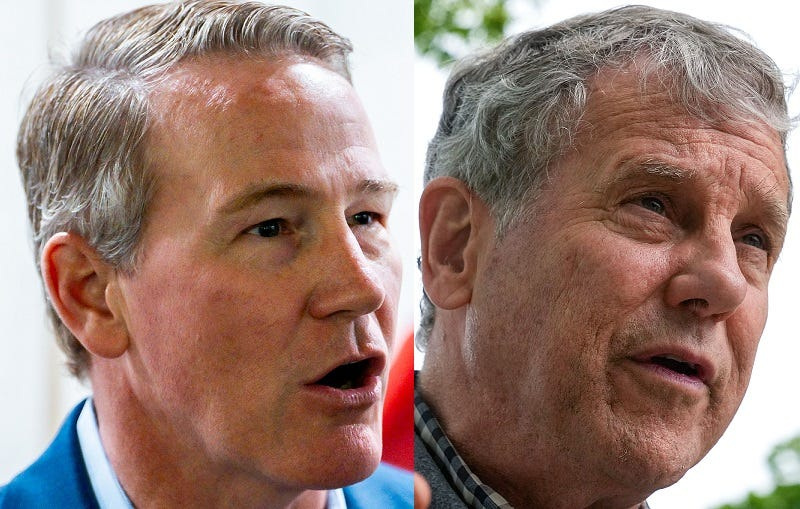
Although Ohio will be predictably late to the trend party, “same old, same old” just doesn’t get it anymore, a theme that drove the Michigan Senate primary that El-Sayed won. It should also influence Ohio’s U.S. Senate race, where ex-Sen. Sherrod Brown, a Bexley Democrat, is challenging the election of appointed Sen. Jon Husted, an Upper Arlington Republican.
Whether an Ohioan is a rock-ribbed Republican or a rock-ribbed Democrat, leaving aside the coastal fat cats and Washington insiders in each party – the status quo isn’t delivering for Ohioans.
The lesson of the Michigan primary and it’s the kind of message that’ll return Sherrod Brown to the Senate, or keep Jon Husted there.
Thomas Suddes is a former legislative reporter and writes from Ohio University.
This article originally appeared on The Columbus Dispatch: People are over it. Wisconsin, Michigan races a warning for Brown, Husted race | Opinion
Reporting by Thomas Suddes, Contributed Commentary / The Columbus Dispatch
USA TODAY Network via Reuters Connect
By Thomas Suddes, Contributed Commentary | USA TODAY Network