Thomas Suddes is a former legislative reporter and writes from Ohio University.
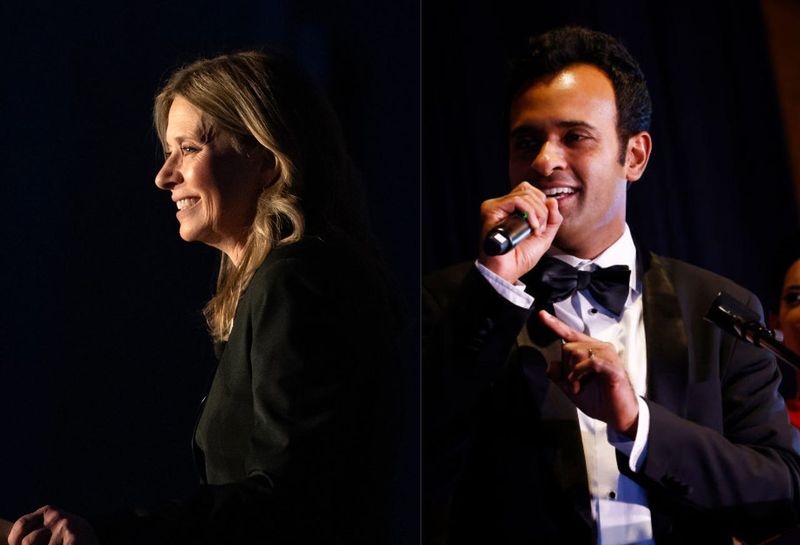
Dr. Amy Acton and Vivek Ramaswamy have a common enemy – complacency.

At the moment, polling suggests Acton, of Bexley, the Democratic nominee for governor, and Ramaswamy, of Upper Arlington, the GOP nominee, are virtually tied.
That’s quite an achievement by Acton, given the ocean of advertising Ramaswamy has deployed in his quest to succeed lame-duck Republican Gov. Mike DeWine, of Greene County’s Cedarville.
In Ohio, hotly contested statewide races tend to produce very narrow margins. For instance, on Election Night 1974, Upper Arlington Republican James A. Rhodes went to bed thinking he’d failed in his bid to unseat Democratic Gov. John J. Gilligan, of Cincinnati, who was seeking a second term.
Wrong.
The next morning, Rhodes learned that he’d landed a third term as governor, besting Gilligan by 11,488 votes statewide, or 0.37%.
The base will be the difference
Then, in 1976, Democratic presidential nominee Jimmy Carter captured the White House in part by besting GOP incumbent Gerald R. Ford in Ohio by 11,116 votes, many gleaned in what were usually GOP bedrock counties, such as Harrison (Cadiz); Jackson; Meigs (Pomeroy); Perry (New Lexington); and Vinton (McArthur).
And in perhaps the closest-ever election contest for any statewide Ohio office, suburban Cleveland Democrat Lee I. Fisher was elected attorney general in 1990 by just 1,234 votes, defeating the GOP candidate, then state Sen. Paul E. Pfeifer, of Bucyrus, later an Ohio Supreme Court justice. (Fisher is now president of Baldwin Wallace University.)
So, for Republican Ramaswamy and Democrat Acton both, firming up their bases has to be the first order of business, though pols and go-fers can forget that rank-and-file Ohioans have many things on their minds besides politics.
Right now, many families are preparing sons and daughters for a new school year. And sports fans … well, they’re sports fans … are laser-focused on the Guardians, Browns and Cavs; the Reds and Bengals, and Ohio State athletics.
That’s maybe enough sensory overload to keep voters’ minds – till after Labor Day – from thinking about towering gasoline and grocery prices, and about Donald Trump’s quest to transform the White House into a vulgar Las Vegas hotel.
Pivotal though the governorship is, so too are the races for seats on Ohio’s increasingly politicized (and undistinguished) Supreme Court, where four candidates are vying to keep or win seats. Republicans, led by Chief Justice Sharon K. Kennedy of Butler County, now run the high court 6-1.
The court’s lone Democrat is Justice Jennifer Brunner, who is seeking re-election.
Earlier, Brunner was Ohio’s secretary of state. Brunner earned her law degree at Capital University. Brunner’s GOP challenger is former Franklin County Common Pleas Judge Colleen O’Donnell, subsequently a federal immigration judge. O’Donnell’s father is former Supreme Court Justice Terrence O’Donnell.
Colleen O’Donnell earned her law degree at Case Western Reserve University.
The other Supreme Court seat on this year’s statewide ballot is held by Republican Justice Dan Hawkins. Earlier, he was a Franklin County Municipal and Common Pleas judge. He earned his law degree at Ohio State.
Hawkins’s Democratic challenger is Judge Marilyn Zayas, of the Cincinnati-based Ohio Court of Appeals (1st District). Zayas earned her law degree at the University of Cincinnati. She’s the first Latina to serve on the Ohio Court of Appeals. Zayas also ran for the Supreme Court in 2022, unsuccessfully challenging the re-election of GOP Justice R. Patrick DeWine, Mike DeWine’s son.
As the Supreme Court now operates, it’s as much a GOP clique as a judicial forum, regressing to what scholars G. Alan Tarr and Mary Cornelia Aldis Porter said the court was (before a spell of Democratic control from the mid-1970s to the mid-1980s): “Dominated by conservative, ‘old stock’ Republicans who fashioned the law to conform to the values and interests they shared with small-town and rural Ohioans, with business and industry.”
Perhaps the Kennedy court’s most outrageous action to date was letting Republican Secretary of State Frank LaRose and his Ballot Board flunkies twist the words of an anti-gerrymandering ballot issue – Issue 1 of 2024 – to assure its defeat by confusing voters, a brazen assault on the right Ohioans have had since 1912 to fashion the state constitution they – not Capitol Square hacks – want.
Thomas Suddes is a former legislative reporter and writes from Ohio University.
This article originally appeared on The Columbus Dispatch: Ohio history shows what could cost Acton, Ramaswamy the governor’s race | Opinion
Reporting by Thomas Suddes, Contributed Commentary / The Columbus Dispatch
USA TODAY Network via Reuters Connect
By Thomas Suddes, Contributed Commentary | USA TODAY Network