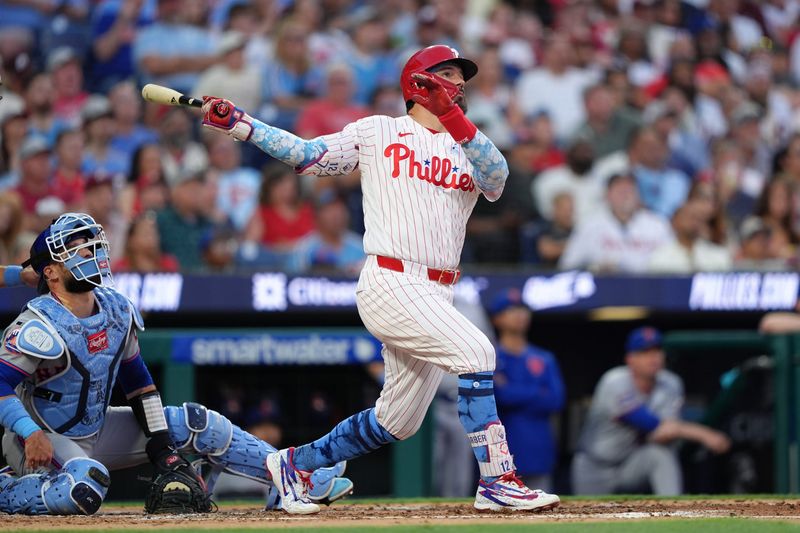
KANSAS CITY ‒ Kyle Schwarber said he’s looking forward to his return this week to Great American Ball Park for the first time since team execs made a free-agent pitch to him in November.
Even if he’s not sure if the fans of his hometown Reds are looking forward to seeing him.

“I haven’t always received the warmest receptions,” said Schwarber, the Philadelphia Phillies’ All-Star slugger.
Some of that history is skewed by Schwarber’s early years with the Chicago Cubs. Maybe a little of it this time around would be about his decision to turn down the Reds’ franchise-record free agent offer and instead return to the Phillies. That bit of fan irritation, however, would be more about Reds ownership and the team’s current state of malaise.
What seems certain is a mutual admiration club formed during that November meeting between Schwarber, his wife, Paige, and Reds officials, from manager Terry Francona to president Nick Krall and controlling owner Bob Castellini.
“My biggest thing was it wasn’t like they were just ploying. They were serious,” said Schwarber, who leads the majors with 30 home runs and just earned a fourth career All-Star selection.
“Everyone was honest,” he said. “At the end of the day, when you walk away, it’s like, I have respect for them, and I feel like they have respect for me. There was nothing bad to say about it.”
Images of what Schwarber might have done for the offense-hungry Reds’ fortunes this year instead of the Plan B pivot to veteran Eugenio Suárez are sure to be stirred this week in the minds of anyone still buying tickets to weekday ballgames in the Greater Cincinnati area.
It might even be fair to wonder if the Reds’ ability to acquire ‒ and pay for ‒ local stars to play for the hometown team no longer is viable in the way it was when the team traded for Ken Griffey Jr. and extended him with a $116 million contract a generation ago. Barry Larkin already was a hometown player drafted and developed by the Reds at that time. Dave Parker, who also grew up in Cincinnati, was a late-career free agent who had already come and gone.
Schwarber was such a perfect fit for the Reds in this free-agent moment, and the Reds were so committed to extending their most creative effort to land him that Phillies teammate Bryce Harper said during spring training he had thought Schwarber was gone to Cincinnati for sure once the Reds made their strong interest clear.
Reds star Elly De La Cruz said he felt the same way after running into Schwarber and his wife in the GABP parking lot on the way out of their November meetings with a half-dozen of the organization’s top officials.
“I thought it was a done deal,” De La Cruz said.
Schwarber always was going to be a shot every bit as long as one of his home runs for the Reds, no matter how serious their intent or how open his mind.
At least as long as the Phillies wanted him back. And Phillies team president Dave Dombrowski made that clear to Schwarber during an exit interview after the Phils were eliminated from the playoffs.
Then owner John Middleton drove home that point by visiting with Schwarber and his family at their house in Philadelphia for three hours before the family headed back to Middletown for the offseason.
No promises. No contract talk. But the appreciation was clear.
“That was the first time that’s ever really happened for me, personally, where you have the owner come over and really want to sit down and talk to you,” Schwarber said. “That meant a lot.
“So I knew that there was a strong inkling that they would want to re-sign (me).”
Eventually, that’s what happened, for five years and $150 million, after Schwarber made the rounds ahead of MLB’s December winter meetings, receiving similar offers from at least Baltimore and Pittsburgh.
The Reds, according to sources, talked about the parameters of a five-year deal believed to be around $125 million ‒ that had room to grow, pending rival offers and further negotiations.
“There was nothing negative that I could ever say about the way that they went about their business, with bringing us in, sitting us down, having a conversation, showing us around,” Schwarber said. “Even on the back end of that stuff (negotiations). At the end of the day, they were serious.”
It never got much further on that back end, mostly because of Schwarber’s desire to go back to a competitive and personal comfort zone in Philadelphia ‒ a place he considers a second home and that his three young kids naturally consider as much a home as Ohio.
Schwarber, who has never finished a season on a losing team and missed the playoffs only once in 11 big-league seasons with three different organizations, also talked about unfinished business in Philly.
The thing is, the kid from Middletown, who grew up dreaming about playing for his Reds, is now a grown-man baseball player, hard-scrabbled through the business of the game. This includes his dealings with the Cubs, which committed one of the two- or three-most regrettable non-tender decisions in the history of the sport after the 2020 season.
He never wanted to leave the Phillies, even though he felt a profound desire and responsibility to listen to teams that wanted to lure him away.
“I’ve got a place that I’ve had a great time at, and I can’t be happier to be here,” he said. “Because there’s also the unfinished-business aspect of it all for me.”
That’s the other thing. The Phillies originally signed him almost five years ago to be one of the last key pieces to a championship team. They got agonizingly close in their 2022 World Series appearance during his first year and went to the NLCS the next.
“You keep making the postseason every year. You feel like that year is the year,” he said. “And then when you’re not holding the trophy (at the end), it feels like it’s heartbreak. Because it is.”
Schwarber won the World Series with the 2016 Cubs, the year after his big-league debut. That year, he spent all season rehabbing a knee injury before his dramatic return to go 7-for-17 (.412) with a .971 OPS as the DH in four World Series games.
“That’s something you want to do with this group,” he said, looking across the Phillies clubhouse on the eve of this week’s series in Cincinnati.
In some very important ways, that’s something the Reds simply could not persuasively offer, no matter how serious their intent or how big their commitment to try to land their top free agent target in years.
Team sources said Schwarber questioned whether the Reds would have the resources to keep a competitive team on the field for the duration of his contract if so much of their payroll was tied up in him.
Actually, he just asked them what he asked every team he talked to: the team’s operating philosophy, its approach approach to the trade deadline, its plans for retaining key, homegrown players.
In the Reds’ case, that included the plan, independent of Schwarber’s status, for trying to retain budding superstar Elly De La Cruz, whose club control would otherwise expire with a year left on any five-year deal Schwarber might sign.
“Those are questions that you want to try to have a picture of,” he said. “They might not even know at that point yet. A team might not know that.”
One insider said Schwarber expressed concern that if he or the team underperformed while he was there, he could become a target of fans, even disliked, in his own hometown ‒ a shrewd take for any potential free agent.
“I don’t know if it went to that extent,” he said.
His input was all about trying to learn as much as he could about the organization, he said. Which goes back to the honesty and seriousness of the Reds’ pursuit.
Like Harper, Phillies teammate Zack Wheeler – who once was courted in free agency briefly by his hometown Braves – knew just enough about the variables involved in free-agent decisions to give Schwarber space during the process and to be concerned about how serious the Reds were.
“Just watching from the outside, I did get nervous a few times,” Wheeler said, “because we did want him back.”
It was no secret why the Reds saw so much value.
“He might have hit 72 (home runs) in Cincinnati,” former Reds manager Dusty Baker said.
Well, there is the enormous power of one of the decade’s premier sluggers, a lefty hitter who might have been the single-biggest difference between the Reds being back in playoff contention this year and becoming all-but-certain deadline sellers.
But executives and teammates from Chicago to Philadelphia have talked for years about the value of Schwarber that goes beyond even some of the tape-measure home runs he hits.
“He’s a great leader, a clubhouse leader. He plays hard. He shows up every day to play,” Wheeler said. “And he’s a good teammate, on and off the field.
“He has dinner set up for us when we get into towns,” Wheeler added. “He makes things happen with the team. It’s important to have that guy in your clubhouse, and if we would have lost him, I don’t know who would have filled those shoes, if anybody could have.”
In the end, the Reds’ best shot at Schwarber would have been the Phillies backing off, because his mind was open as he keenly listened to what every suitor said during the process.
“Sure, if this didn’t work out in Philadelphia, I don’t know what happens,” Schwarber said. “But the thing I can say is that I’m happy that Philadelphia worked out because I knew that was obviously the strong calling card personally, and the unfinished business. And all the other things lined up.
“This is where I want to be.”
This article originally appeared on Cincinnati Enquirer: How close hometown slugger Kyle Schwarber got to signing with Reds
Reporting by Gordon Wittenmyer, Cincinnati Enquirer / Cincinnati Enquirer
USA TODAY Network via Reuters Connect
By Gordon Wittenmyer, Cincinnati Enquirer | USA TODAY Network