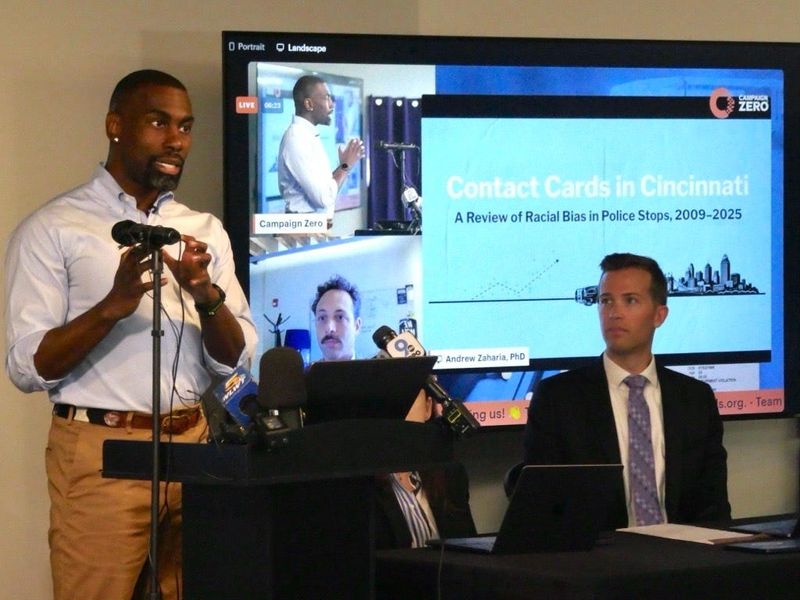
You may have experienced a sense of whiplash if you’ve been following Cincinnati police’s response to a comprehensive report released in June about racial bias at the Cincinnati Police Department.

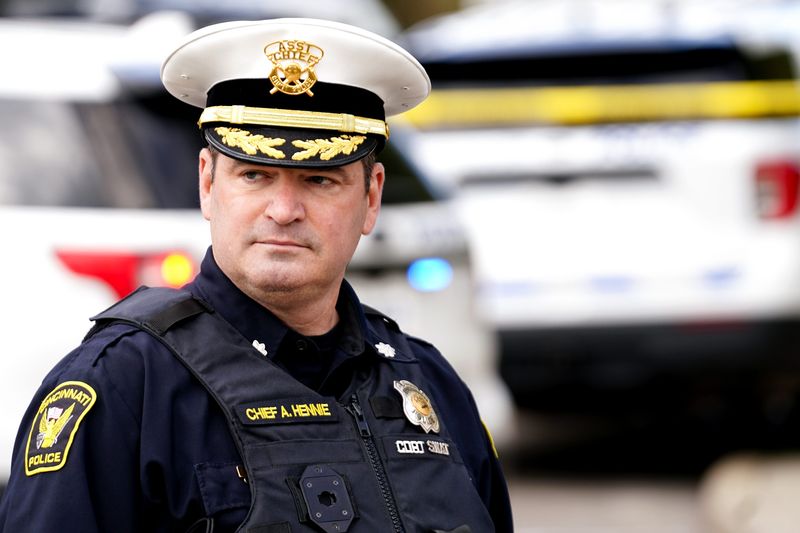
Interim Police Chief Adam Hennie’s initial take, in an email to officers, was to label the report flawed. “I will not stand by,” he wrote, “while the professionalism, integrity, and dedication of our officers is unfairly questioned.”
Fast forward about a month, and Hennie said at a recent public forum he was “glad this report came out.” He added that it was the “first time that I’ve known that we are really taking a look at this information,” referring to the contact cards that are the basis of the Campaign Zero report.
City Manager Sheryl Long initially suggested the report was “overly simplistic.” And Mayor Aftab Pureval said he was frustrated the city was not asked to provide input on the report’s findings. This is a red herring, as a nonprofit like Campaign Zero has no obligation to alert the government that it is analyzing its performance.
The data deserves an honest response
Even with these responses, there is reason for optimism that city leadership will work to address the stark racial bias identified in the report, in which Black people are overwhelmingly more likely to be stopped than White people. Hennie has at least verbally committed to transparency and change. And the city, in another public forum, this one sponsored by the Cincinnati Black United Front, shared recommendations for improving contact cards and decreasing bias. One proposal is to link stop and arrest data to civilian complaint data “to develop additional metrics of officer compliance with policy, law and procedure.”
But I remain skeptical about the city’s commitment to change. City leaders failed to meaningfully engage with or even address the report at the Black United Front event. And the city has stored contact card data for more than 15 years. Why is this the first time the department is “really taking a look” at them? These cards have been in the news before. As an Enquirer journalist, I wrote about them in 2019. We reported then that Black people were more likely to be stopped and arrested than Whites.
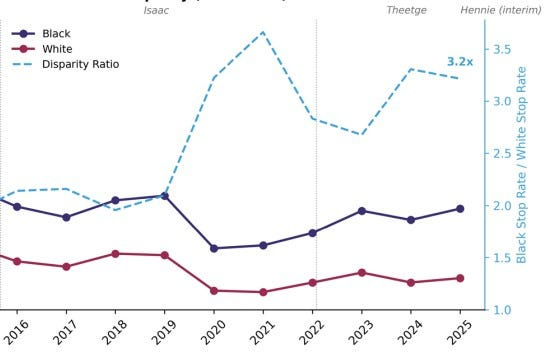
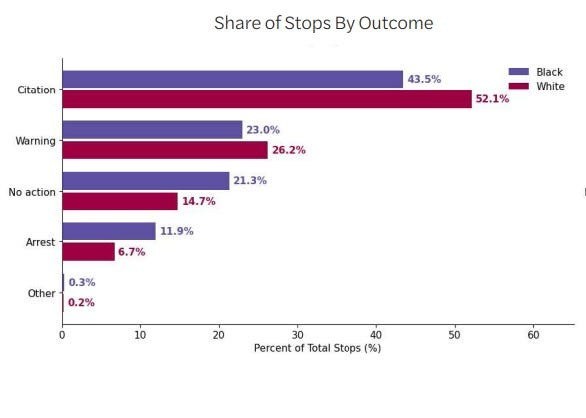
This year’s report analyzed nearly half a million stops since 2009 and considered millions of data points. Campaign Zero compared outcomes for Black versus White citizens and police. They found: Black people were three times more likely to be stopped than Whites; Black people were about twice as likely to be searched, have force used against them, and arrested; in majority White areas, Black motorists are nearly four times as likely to be stopped (Page 16, Figure 9 of the report); in the most disproportionate majority White areas, Black pedestrians are 16 and even 32 times as likely to be stopped (Page 17, Figure 10); crime rate by neighborhood does not explain the racial disparities (Page 19, Figure 12), suggesting that calls for service will not somehow justify the numbers. The report even analyzed when Black motorists face the highest stop disparity (around 3 a.m.), and when Black pedestrians do (about 8 p.m.). (The report notes that White people account for 49% of the city’s population, and Black people 36.5%.)
The report is many things. “Overly simplistic” is not one of them.
I’m no longer a journalist. Now in my work as a public defender in Hamilton County, I have viewed countless hours of body-worn camera footage. I see every day just how critical it is that we address anti-Black bias in policing because of its ill effect on people of color.
The camera footage matters, too
Don’t just take my word for it. Watch the footage that has gone public in recent years, which is just a fraction of the footage that CPD collects.
In 2018, Officer Kevin Brown fired a Taser at an 11-year-old girl suspected of stealing food and clothing from Kroger. After the barbs lodged into her skin and then were painfully pulled out, he taunted, “You know what sweetheart? This is why there aren’t any grocery stores in the Black community.” Brown was 1.43 times more likely to stop Black people than Whites in his career, according to the report.
In 2024, Sgt. James Perkins detained two Black women, pushed one of them, and threatened both of them with jail time because the driver honked at him. (I represented one woman. The charges against both women were eventually dismissed.) Perkins, according to the contact card analysis, stops Black people at twice the rate of Whites.
In 2024, Officer Michael Roetting fired a Taser into a woman who was handcuffed to a wall. The woman was charged with driving impaired and resisting. All charges were eventually dismissed. The case began with a traffic stop, though Roetting was not involved. Roetting stops Black people at 2.38 times the rate of Whites and is twice as likely to use force on Black people, per the report.
In 2025, CPD stopped and arrested a Black man for seemingly no reason and charged him with trespass. The man lost his job as a result. His charge was eventually dropped.
Sometimes mistreatment is more subtle. Some CPD officers respond with apparent delight upon making an arrest, laughing or taunting a person as they cry or show signs of distress. Sometimes, when the person arrested is a teenager asking to call their mother, officers simply disregard them. Sometimes force is used (a shove or a tackle or a Taser or mace) at the slightest provocation, or, occasionally, no provocation at all.
Accountability must be public
Hennie, in his email, portrayed CPD officers as victims of a flawed report. Police perform what can be a difficult job. But that does not give them carte blanche to mistreat citizens. Nor should CPD or city leaders sell a surreality to its citizens that racial disparities are merely a fiction, while storing footage that testifies otherwise.
The mayor, in his initial statement, said that the “bedrock of the Collaborative is open and transparent information.” Yet the city, which is seeking an “independent” review of CPD data, wrote in its Request for Proposals that the reviewing firm will incorporate city feedback into its final report, which will be presented to the city and “designated stakeholders” but, notably, not to the public.
The public, and particularly Black Cincinnatians, deserve fair and frank accountability from their police. So far, I have yet to see it.
Max Londberg is a trial attorney for the Law Office of the Hamilton County Public Defender.
This article originally appeared on Cincinnati Enquirer: Cincinnati police stop data demands answers, not defensiveness | Opinion
Reporting by Max Londberg, Opinion contributor / Cincinnati Enquirer
USA TODAY Network via Reuters Connect

By Max Londberg, Opinion contributor | USA TODAY Network