A bale of turtles released by the Cincinnati Zoo roughly a month ago are slowly but steadily acclimating to their new home at Bowyer Farms, the conservation project’s leader said.
The Cincinnati Zoo & Botanical Garden joined the Ohio Division of Wildlife in September for a statewide research effort to find new homes for Eastern box turtles. The species is native to Ohio but faces declining populations due to poaching, habitat loss and road mortality. The zoo’s reptile team rescued and cared for 10 turtles with ties to the Midwest for months before placing them in an enclosure at Bowyer Farm, the zoo’s secure plant nursery. They were released on June 24.

But that was far from the end of their story.
The central goal of the research is to learn whether box turtles will thrive after being moved to a new home. The turtles were released with tracking devices, and their location is monitored every three hours. Researchers also perform body condition checks every two weeks.
Mollie O’Neill, the Cincinnati Zoo’s director of partnerships in local conservation, said locating and understanding turtles’ movements is a tedious process. It’s too early to declare success, she said, but the team has seen no signs that would indicate eating concerns or threats from predators.
All turtles left the enclosure on the first day
Researchers said they hoped to see the turtles explore Bowyer Farm but not wander back to their previous home. When an Enquirer reporter left the farm on June 24, some turtles hadn’t yet left their enclosure. But O’Neill said that within 12 hours, all of them had ventured into the woods and fields across the farm.
Since then, some of the turtles have explored up to 200 meters in a day. If measured in a straight line, that would equate to around 45 car lengths, O’Neill said. The turtles, however, are moving in various directions. Their recorded movements look like “squiggly labyrinths,” she said.
“The actual area covered is pretty small,” O’Neill said. “So they are sticking around, which is a good sign. We have one wanderer who seems to be going farther than others but still staying within the farm property and even within the forest plus a little bit into the field.”
Eileen Wyza, a wildlife biologist and the project’s field research logistical lead, said this suggests that giving them a month to acclimate to their new home has worked so far. Researchers haven’t seen any turtles wandering in a straight line, which would indicate searching for a different territory, O’Neill said.
Box turtles are resilient, researchers say
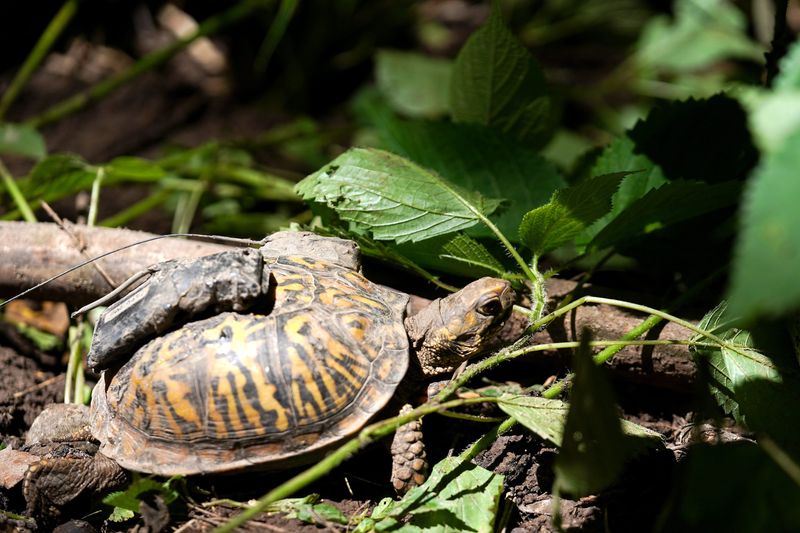
Researchers glued GPS and VHF devices to the turtles’ shells to track their movements. Using long-range technology, the devices provide near-real-time measurements of location, said Adam Parlin, a postdoctoral associate at Colorado State University, who led the construction of the devices. The trackers alert researchers of the turtles’ locations two to four times a day.
Parlin said that prior to the turtles’ release, researchers checked the turtles’ righting response, or their ability to return to their upright position if knocked off-balance. Wyza said their size was also assessed – devices were only placed on turtles large enough, and did not exceed 15% of a turtle’s body mass. While this is higher than the general rule for animal tracking devices – 5% or less body mass – Wyza said turtles have the benefit of strong shells and a minimal range of movement.
“We felt that this compromise was worth it to get high quality tracking data for our first year of repatriating box turtles,” Wyza said. “Box turtles are very adept at burrowing and navigating complex landscapes, so while they may occasionally get temporarily hung up on a log or branch, we are confident that they will be able to problem solve around it.”
The tracking devices are not permanent, Parlin said. They can fall off as turtles shed their scales. They can also be changed or removed “quite easily” with a thin flathead screwdriver. Wyza said if any turtles appear distressed from the trackers, the tracking device will be immediately removed.
Locating the box turtles has been a learning experience for O’Neill’s team. She said the combination of GPS and VHF is new to them, and that even when the location pings, it can be hard to find turtles, especially if they burrow underground or camouflage. Each turtle has its own frequency tracker, so they can only scan for one at a time. Turtle movement and behavior also changes with weather, she said, and this summer has brought heat waves and heavy rain.
It helps that Eastern box turtles are “one of the most resilient animals in our region,” she said. Turtles can go a long time without eating and remain healthy. Of the turtles they’ve located to date, just one has seen significant weight loss, but O’Neill said experts predict the turtle laid eggs somewhere on the farm.
More turtles expected to join project
Near the end of fall, the turtles will enter their hibernation period, known as brumation. Researchers will change the devices’ batteries so that when the turtles emerge in the spring, their movements will continue to be tracked. O’Neill says she expects to have a more solid idea of how successful the project has been during that time.
The zoo held fundraisers to increase the project’s budget. For a $500 donation, visitors could name a box turtle. All 10 have been named. The public also had the opportunity to “adopt” the turtles and win a behind-the-scenes tour for a donation. O’Neill said almost 200 people contributed. She said they plan to use the money for program fees such as for lab work, prepping holding sites and purchasing more monitoring equipment.
O’Neill said Bowyer Farm and other release sites in the region will likely end up with more turtles in the program because people who have taken them for pets are starting to realize that they should be returned to the wild. She said she’s seen an increase of both people turning turtles over to authorities and authorities confiscating turtles that were taken illegally. It’s illegal to take a turtle from the wild.
O’Neill said the program has received a positive response from the public. She hopes that one day the Eastern box turtle will thrive again, and a repatriation program will no longer be needed.
This article originally appeared on Cincinnati Enquirer: A month on the farm: How Cincinnati Zoo’s rehomed box turtles are faring
Reporting by Carly Gist, Cincinnati Enquirer / Cincinnati Enquirer
USA TODAY Network via Reuters Connect
By Carly Gist, Cincinnati Enquirer | USA TODAY Network