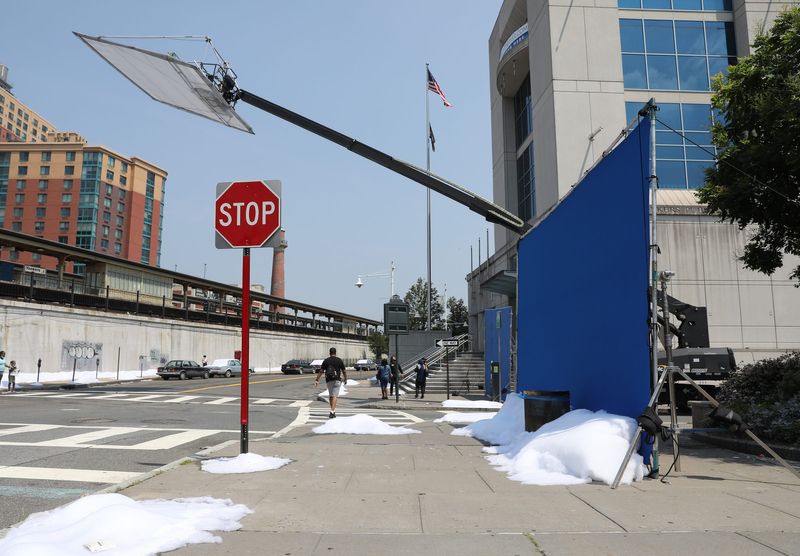
State taxpayers are on pace to spend $920 million in tax credits provided to the producers of “Saturday Night Live,” “FBI: Most Wanted,” “Only Murders in the Building” and others in 2025, money a good government group says would be better spent elsewhere.
The government watchdog Reinvent Albany analyzed Empire State Development tax records for the first quarter of 2025 and found the state had already paid out some $230 million in subsidies to Hollywood film and TV producers.

Heading the list was Saturday Night Live and FBI: Most Wanted, which combined for nearly $42 million in credits, according to the analysis. Only Murders in the Building received $12.3 million, according to ESD records.
Reinvent Albany estimates state taxpayers pay out $65,000 in subsidies for each full-time job in the film and TV industry.
“Their tax dollars are going to these big Hollywood film productions that ultimately do very little to boost New York’s economy, and we know we could be putting our money into these things that have proven to have a much better societal benefit, such as education, clean water and public transportation,” said Tom Speaker, the group’s legislative director.
Other shows receiving tax credits in the first quarter include “Dead Ringers,” $20.8 million; “Power Book II Ghost,” $19.9 million; and “The Watcher,” $16.1 million.
New York pushes back on film tax credit criticism
Empire State Development disputes Reinvent Albany’s projection of $920 million in subsidies this year and says investing in Hollywood has been a boon for the state’s economy.
“Reinvent Albany’s math is worse than pineapple on pizza,” spokeswoman Emily Mijatovic said. “New York gets a positive return on its investment from the industry — over $1.1 billion in the last quarter alone — which means tens of thousands of jobs for New Yorkers. ESD’s production credit program is reasonable, responsible, and helps keep the Empire State competitive against other states desperately trying to copy our blockbuster success attracting and accelerating local film production.”
And she said it’s misleading for Reinvent Albany to multiply by four the first quarter totals. “It’s impossible to divine the actual yearly total after the first year’s quarter, and supposing every quarter will mirror the first quarter is nothing more than just guessing. The quarterly report represents a snapshot, not a trend,” she added.
Some county and city governments where filming took place have also welcomed the film industry. That group included Westchester County and New York City, which both cited how the industry generated billions of dollars in local economic activity.
How does NY’s Hollywood film, TV tax credit work?
The state provides the tax credits based on a tiered system. Those with $1 million in credits can claim the entire credit in the first year. Those with credits between $1 million and $5 million claim credits over two years and over three years for producers getting credits of $5 million or more.
This most recent study piggybacks on a 2023 state-funded study by the PFM group, which found that between 2018 and 2022 the state paid out $3 billion to keep Hollywood producers filming in New York, while getting back less than $1 billion in tax revenues.
“Reinvent Albany believes the Governor and Legislature are happy to waste enormous amounts of our tax dollars on an utterly debunked, trickle-down economics scheme because of the substantial political reward they get from the Motion Picture Association, its corporate members, its unions and tens of millions of dollars of top gun Albany lobbyists,” the group said in a statement.
At the same time, the new Reinvent Albany analysis comes with a lag time. For instance, the subsidies for SNL are for Season 47 of a show that celebrated its 50th anniversary in 2025. And CBS’ “FBI: Most Wanted” was cancelled earlier this year, according to reports.
For a full list of subsidies go here.
During the first quarter of 2025, ESD determined that 20 projects – 16 films and 4 series – will be eligible for $146 million in credits in the coming years. That number is expected to grow as additional projects look to tap New York’s tax credit program.
Westchester County getting $2B from films, welcomes the biz
Meanwhile, Westchester County reported that in 2022 and 2023 film production in the county generated $2 billion in economic activity, nearly 7,000 jobs and $656 million in wages, according to county statistics released in 2024.
Then-Westchester County Executive George Latimer credited the county’s diverse locations and film-friendly communities with attracting the projects.
“This report underscores the film industry’s vital role in driving our local economy, creating jobs and boosting tourism,” Latimer said at the time.
Some of the shows connected to Westchester’s report included: “The Crowded Room” (Apple TV+); “Feud: Capote vs. The Swans” (FX, Hulu); “The Gilded Age” (HBO); “The Girls on the Bus” (HBO); “Leave the World Behind” (Netflix); “Succession” (HBO); “Severance” (Apple TV+) and “Life and Beth” (Hulu).
Further, New York City described the film and television industry as critical to its culture and economy, noting the industry accounted for about 6.5% of the city’s gross domestic product. In 2019, the film and television industry supported in total about 185,000 jobs, $18.1 billion in wages, and $81.6 billion in total economic output in New York City, the city reported.
This story has been updated with new information and comments from Empire State Development
Thomas C. Zambito covers energy, transportation and economic growth for the USA Today Network’s New York State team. He’s won dozens of state and national writing awards from the Associated Press, Investigative Reporters and Editors, the Deadline Club and others during a decades-long career that’s included stops at the New York Daily News, The Star-Ledger of Newark and The Record of Hackensack. He can be reached at tzambito@lohud.com.
This article originally appeared on Rockland/Westchester Journal News: New York spending millions to keep Hollywood filming. Is it worth it? Watchdog says no.
Reporting by Thomas C. Zambito, New York State Team / Rockland/Westchester Journal News
USA TODAY Network via Reuters Connect