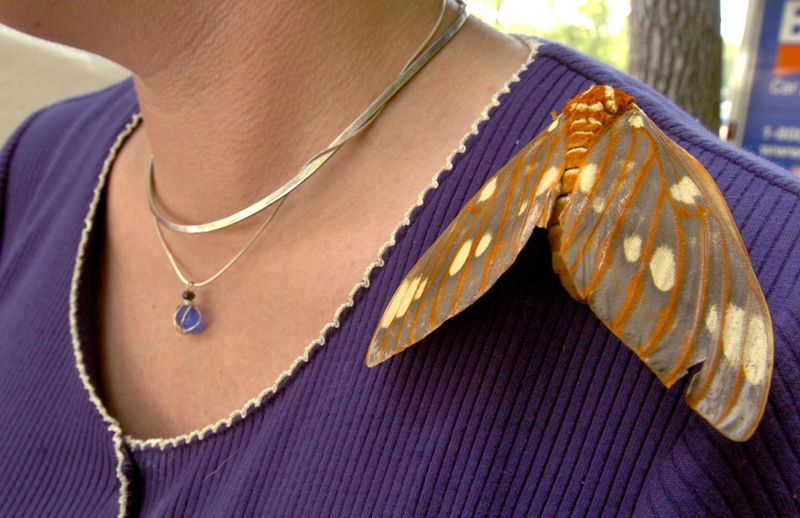
Moths are amazing creatures.
As part of the food web, moths and their larvae are food sources for birds, owls, bats, frogs, and toads. Adults emerge from winter cocoons in spring to mate.

Females can drop more than 1,000 eggs which become caterpillars in summer. However, only about one percent of the caterpillars survive to become adult moths.
We all recognize butterflies as important pollinators. However, the importance of moths is often overlooked.
What’s the difference between a butterfly and a moth?
Color is a common distinction. Butterflies pupate in a chrysalis whereas moths pupate in a cocoon. The biggest difference is their active time; butterflies are active during the day; moths are active day or night.
Protect moths by creating the right environment. Moths prefer pale and light-colored flowers because they reflect moonlight better and are easier for moths to find at night.
Using native plants is the best option. Many moth species prefer native plants to their survival. A mix of ornamental grasses, flowers, shrubs and trees is essential for egg laying.
Nesting places are also necessary along with protection from weather and predators. Shelter can be in leaf litter, brush piles, dead/dying trees, rock crevices or plant stems.
During the day, you may see the Snowberry Clearwing Moth, native to the eastern US and Canada. It resembles a large bumblebee. I love seeing the Hummingbird Clearwing Moth in my garden. It resembles a mini hummingbird, hovering in the air over flowers. Most often seen in the early morning or dusk, these moths are attracted to many flowers including bee balm, clover, and phlox.
Adding a native plant to your garden will go a long way to increasing habitat for moths. The Xerces Society has a list of native plants for the Northeast and what pollinator species they attract; visit https://xerces.org/sites/default/files/publications/22-026_01_NPPBI%E2%80%94Northeast_web.pdf. There’s also the New York State Native Plant list from the NYS Department of Environmental Conservation; visit https://extapps.dec.ny.gov/docs/lands_forests_pdf/factnatives.pdf. Don’t forget our moths; they contribute to our ecosystem as an important pollinator.
Cornell Cooperative Extension Oneida County answers home and garden questions which can be emailed to homeandgarden@cornell.edu or call 315-736-3394, press 1 and ext. 333. Leave your question, name, and phone number. Questions are answered on weekdays, from 8am to 4pm. Also, visit our website at http://cceoneida.com/ or phone 315-736-3394, press 1 and then ext. 100.
This article originally appeared on Observer-Dispatch: Moths are amazing creatures
Reporting by Rosanne Loparco / Observer-Dispatch
USA TODAY Network via Reuters Connect