Residents of the Holy Trinity Monastery in the hamlet of Jordanville don’t talk during meals in the dining hall; they listen to the voice of one monk reading from “The Lives of the Saints.”
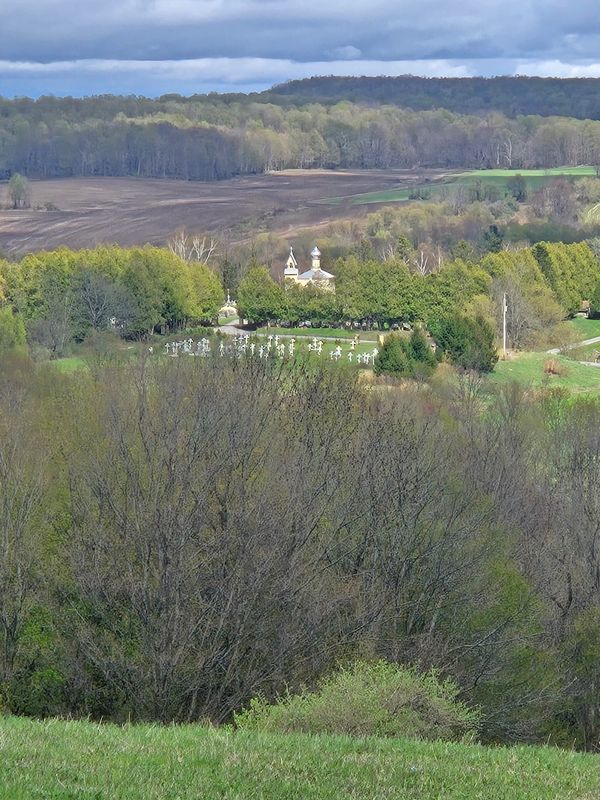
Monastery rules also declare a general silence between the hours of 9 p.m. and 9 a.m., a silence largely echoed by the rolling hills, fields and woodland surrounding the Russian Orthodox monastery. Its setting captures the isolation in which Russian Orthodox have traditionally been built and reminded its founders back in 1930 of the hills of their homeland in Belarus.

Yelena Yegorova joined a neighboring, affiliated convent as a novice in 2019 after visiting the monastery as a pilgrim from Houston in 2010 and appreciating the peaceful contrast with her life in the city, she said in a public comment filed with the state in a case involving the monastery.
“The quiet and natural environment of Jordanville has a direct impact on my ability to live a balanced and healthy spiritual life,” she said. “Having previously lived in an industrial city, I deeply experienced the effects of constant noise, traffic, and environmental stress. In contrast, Jordanville provides a rare sense of peace and silence that supports reflection, prayer and emotional restoration.”
But now Yegorova, the monks of Holy Trinity, their supporters and many of their neighbors believe that the monastery’s atmosphere of peace is under threat. The monastery, which is listed as both a national and state historic site, could soon be surrounded by wind turbines towering over its treetops.
Terra-Gen, LLC, one of the largest independent power providers in the United States, has proposed building the Rolling Hills Wind Project in the towns of Warren, Stark, German Flatts, Little Fall and Danube in Herkimer County and the Town of Springfield in Otsego County. The siting of the wind turbines has not yet been determined, but they are likely to surround the monastery.
“Everything we do is oriented to peace,” said Archimandrite (a Russian Orthodox clerical title just below the rank of bishop) Nektarios Harding, the monastery’s business manager. “And that’s what we’re going to be looking at every day?”
Documents from Terra-Gen filed with the New York State Department of Public Service describe the project as placing about 74 wind turbines, capable of generating 250 megawatts of electricity, in a 75,000-acre area.
Yegorova’s letter is among the 26 public comments in the department’s document file for the project. Some are from monks, local Russian Orthodox families and other concerned, local residents.
Not all of the monastery’s neighbors object, though. Farmers who have already agreed to lease their land to Terra-Gen welcome the income, said farmer Ed Mower, who has signed a lease with Terra-Gen.
“Of course we should have it,” he said. “The farm community and people out here in the country, we need all the help we can get.”
Plan update and next steps before approval
In any case, the project won’t be as big as the documents filed with ORES suggest. The project is still in the early stage of development, pointed out Patricia Ortega Mitchell, Terra-Gen’s manager of communications. At this time, the company is looking at about 50 turbines generating 198 MW, she said.
“We would expect the total acreage to be much smaller than 75,000 acres,” she added, “with the footprint of the project to be substantially smaller than that.”
She was not able to answer all of the O-D’s questions because the project manager was out, she said.
The project requires a siting permit from the Office of Renewable Energy Siting and Electric Transmission, known as ORES, which is under the New York State Department of Public Service. ORES was created by the state in 2020 to streamline the review and permitting process for major renewable energy projects.
Such projects no longer need to receive permits from each of the municipalities in which the project is located. But ORES reviews the impact of projects on the environment and on local communities, according to its website, a promise that some project critics don’t trust.
A farmer’s perspective
Mower and his late wife of 65 years, Shirley, spent decades building up their farm, buying whatever land became available, until they owned 700 acres worth, at one time worth a couple of million dollars, he said.
Shirley died two years ago after 65 years of raising a family and living the “happiest life you could ever have,” Mower said. Now he describes himself as a “lonely old man wondering how the hell I’m going to survive.”
Mower, who will turn 90 in two months, doesn’t have much income and has paid bills so far by selling off parcels of his land, Mower said. He drives a 2007 Dodge Dakota pickup, which saves money on gas, he said.
Money from the turbine lease will make a difference, he said.
“If it gets taxes paid and stuff like that, do you know what a benefit that would be?” Mower asked.
Many of the people who want to stop the wind farm moved to the area from New York City and retired with big incomes so they don’t have to struggle like many of the area’s farmers, he said. And the monastery doesn’t “pay a nickel” in school taxes, he said.
“They’re a totally different breed of people (at Holy Trinity),” he said. “They have money; it comes from all over the world.”
Like many of their neighbors, Mower, his wife and their families have worked hard their whole lives and done a lot for the community, he said.
“It just doesn’t feel like we count any more. … We can’t handle it no more,” he said. “We just can’t do it. We need some other income.”
About the Holy Trinity monastery
Although the monastery was founded in 1930 as part of the Russian Orthodox Church Outside Russia, its buildings aren’t that old. The initial house, which contained the monastery and a church, were completed in 1935, but burned down during a ceremony to bless it.
The current cathedral was consecrated in 1950. The complex also includes a bell tower, the seminary, monastic and student dormitories, a monastic cemetery, a Russian History Museum and Library, a church supplies and bookstore, and a studio and school for painting religious icons. A guesthouse lies just down the road.
The monks make many of the products sold in their store including Jordanville candles, incense, prayer ropes, books and icons.
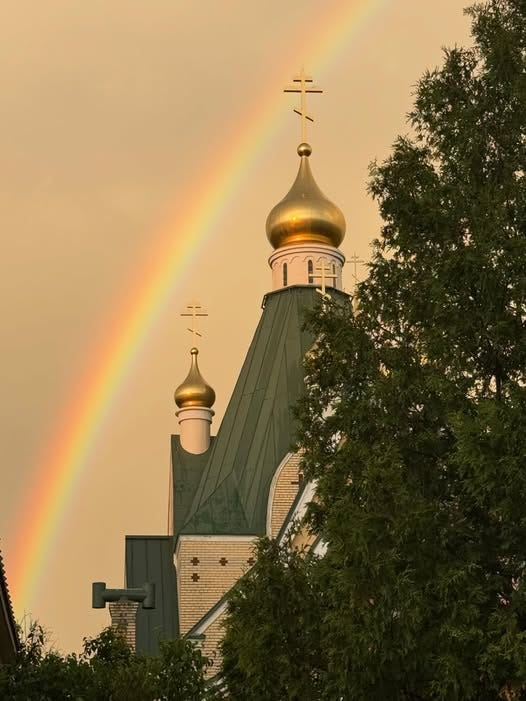
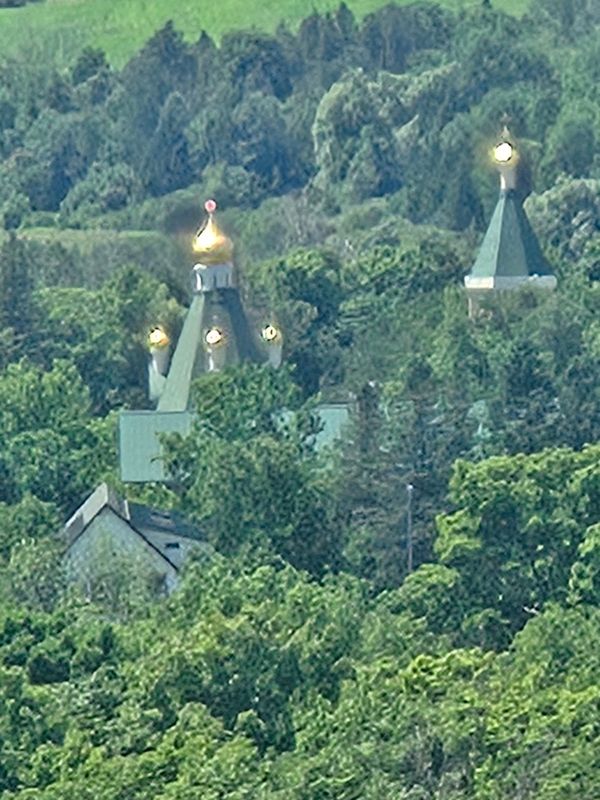
The buildings’ green rooftops may blend in with the treetops, but the cross-topped golden onion domes on the cathedral and bell tower soar above the treetops, declaring the presence of the largest development in the area.
Opponents of wind farm speak out
Despite their history of quiet, the monastery’s residents as well as its neighbors and other supporters, are using their voices to try to prevent the wind farm.
“We ask all of you to pray for our success in the struggle to preserve the Monastery and Seminary from this intrusion into the natural beauty of our surroundings, its effect on the spiritual life of our community and the negative impression it will have on the many pilgrims seeking solace here,” wrote Bishop Luke Murianka of Syracuse, abbot of the monastery, in a post on the Holy Trinity website.
He also asked supporters to send letters of concern to their state legislators.
Another article on the website asks people to sign a petition seeking to block the project on Change.org. The petition had garnered 12,146 signatures as 1 p.m. Monday, Aug. 10.
The monastery hosted a conference on Saturday, Aug. 8 for Stop Energy Sprawl, a coalition of community groups, municipalities and elected officials concerned about the spread of large-scale wind and solar projects in upstate New York. Harding is a member.
And a number of monastery residents have signed on as parties to the permitting process on the ORES website and/or submitted comments for the record.
Other concerns include efficiency, wildlife harm
The monastery’s location is far from the only objection critics have made to the project.
Harding said there’s a “plethora of reasons” that the wind farm shouldn’t be built. For one, wind power is neither affordable nor efficient, he contended, and the turbines would not, he argued, produce nearly as much power as claimed by Terra-Gen, given the variation in how hard the wind blows, he said.
He submitted several articles with his public comments raising environmental concerns.
And a previous, smaller wind farm proposal was defeated because it violated a local law in one town, he said. But local laws won’t count this time around, a state of affairs with which he does not agree, Harding said.
“It’s definitely going to decrease tourism,” he added, “because who wants to look at a bunch of windmills?”
Other critics have cited concerns about the project’s impact on wildlife habitat, on bird migration, on bird and bat deaths from the turbines, and on local property values.
Terra-Gen has 2 other NY projects in development
But the company is touting wind energy as green and reliable.
“Once in operation, the project will deliver clean, reliable renewable energy,” Mitchell said, “to help meet growing regional electricity demand while creating local economic benefits through jobs, tax revenue, and long-term investment in the surrounding communities.”
Terra-Gen’s portfolio already includes 4.26 GW of wind, solar ad battery storage projects, most of them in California and Texas. That’s enough to power more than 1 million homes, according to Terra-Gen.
Two of the company’s six projects in development are in New York. Including a North Country project in Franklin and Clinton counties with up to 80 turbines generating as much as 365 MW; and a project near Prattsburgh in Steuben County with 35 to 40 turbines generating 147 MW, according to the company website.
The company listed other benefits of its North Country project, which is bigger than the Rolling Hills proposal, on its website: about 179 construction jobs, about 11 permanent jobs, up to $1.5 million in annual payments to landowners, up to $25 million in increased revenues to local governments to cover public service costs, and an estimated $7.4 million in local spending during construction.
‘Cultural landscape’ is another concern
The presence of the monastery, though, does set Rolling Hills apart from other wind projects, said Ellen Pope, executive director of the nonprofit Otsego 2000, Inc., who also signed up as a party in the permitting process. For some historic places like the monastery, the view can matter, she argued.
Pope shared a letter Otsego 2000 had submitted to the New York State Division of Historic Preservation in response to a previous, smaller proposal to site wind turbines near the monastery. That letter referred to cultural landscapes, historical places for which the geographic context matters.
“(The National Park Service) recognizes that in many instance, buildings were sited and oriented very much in relation to the natural landscape, and in the case of the Holy Trinity Monastery, its siting in the landscape was absolutely intentional with all important religious buildings, cemeteries and structures (the hill cross) oriented to the east as the Orthodox religion dictates,” the letter said.
That letter also references another concern that Otsego 2000 has with the Rolling Hills project, too, Pope said. The Glimmerglass National Historic District, also a cultural landscape, would be affected, too.
Its boundaries are defined as the view from any point on the Otsego Lake shoreline. That is, the letter says, “a view significantly unchanged since the late 19th century and which was made famous by the novels of James Fenimore Cooper.”
But the turbines would change that view and the context of the historic buildings constructed as Cooperstown evolved into a summer retreat and center of literary tourism, Otsego 2000 argued.
What’s next before final decision
For now, according to the documents filed with ORES, Terra-Gen has spent months planning and having bird studies conducted, to check for the presence of endangered or threatened species within the 750 acres under consideration as part of the pre-permitting process. There will be more studies and more feedback from ORES before the final project design is submitted and before ORES issues its decision.
In the meantime, the debate will undoubtedly continue between those who want to honor and preserve the past, and those who think wind energy can create a better future for the climate and for landowners.
Father Joseph Kern moved to Holy Trinity from Florida, drawn by the area’s “immense beauty” and the monastery’s “spiritual atmosphere,” he wrote in his public comment.
“Holy Trinity Monastery is not just a historical location, but a place where many people can come to get away from life’s struggles and to be at peace,” he continued. “Please do not allow a large-scale industrial project to take away from the peaceful and spiritual atmosphere that people need in these hectic and troubling times.”
And Mower will keep receiving his tax bills.
“I’m totally against,” he said, “anybody that opposes progress.”
This article originally appeared on Observer-Dispatch: Jordanville monks want peace, not wind farm, surrounding monastery
Reporting by Amy Neff Roth, Utica Observer Dispatch / Observer-Dispatch
USA TODAY Network via Reuters Connect
By Amy Neff Roth, Utica Observer Dispatch | USA TODAY Network