It’s that time of year at Canandaigua Lake.
Three harmful algal blooms, or HABS, were reported July 31 and Aug. 1 as of Monday morning, on the eastern side of the lake. This comes a week after Canandaigua Lake Watershed Association volunteer shoreline monitors on July 24 reported what is believed to be the first harmful blue-green algal bloom of the summer, also on the east side of the lake. A large, localized bloom also was reported on the west side of the lake two days later.

The Watershed Association fielded questions over the weekend about a “floating mat of watermeal and duckweed,” which look like HABS, but are not and are a fairly common sight on the lake. The questions, however, show people are on the lookout for the harmful algal blooms, which is a good thing, the Watershed Association noted.
The first of the harmful algal blooms are usually reported around this time of year, although they tend to come with more frequency in August and September and can pop up as late as October and November. That said, first reports in three of the last years came in June.
Last year, 92 blooms were reported, with the first coming July 28.
Emily DeBolt, executive director of the Watershed Association, said the number of confirmed blooms is talked about and studied each year. But on Canandaigua Lake and other lakes, are the numbers a function of the number of volunteers reporting? Perhaps, as no metric is perfect.
“So we are still counting bloom reports, but we are also starting to talk about the number of days with confirmed blooms in an attempt to improve our data interpretation,” DeBolt said in an email. “Number of bloom days is more closely aligned with the potential impact of the blooms on our lake in terms of potential days out of the season where recreation and also tourism/economic impacts are possible.”
Here are some things to keep in mind as the summer eases into fall and HABs may become more prevalent.
What do harmful algal blooms look like?
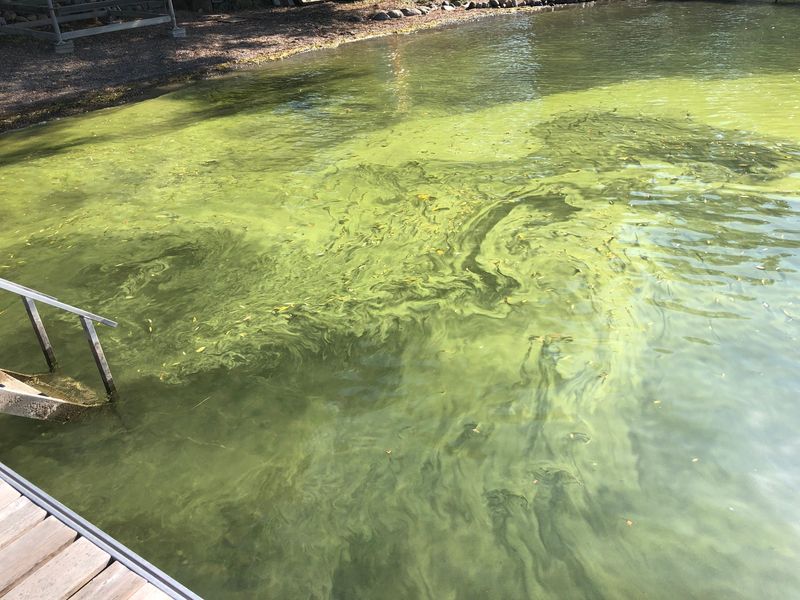
The harmful blue-green algae looks like green parallel streaks on the water surface. It can also look like spilled paint or have a pea soup appearance.
The bloom reported on the west side of the lake last weekend was described as having high levels of algae with heavy streaking and limited water clarity. The east-side blooms had what were described as mild, green-colored water with light algae and streaking.
Cyanobacteria, or blue green algae, are in the lake year round in low levels, DeBolt said. But under the right conditions their growth explodes and a bloom is formed. Heavy storms that bring nutrients into the lake are believed to be contributing factor in bloom formation.
“Typically warm, calm days are ideal,” DeBolt said. “In our lake, the type of cyanobacteria that we have the most of is microcystis. While its growth becomes possible at approximately 52 degrees F, optimal temps are between 68 and 86 degrees for it.”
The average surface water temperature last week was 77 degrees, as measured by the Watershed Association’s volunteers.
“So we are right where they like it,” said DeBolt, adding that microcystis is typical for this and other lakes, but not all of them.
Should harmful algal blooms be avoided?
The Environmental Protection Agency recommends that when blooms are visible, avoid playing and swimming in the water.
Also avoid jet-skiing and tubing through blue-green streaks and blooms because accidental inhalation is also a pathway for ingestion.
Don’t eat fish caught during blooms. Boiling lake water doesn’t remove the toxin.
Should pets also avoid harmful algal blooms?
Keep pets from entering the lake.
If your dog has gotten into the water, rinse it thoroughly, provide plenty of fresh water and watch for signs of gastrointestinal or neurologic distress. Call a vet immediately if your dog displays symptoms and tell them about their exposure.
How does one find harmful algal blooms?
The Watershed Association offers this reminder: Harmful algal blooms are constantly changing, and can appear, move and disappear quickly.
A bloom reported in one location does not mean that the entire lake is affected, or that conditions are the same everywhere, watershed officials said.
The Canandaigua Lake Watershed Association shares bloom reports, along with other information, on its Facebook page at https://www.facebook.com/CanandaiguaLakeWatershed/ and on its website at https://www.canandaigualakeassoc.org/.
The harmful algal bloom map on the Canandaigua Lake Watershed Association site is updated more frequently than the state Department of Environmental Conservation’s map. Check https://www.canandaigualakeassoc.org/…/shoreline-habs…/ for the most current information on Canandaigua Lake.
This map may be a helpful tool for seeing where blooms have been reported, but it is not an exact, real-time picture of conditions across the lake, the Watershed Association stated.
If you find a harmful algal bloom, what should you do?
The Watershed Association counts on 74 volunteers — also known as citizen scientists — who are trained and take regular water samples at spots around the lake.
But you can help, too.
For those who believe they have observed a bloom, take three good pictures with your location services toggled on and submit a report to the NYSDEC NYHABs portal at on.ny.gov/habform.
Mike Murphy covers Canandaigua and other communities in Ontario County and writes the Eat, Drink and Be Murphy food and drink column. He can be reached at mmurphy@messengerpostmedia.com. Follow him on X at @MPN_MikeMurphy.
This article originally appeared on Rochester Democrat and Chronicle: Harmful algal blooms reported in Canandaigua Lake. What to know
Reporting by Mike Murphy, Rochester Democrat and Chronicle / Rochester Democrat and Chronicle
USA TODAY Network via Reuters Connect

By Mike Murphy, Rochester Democrat and Chronicle | USA TODAY Network