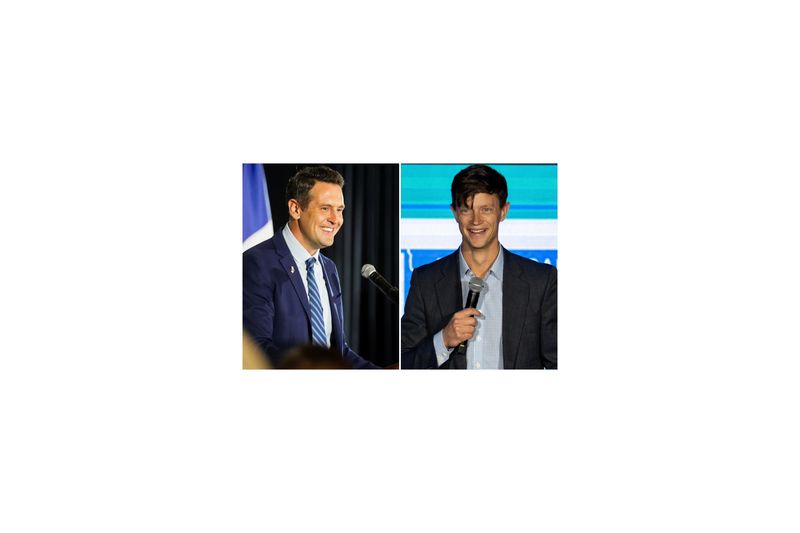
Iowa politicos are resetting their expectations for a governor’s race they say will remain highly competitive, even as the contours shift significantly in the wake of Republican Zach Lahn’s upset primary victory over Randy Feenstra.
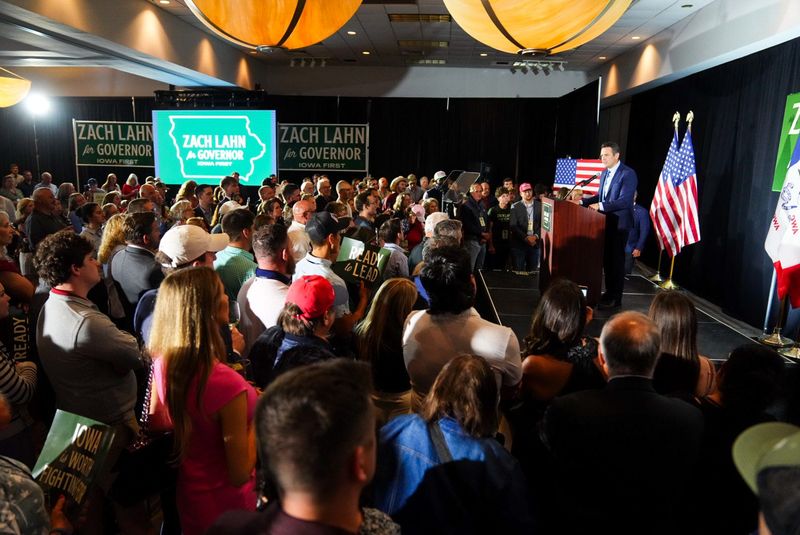
Lahn rode a wave of anti-establishment, MAHA-driven enthusiasm to a narrow victory over Feenstra in the June 2 primary election.

Iowa Republicans, who are quickly adjusting to the change in standard bearer, say they believe Lahn could prove an even stronger matchup than Feenstra against the Democratic Party nominee, state Auditor Rob Sand, whom they acknowledge is a formidable opponent.
Although Feenstra started with higher name recognition, more money and garnered high-profile endorsements — including from President Donald Trump — it was Lahn who rallied the grassroots and generated enough enthusiasm to overtake him.
Some Republicans say they’re glad to have a candidate who can better tap into that excitement after Feenstra struggled to energize the party’s base.
Others say Lahn’s focus on water quality concerns, rising cancer rates and a populist economic agenda could scramble some of the Democrats’ messaging in a general election matchup.
“In many ways, it rolls a bomb into Rob’s tent,” Republican political consultant Josie Albrecht said.
But Democrats say they’re confident Sand’s operation is ready for Lahn, just as it would have been for Feenstra.
Iowa Democratic consultant Matt Paul noted that Sand already has completed the first of two 99-county tours and has been working aggressively to court voters for more than a year.
“He spent that time preparing for this race, I think, wisely, and he comes in with an advantage in his relationship with Iowans,” Paul said. “I think Mr. Lahn is going to have to play a lot of catch-up.”
Following the arduous primary, the Lahn campaign began shifting into general election mode — a place where Sand, who ran unopposed, has long been.
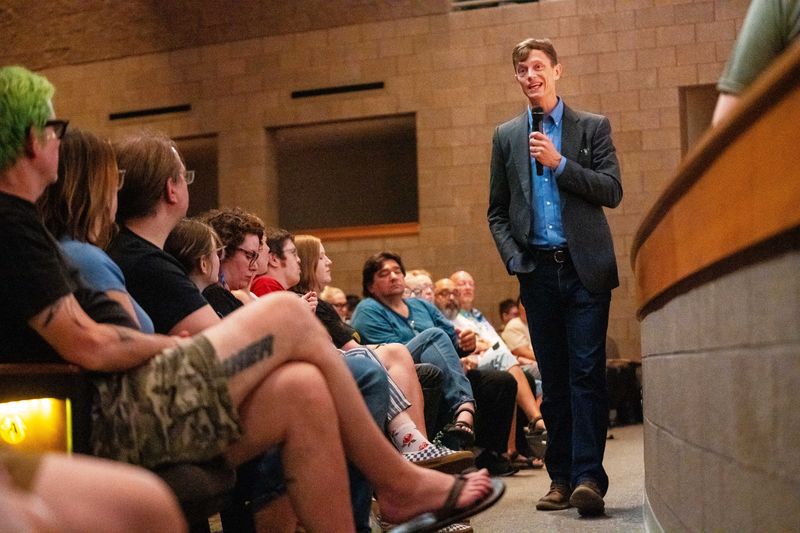
Immediately after the election, while the Lahn campaign appeared to be regrouping, Sand attended public events, challenged Lahn to a series of debates, began airing attack ads and rolled out the dates for his next 100-stop town hall tour.
Matthew Klein, an analyst who focuses on gubernatorial contests for the nonpartisan Cook Political Report, said the race remains in the group’s most competitive “toss-up” category following Lahn’s nomination.
“Even as the contours of this race have changed, its competitiveness has not,” he said.
On that, Iowa Republicans and Democrats seem to agree.
“It’s going to be a long, loud cycle with a lot of spending and a lot of political activity,” said Drew Klein, a regional vice president for the conservative Americans for Prosperity who is based in Iowa. “And it’ll just continue to heat up over the next several months.”
How Randy Feenstra lost and Zach Lahn surged
Republicans congratulated Lahn on a well-run race and argued that what made him a strong primary candidate against Feenstra would also serve him well in November.
Where Feenstra ran a sheltered campaign that largely avoided public events and debates, Lahn was available to voters — both in person and with an online presence.
“I think Zach Lahn was a much more aggressive messenger,” Republican consultant Jimmy Centers said. “It’s as simple as that.”
Where Feenstra failed to rally the base, Lahn energized supporters. And where Feenstra’s message fell flat, Lahn brought new issues to the forefront.
He checked key conservative boxes, such as calling for restrictions on abortion, fighting DEI and “gender ideology,” keeping taxes low and avoiding overly regulating schools and businesses.
But he also broke the mold by calling for raising taxes on out-of-state landowners to bring down property taxes for Iowans and criticizing big agriculture companies for contributing to rising cancer rates.
“I think the message and the way that he talked about his vision for the state of Iowa was just fresh enough and novel enough that I think people were really intrigued by that,” Drew Klein said. “And it helped him stand apart from, quite frankly, a field of other candidates that sounded just kind of like your generic boilerplate Republican candidates.”
Although Feenstra emphasized his ties to Trump at every turn, Lahn was ultimately more effective at courting MAGA primary voters.
So much so, that even when Trump gave Feenstra his last-minute endorsement, just days before the primary, it was “too little, too late,” Drew Klein said.
“By the time that endorsement came in, a lot of his base had already made a decision that they weren’t going to vote for Randy,” he said.
He said the primary outcome reflects many Republicans’ belief that Lahn will be the better general election candidate.
“A part of the calculation was an uncertainty about whether or not Feenstra could win in November,” he said. “That pushed voters away from Feenstra, and they found a home in Lahn.”
Lahn could better energize the party base, Republicans say
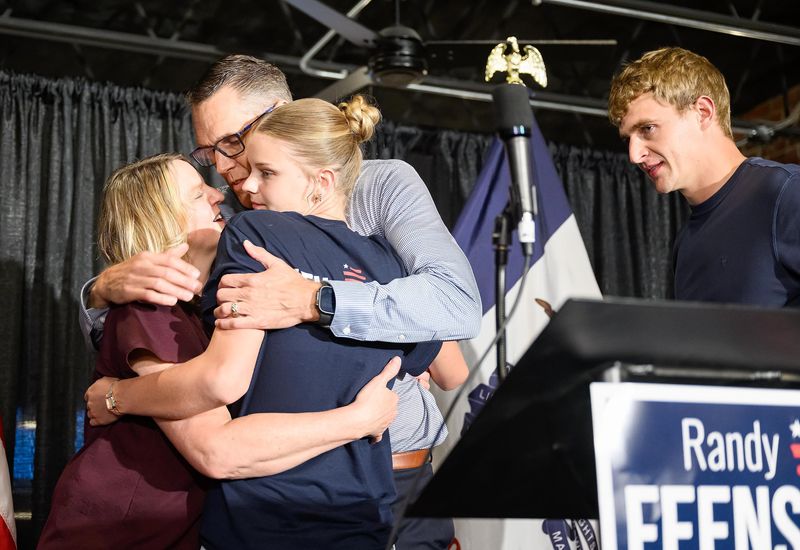
Feenstra conceded to Lahn well before the Associated Press called the race, promising to throw his support behind the nominee.
Other Republicans who had stayed neutral during the primary quickly joined him in congratulating Lahn.
“Zach will work to keep Iowa the best place to live, work and raise a family,” Republican Party of Iowa Chair Jeff Kaufmann said in an election night statement.
Republicans said it likely will be easier to unify the party following Lahn’s victory than it would have been had Feenstra won, given the growing animosity the congressman faced from the grassroots.
A unified party will be instrumental for Republicans come November, Centers said.
“The voter registration advantage that Republicans have is absolutely critical to retaining Terrace Hill” he said. “If you don’t have a unified party, the math gets really, really hard.”
Republicans have about a 200,000-person edge in registered voters in the state.
Cook’s Klein said one of Lahn’s upsides in a general compared with Feenstra is his devoted activist base, which will help get out the vote.
“It was clear that Feenstra was going to struggle to get a lot of base voters out,” he said. “I don’t think Lahn will have that problem quite as much. And keep in mind, Iowa is a state where, if Republicans get out the base, they should win, all things being held equal,” he said.
How will governor candidates’ messages stack up in a general election?
Nationally, the MAHA agenda has attracted a cross-party coalition that has cut across unusual political lines.
Some Republicans said that could benefit Lahn and help him retake some of the moderate and independent vote that Sand has been aggressively courting.
Matthew Klein, of the Cook report, said Lahn’s economic populism could also pull in nontraditional Republican voters.
“Especially on economic matters, like taxing Wall Street hedge funds that buy lands, Lahn’s message isn’t necessarily what you’d expect to hear from a traditional Republican,” he said. “That type of pitch could help him appeal to more populist voters who might be open to supporting Sand but weren’t motivated by an establishment congressman like Randy Feenstra.”
Sand, too, is courting voters beyond the traditional Democratic electorate with appeals to independents and Republicans. He’s rolled out an “accountability for all” agenda focused on government transparency as well as a health policy agenda that in some ways overlaps with Lahn on cancer and water quality concerns.
Centers said that on some of those issues, Lahn and Sand are “not all that far apart, at least on principle.”
“But I’m sure they’re going to be drawing sharp contrasts with each other as well on issues that Iowans are very passionate about, whether it’s reproductive rights, whether it’s fiscal policy and how we work on the state budget going forward,” he said.
Those on both sides of the political aisle said they expect the general election will be more focused on the economy and affordability.
Paul said that will favor Democrats as they hammer Republicans, who control both the state and federal governments, over those issues.
“The midterm election is a referendum on Trump. I don’t think there’s any question about that,” Paul said. “And in Iowa, it’s all about kitchen-table issues.”
Paul also said Lahn will have to answer for the more “extreme” positions he’s taken that might alienate moderate voters. Lahn has said he believes life begins at conception and he would ban all mRNA vaccines.
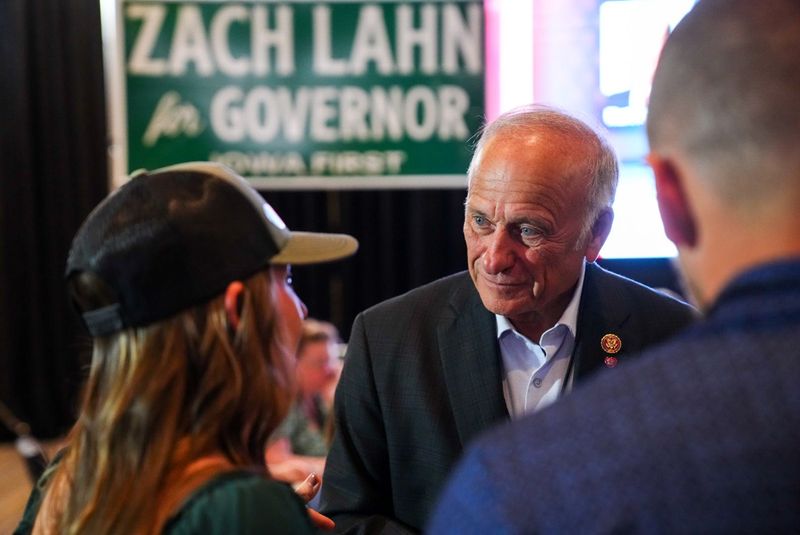
Lahn also has touted the endorsement of controversial former U.S. Rep. Steve King — someone who still has sway in some Republican primary circles but is far more polarizing among a general electorate.
“I get the lane that he carved in the primary,” Paul said. “But I think as we get into the general, high-information Iowa voters will dig into this and some of these really extreme stances that he has taken.”
Paul said Republicans are taking a risk by nominating a largely unknown, untested and unvetted candidate for governor.
Democrats have already begun criticizing Lahn as a “career political operative” and “Kansas carpetbagger.”
Lahn frequently flies back and forth between Iowa and Kansas, where some of he and his wife’s children from previous marriages are based.
Sand’s first TV ad of the general election criticized Lahn over the issue.
“Turning Iowa around will be a full-time job, but Zach Lahn isn’t even a full-time Iowan,” the ad said.
Lahn previously told the Des Moines Register that he is in Iowa “the majority of the time.”
“I have an airplane, and when I need to go down for things with the kids, it’s an hour flight for me,” he said. “And so I just try to make sure I’m fulfilling that obligation as best as I can. … I have no worries that we’ll be able to fulfill every duty we need to on the campaign or as governor.”
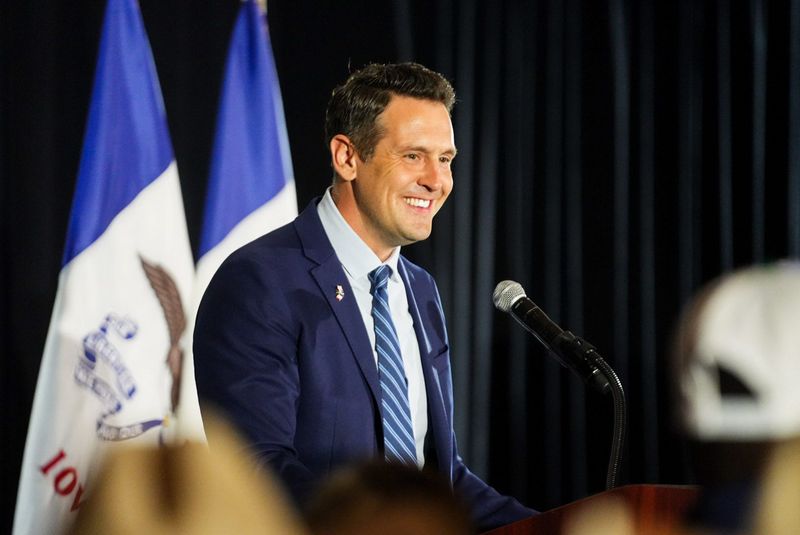
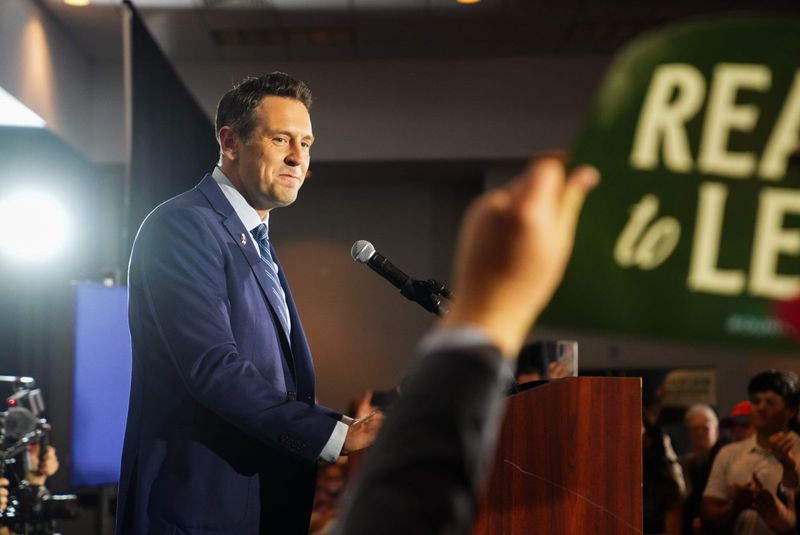
Lahn also quickly pivoted to Sand in an election night speech, saying he has portrayed himself as moderate but will “govern like a radical.”
There has not yet been public polling of a head-to-head matchup between Lahn and Sand.
But the Sand campaign issued a post-primary memo that said polling conducted on behalf of the campaign April 23-28 gave Sand a 9-point lead over Lahn, 50% to 41%.
How Zach Lahn and Rob Sand match up on fundraising
Sand is already well financed going the general election. He’s raised about $28 million and has about $18 million cash on hand, according to recent financial disclosures.
So far, Sand’s family members have contributed about $11.5 million of the total.
But Lahn also has personal money at his disposal, funneling $2.5 million into his primary campaign, financial disclosures show.
Although Lahn can’t currently match Sand’s war chest, Republicans noted that Feenstra was not in a stronger position at the end of his bruising primary fight.
Feenstra’s final financial disclosure showed he had just $150,000 in cash on hand at the end of May, leaving him with almost nothing ahead of a general election campaign.
“So, it’s not as if with Zach Lahn we start in a far worse spot in terms of having resources,” Centers said. “It might be the opposite, as a matter of fact.”
Outside groups are also likely to come in big for both candidates, driving up the cost of what is expected to be a very expensive contest.
Bottom line: Iowa’s governor’s race will be a fight for both parties
The Lahn-Sand matchup is expected to be a fight for both parties, and neither is taking their chances for granted.
Centers said he expects a “highly competitive” race.
“Rob Sand is a formidable candidate,” he said. “He’s well-resourced. He has been honing his message for the better part of eight years, maybe longer. He is well traveled around the state. And it is a very difficult environment, as it always is in a midterm of a sitting president’s final term in office.
“But that said, Zach Lahn caught fire, and he has real energy behind him. And I think it’s fair to say he had energy that no other candidate did in the race for governor. He surged, he won, and that’s not something you can discount or bat an eye at.”
Drew Klein said he thinks the race “is the Republicans’ to lose.”
“But Rob Sand is a very strong candidate,” he said. “I think he’s likely to be well resourced throughout the race, and so it can’t be taken for granted.”
Paul said Sand has run “a really strong campaign” so far but acknowledged “there’s a very long way to go.”
“I think they had been clear-eyed in looking at the state’s voter registration situation,” he said. “But the national political environment, the economy, 16 years of Republican control — all of these have factored to put him in a strong position for the general election.”
Brianne Pfannenstiel is the chief politics reporter for the Des Moines Register. She writes about campaigns, elections and the Iowa Caucuses. Reach her at bpfann@dmreg.com or 515-284-8244. Follow her on X at @brianneDMR.
This article originally appeared on Des Moines Register: Zach Lahn v. Rob Sand. How they match up in the Iowa governor race
Reporting by Brianne Pfannenstiel, Des Moines Register / Des Moines Register
USA TODAY Network via Reuters Connect
By Brianne Pfannenstiel, Des Moines Register | USA TODAY Network