Keep updated on the latest flood recovery efforts with IndyStar’s live blog.
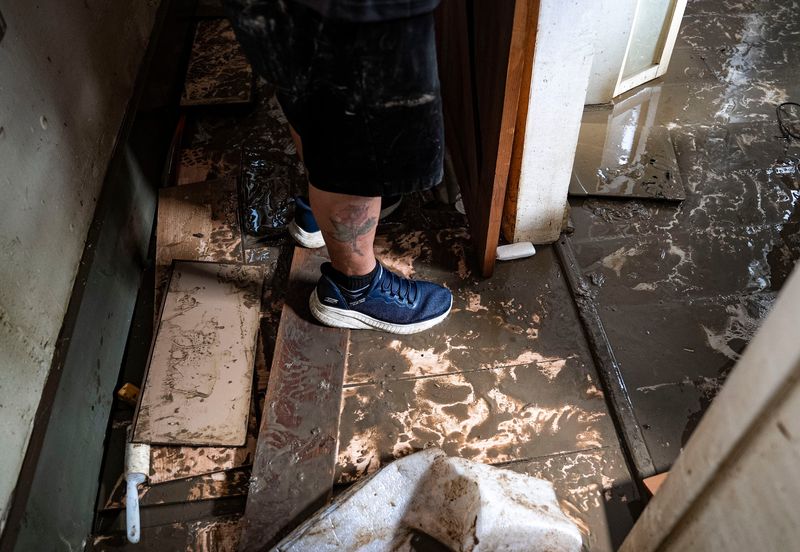
When Delaware County resident Kara Riley’s home was deluged with water as flooding recently ravaged Indiana, top of mind for her family was the thousands of dollars of immediate damages that were visible to the naked eye.

The furnace and water heater in the cellar. A damaged barn.
But Riley said it took longer to process the potential consequence of lurking contaminants caused by the floodwaters that she couldn’t see.
Was her family’s water safe to drink after their private well became fully submerged? What about the vegetables from the dozens of tomato and pepper plants her family has cultivated all spring and summer long?
“If our water is contaminated, our garden is absolutely contaminated,” Riley said. “Even if the new produce grows and looks healthy, those were underwater, soaking up whatever was in the flood. I can’t risk my family’s health for that.”
Public health officials and other experts contacted by IndyStar said such concerns are warranted. They are urging that people who have come into contact with floodwater take health precautions and understand the health risks, even as waters recede.
Floodwater contains multitudes: According to the Centers for Disease Control and Prevention, while it’s hard to know exactly what’s in floodwater at any given time, it could contain everything from human and livestock waste, medical and industrial hazardous waste, coal ash waste with carcinogenic compounds, not to mention dangerous debris.
“Unfortunately, a common perception is that floodwater is just river water that’s gone over its banks,” said Jason Ravenscroft, administrator for the Department of Water Quality and Hazardous Materials Management at the Marion County Public Health Department. “The problem is that when water goes places it’s not supposed to go, it may pick up sewage. Chemicals may be in there. You have to think about everything at someone’s home: gasoline, pesticides, household hazardous waste. There’s also a lot of debris.”
Exposure to such contaminants, even briefly, can lead to illness and injury, according to the CDC. It can cause wound infections, skin rashes, ear and eye infections, tetanus, gastrointestinal issues such as norovirus and giardiasis. Less commonly, leptospirosis, a bacterial infection that can cause flu-like symptoms but lead to more severe damage if untreated, is also a risk.
“Just coming into contact with floodwater could cause potential exposure to infectious agents,” Ravenscroft said.
‘You don’t want to risk getting infected’
Generally, people should avoid interacting with floodwater, experts said. But that proverbial ship may have already sailed for people who have been walking through or otherwise dealing with such waters while trying to salvage their homes and businesses.
If you have to go into floodwater, the Marion County Health Department recommends wearing protective equipment including waterproof boots, gloves, hip waders and eye protection such as goggles.
After contact, people should wash their hands thoroughly and clean and disinfect exposed skin. Contaminated clothing should be washed before reusing it.
Shandy Dearth, director of the Center for Public Health Practice at the Indiana University Fairbanks School of Public Health, said it’s important for people to be aware of cuts they’ve sustained during the cleanup or existing injuries that were exposed to floodwater. The water can be murky and sharp debris within the water can be hard to spot.
While all adults are recommended to get a tetanus booster every 10 years, Dearth said if it’s been at least five years and you’re exposed to floodwater, you should possibly consider a booster.
“I know people are busy, but you don’t want to risk getting infected from dealing with the water,” Dearth said.
Ravenscroft said that people should pay attention to their health in the weeks ahead and be diligent, as some issues such as hepatitis can take time to show up.
“If you have any concerns, call your doctor,” he said.
There could be additional public health risks that will need to be mitigated as flood damage continues.
For example, Carmel officials have warned that there is a possibility of infrastructure failures that could cause raw sewage to be discharged into the water.
“That would be a big problem going forward if a big system like that failed,” Dearth said.
How to safely clean up
Cleaning up from a flood is a lengthy, complicated and potentially expensive process. But Ravenscroft said it’s important to keep health and safety top of mind in the process.
Items that can be sanitized and cleaned in a bleach-water solution can likely be saved, he said.
But there’s things that can’t easily be cleaned, such as large porous items, like mattresses, carpet, couches and even drywall. The same goes with small porous items like wooden cutting boards or baby bottle nipples.
The risk is that those materials can more easily sustain mold, which can cause health problems like respiratory issues, allergic reactions or infections. The problems can be worse for people with weakened immune systems or breathing problems like asthma. The CDC says to assume items submerged with water for over 24 hours will develop mold.
Multiple experts recommended throwing away all food that may have come into contact with floodwaters, even if it looks dry now.
Special precautions also need to be taken with fruit and vegetable plants such as the tomatoes and peppers Riley had on her property.
“The basic answer is no, don’t eat them,” said Jayde Grisham, a Purdue Extension educator for Marion County. “Even if there wasn’t contamination with the sewage, there’s definitely animal manure out there, and everything from the road, like old salt from previous winters or fuel or oil leaks. All of that gets mixed in.”
Grisham said she would remove all current fruit on above-ground plants, along with root vegetables and other plants like lettuce that are close to or inside the ground. Soil may also need to be treated.
People who drink and use water supplied by a private well should take precautions if the wellhead for a home was submerged at all by floodwater, according to the health department.
“If people are on private wells and that got submerged, they do not want to drink that water,” Ravenscroft said.
The well should be first disinfected and then tested to ensure water is safe. Marion County residents can get free well water testing by calling 317-221-2266.
Download the free IndyStar app and turn on notifications to get breaking news and sports alerts.
Contact investigative reporter Hayleigh Colombo at hcolombo@indystar.com or follow her on X @hayleighcolombo.
This article originally appeared on Indianapolis Star: What’s lurking in floodwater? ‘You don’t want to risk getting infected’
Reporting by Hayleigh Colombo, Indianapolis Star / Indianapolis Star
USA TODAY Network via Reuters Connect
By Hayleigh Colombo, Indianapolis Star | USA TODAY Network