EVANSVILLE — Vanderburgh County’s chief elections official says a key change needed to speed up slow vote counting is hanging by a thread in the final week of Indiana’s 2026 legislative session.
Vanderburgh County Clerk Dottie Thomas and other clerks in Indiana are fighting for changes that Thomas believes will eliminate the delays that prevented final but unofficial results from being known until nearly 24 hours after polls closed in Vanderburgh County in 2024.

But Thomas told the Courier & Press Wednesday that House Bill 1359, which would have made it possible for Vanderburgh County to scan early voting ballots rather than put them in secrecy envelopes until Election Day, died this week in the Indiana Senate. It likely died, Thomas said, because of a controversial amendment to it that would have reduced Indiana’s early voting period from 28 days to 16.
That leaves the Association of the Clerks of Circuit Courts of Indiana, of which Thomas is treasurer, to work with legislative allies in a last-ditch effort to get its language on scanning early ballots into a bill that’s still alive before the end of the week.
“(The clerks association) is saying, ‘Keep your fingers crossed, we’re trying,'” Thomas said Wednesday. “I don’t know if it’s going to happen.”
It’s about early in-person voting
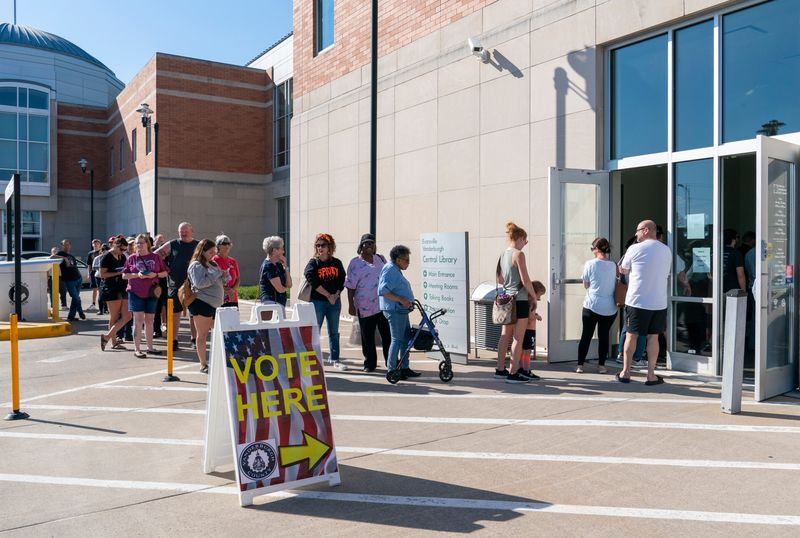
The core fact for voters who want same-day results — and election administrators — is the popularity of early in-person voting.
In the 2024 presidential election year in Vanderburgh County, 38,886 voters cast their ballots early and in-person. Of all the ways to vote — including election day voting, mailed absentee ballot voting, overseas and travel board voting — more people opted for early in-person voting than the rest of them combined. It was 52% of total ballots cast.
But that also spelled problems for the teams of workers charged with tallying all the votes and issuing election results.
The problem wasn’t a shortage of scanners to process the paper ballots that are a part of the state-mandated “voter-verified paper audit trail” technology Vanderburgh County has been using since 2020. The county has two of the scanners.
For voters who cast their ballots on election day, Voter Verifiable Paper Audit Trail means using ballot marking devices that generate grocery store receipt-sized slips they can double-check for accuracy and change if necessary, before dropping into an optical scan device to be cast and tallied.
Those votes — there were 29,561 of them in Vanderburgh County in 2024, the second-largest category — were tabulated not long after the polls closed at 6 p.m. on Election Day.
But during early in-person voting, a voter seals a paper ballot produced by a marking device in an envelope. They then drop it into a box.
In 2024, those early vote ballots couldn’t be handed off to workers to be fed into scanners for tabulation until 6 a.m. on election day.
In this year’s election, changes to state law will allow vote-counters to begin that process up to three days before the election. Thomas has said she will likely need all three days, given that Vanderburgh is one of the state’s largest counties.
Here’s the biggest problem for vote-counters
But while the three days do help, here’s what the clerks call their biggest problem:
Early voters may not cast their ballot cards on tabulators. It’s the requirement for voters to place their ballots in security envelopes that are attested by bi-partisan board members staffing early voting locations that is the problem.
Doing away with the requirement for envelopes for early voting is the state clerks’ overarching goal.
The clerks association says local elections officials should be allowed to place optical ballot scanners atop ballot boxes for early in-person voting. Making that single change, they say, would mean voters could insert the early vote ballots into scanners in real time and those could be tabulated quickly on election night.
“If we could get rid of those envelopes and be able to go ahead and put their ballot into our counter, where it’s not tabulating, that would help,” Thomas said in December. “It doesn’t start tabulating until we program it to tabulate. We just have to get the (Indiana Election Division) to recognize that we’re not counting yet, we’re just entering.”
House Bill 1359 “specifies a process by which certain counties may scan voted optical scan ballot cards during the early voting period and on election day without using secrecy envelopes,” according to its summary on the Indiana General Assembly’s site.
There’s been too much poll worker error under the current system, Thomas and other clerks say.
Indiana election law requires that early voting ballots be initialed by two poll clerks, Republican and Democratic. The envelopes have to be printed and signed by the workers and then signed and dated by the voter.
But Posey County Clerk Kay Kilgore has pointed out that the poll clerks are typically elderly retirees who — pressured by the need to move fast and to go through the process hundreds or thousands of times in a day — make mistakes.
Errors cost voters the right to have their ballots counted, something the clerks say should never happen.
In 2022 in Vanderburgh County, early ballots cast by 159 voters had to be invalidated because of poll worker error.
The clerks have other complaints about the envelopes. They cost money. Using them is more time consuming because by state law those early ballots must then be stored at the Election Office, sorted by precinct daily.
Looking ahead to 2028
It’s the 2028 presidential election that may come with serious problems if the clerks association’s desired language on scanning doesn’t make it into law, Thomas says.
Midterm elections such as will be held this year do not attract nearly as many voters as presidential election years.
In 2022, the most recent midterm election, 47,815 voters cast ballots in Vanderburgh County. It was slightly more than 37% of eligible voters. In presidential election year 2024, 74,605 people voted in Vanderburgh County. It was just short of 56% of eligible voters.
There’s still time to enshrine scanning of early voting ballots into law before the 2028 election, but the clerks have an opportunity this week with plenty of work done to advance legislation as far as it has gone.
Thomas doesn’t want to think about what 2028 might be like.
“For us, early voting in a midterm (election) isn’t going to be like early voting in a presidential (election year),” she said.
This article originally appeared on Evansville Courier & Press: Clerk says push for faster vote counting in Vanderburgh is hanging by a thread
Reporting by Thomas B. Langhorne, Evansville Courier & Press / Evansville Courier & Press
USA TODAY Network via Reuters Connect