It’s been a mixed bag for sea turtle nesting this summer as some beaches are seeing high numbers of nests while some nests on other beaches have fallen into the sea.
Many Southwest Florida beaches are seeing record numbers of nests, but some have been lost to the sea and some to predators. And this comes at a time when researchers are concerned about hatch rates.

Sea turtles flock to Florida shorelines during the summer and early fall to breed, feed, dig nests and deposit the next generation onto local beaches.
And this year is shaping up to be a record one for some beaches.
Kelly Sloan, sea turtle coordinator of the Sanibel-Captiva Conservation Foundation, or SCCF, said Sanibel beaches are having a record year for overall nest numbers.
“It’s going great as far as nest counts go,” Sloan said. “We’re having a record. “It’s peak hatching season, and they’re hatching every day right now. And it will slow in September and then into October.”
Coyotes, other threats to sea turtles still concerns for researchers
Sanibel is the largest beach island in Southwest Florida, and the community is known for preserving native plants and trees and only allowing low-key development.
The immense green there is beautiful, and it’s part of what draws visitors to the island each year.
But the vegetation also allows predators like the coyote set to roam along the beaches and wait for an opportune time to dig up and eat dozens of sea turtle eggs.
“Coyotes are having an impact,” Sloan said.
But many of the lost nests in Southwest Florida this year are being attributed to erosion.
“After they renourish the beach, we generally see them nesting close to the water,” Sloan said. “And the elevation is higher, and that a steep slope. So, they lay closer to the water (and can be lost to erosion) and we have seen that on Captiva.”
The sea turtle monitoring program on Sanibel is the oldest in the nation and started in 1950.
Another concern for researchers like Sloan is the fact that hatch rates have been lower in recent years. Hatch rates compare the number of eggs laid to the number of hatchlings that emerged from the nest.
“We look at hatch rates and those have been down the past few years,” Sloan said. “Coyotes are a big threat, and some nests may get too hot and dry if they’re built on high lands.”
Ancient giants: Sea turtle nesting season lasts through Halloween
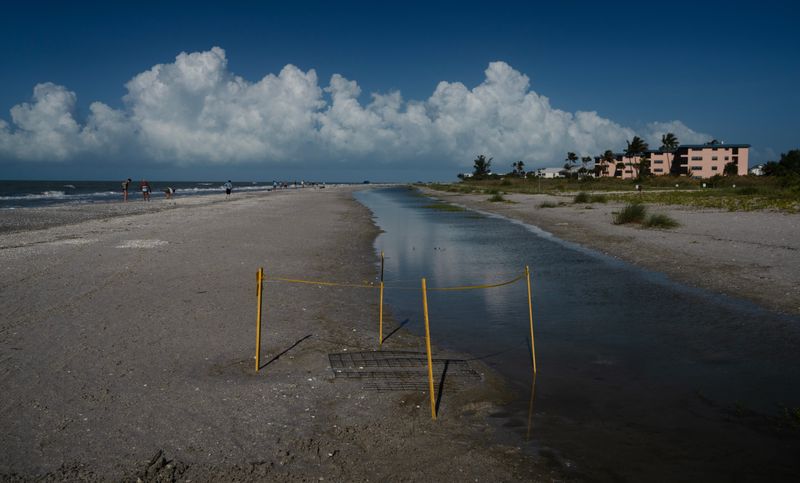
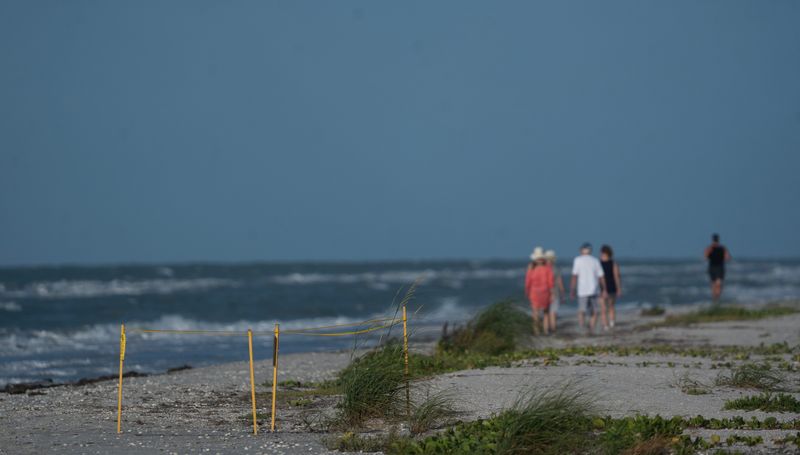
Sea turtle nesting season runs from May 1 through Oct. 31, and hundreds of females will lumber onto local beaches, dig giant holes and deposit thousands of eggs into the sandy shoreline along the Gulf.
Compared to their land cousins, sea turtles are enormous, some (like the leatherback) reaching the size of a small car.
They first emerged around 110 million years ago, according to the Florida Fish and Wildlife Conservation Commission, or FWC, the state agency charged with protected sea turtles and other wildlife.
FWC describes the loggerhead as having a log-like appearance, hence the name.”Its shell, ruddy brown on top and creamy yellow underneath, is very broad near the head and tapers toward the rear,” and FWC website reads.
Loggerheads are the primary nesting sea turtles in Southwest Florida, although the gigantic leatherback and smaller green sea turtles will occassionally nest here.
Loggerheads are found in subtropical oceans across the planet, and hundreds come here each summer to produce the next generation.
Collier seeing high numbers of sea turtle nests this season
Parts of Collier County, like the ever-popular Keewaydin Island) are having good years, showing upward ticks from last year’s nesting numbers.
Mary Toro, Collier County’s sea turtle protection team environmental supervisor, said beaches there have lots of sea turtle nests.
“Several beaches are doing better than last year like Naples, Park Shore, and Marco but Vanderbilt and Barefoot are a little down from last year,” Toro said.
The strong westerly winds had an impact on some Collier beaches as well.
“Collier did lose some nests to the erosion we experienced with the west winds,” Toro said. “The City of Naples beach was the hardest hit with 50 nests lost and 160 inundated. Hopefully, the west wind event was all we will see for the rest of this season.”
Sloan said there are positive sides to recent sea turtle population trends.
“For greens, in my career, the Florida population has really skyrocketed and that’s really encouraging,” Sloan said. “They were downlisted from endangered to threatened and loggerhead is increasing here and stable in other parts of Florida.”
Loggerhead facts:
-Incubation lasts for 49 to 58 days, and the hatchlings dart for the ocean once they break through their leathery shells.
-They grow to several hundred pounds and nearly 4 feet in length.
-Adult males have longer tails than females.
-False crawls are when females emerge from the water but don’t lay eggs.
-Loggerheads turtles are considered threatened by the U.S. Fish and Wildlife Service under the Endangered Species Act (1973).
-The top threat to loggerheads is getting entangled in shrimp and fishing nets.
-Continued development of nesting beaches is also a threat.
Source: Florida Fish and Wildlife Conservation Commission
Chad Gillis is an environment reporter and can be reached by email at cgillis@news-press.co
Please support local community journalism and stay informed about Southwest Florida news by subscribing to The News-Press and Naples Daily News; download the free News-Press or Naples Daily News app, and sign up for daily briefing email newsletter, food & dining and growth & development newsletters here and here.
This article originally appeared on Fort Myers News-Press: Wile E. Coyote? Sanibel sets sea turtle nest record, despite predation
Reporting by Chad Gillis, Fort Myers News-Press & Naples Daily News / Fort Myers News-Press
USA TODAY Network via Reuters Connect
By Chad Gillis, Fort Myers News-Press & Naples Daily News | USA TODAY Network