This fall, students in Santa Rosa County schools will learn about Native Americans, their culture, contributions and impact, using lessons that members of the Lower Muscogee tribe helped developed.
The school district’s Social Studies Department collaborated with the Santa Rosa Band of the Lower Muscogee Chief Sky Horse (Chief Dan Helms) and other community members to create a Native American Studies curriculum.

The homegrown curriculum — the first of its kind in Florida — took 1½ years to create and incorporates everything from Muscogee elders sharing legends and stories to simulated 3-D environments and even farming, said Amy Parker, Santa Rosa County District Schools Social Studies, World Languages and ESOL coordinator.
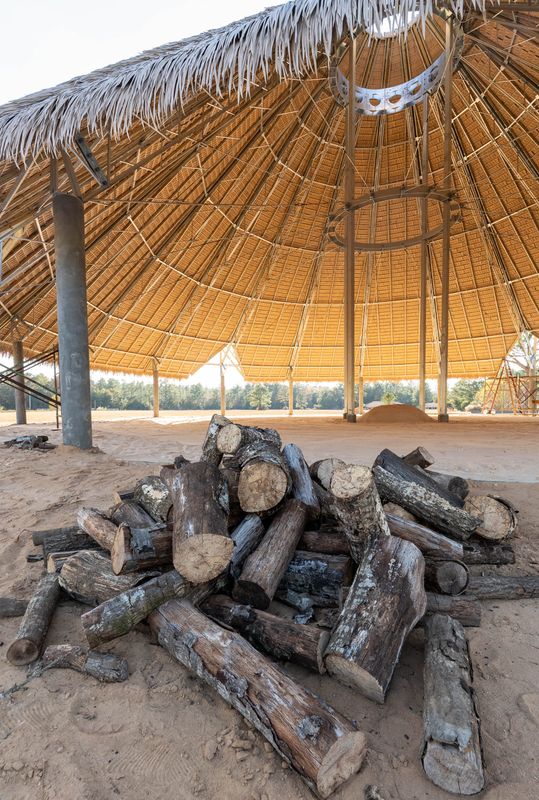
Using the curriculum and Virtual Reality goggles, Santa Rosa students can walk around the Lower Muscogee 96-acre tribal grounds, visit the Round House and even pick up and look closely at the tribe’s artifacts — without ever leaving their classrooms.
And students can actually plant and grow the three-sister crops — corn, beans and squash — while learning about planting seasons, crop rotation, weather patterns, storm forecasting and more.
Parker said the curriculum was the result of a sixth-grade field trip last year to the Lower Muscogee tribal lands and museum in Milton.
“When we arrived the students were really disappointed there weren’t teepees everywhere. They had been through Florida History already in elementary school. But more than that, they had this image in their head of what an indigenous person should look like,” Parker said. “And it was kind of this stereotype that was popular in the spaghetti westerns. We immediately saw a need for students to understand the foundations of our communities.”
The students are not alone. Parker said most residents don’t realize the tremendous impact this area’s first inhabitants have on present day. She cited the common adage, “God willing if the creeks don’t rise,” or the term “bucks” when referring to money.
“For my whole life, I thought that meant if the creeks don’t flood. But in reality, it dates back to a letter about a man going through Creek (Indian) territory and saying if the Creeks don’t rise up and fight him. If he doesn’t encounter Creek resistance,” Parker explained. “Another interesting thing, when you say, ‘How much did you pay for your purse? Oh, it was 20 bucks.’ That dates back to the Panton Leslie and Company, right here in Pensacola, when they were literally trading buck skins for goods with native Americans.”
The digital curriculum will also include breakdowns of Pre-European Contact, European Colonialism and American Founding, Pre-Removal, Post-Removal, Connections and Thought Lines, and Myths and Misconceptions.
Along with input from the Muscogee tribe, Matt Santillo with the University of West Florida Historic Trust, UWF Honors College students, historian Farris Powell, and Santa Rosa teachers Elizabeth Cunningham, Justin King, Jackie Sines, Piper Singletary and Theresa Yankovoy contributed to the finished curriculum.
Sixth-graders in Avalon Middle School’s gifted program also created the 3-D Minecraft Educational simulated Lower Muscogee village where kindergartners and first-graders can use the VR goggles.
“It was indeed a community effort,” Parker said of the curriculum, which uses storytelling and legends voiced by Lower Muscogee members and can be incorporated into history, science, English Language Arts and other subjects.
Helms is pleased with the project’s outcome and wanted to ensure that Native Americans were humanized in the curriculum, rather than how they’ve been portrayed in history books, films, television shows and other media.
“We gave (the school district) the resources for the true Native American history in the Southeastern United States. It is not specifically just for Santa Rosa County or Northwest Florida. This is for the Southeastern United States, which has been greatly underrepresented in the educational teachings and in the overall awareness of Native Americans in this country,” Helms said, noting Native Indians in the western states have received more attention.
“The Native Americans who came out of the woodland culture of the Southeastern United States have not been recognized as they should have been.”
While developing the curriculum, Helms said he and tribal members visited Santa Rosa schools to share their tribe’s history.
“It has been phenomenally received by the students. One of things they were particularly enthralled with was the Muscogee language. So we taught some of those words to the students, and they were very quick learners to pick up the language, more so than adults. We heard our language up and down the halls of the schools we would go into,” he said.
Over the past 200 years, Helms said education has been used against Native Americans as a way to erase the culture, traditions and contributions from U.S. history.
“That resulted out of (President) Andrew Jackson’s Indian Removal Act of 1830, which made it illegal to be an Indian east of the Mississippi River,” Helms said. “So the educational system was used to erase the culture. You can kill everybody, but you don’t get rid of the culture until you erase it and make it invisible. So invisibility has become the discrimination that been used against Native Americans. We thought what better way to rectify the use of education as an erasure, why not better use education to revitalize the culture in the school system.”
Helms wants to share the curriculum with other school districts and schools across Florida. The experience also forced Helms to do some self-reflection, after an Avalon Middle sixth-grader asked him what was the most important thing about the Native American culture.
“My answer was the biggest thing that has impacted me is the realization of our place as a part of the natural world. And that everything and everyone — the two-legged, four-legged, winged, finned and the things that crawl upon the earth — are all related and all part of the natural world. None being more important than the other,” he said.
Parker also thanked SRCDS Superintendent Karen Barber for supporting the curriculum.
“All of the work that we do is because Dr. Barber’s example of continually being learners and finding ways to make learning relevant for students,” Parker said. “She is so instrumental in giving us the encouragement to take chances like this and to prioritize the stories that are worthy of being told. None of this work happens without her.”
Mary Lett is the Youth Development Reporter for the Pensacola News Journal. She can be reached at mmabins@gannett.com.
This article originally appeared on Pensacola News Journal: Santa Rosa’s new Native American curriculum is first in Florida
Reporting by Mary Lett, Pensacola News Journal / Pensacola News Journal
USA TODAY Network via Reuters Connect
By Mary Lett, Pensacola News Journal | USA TODAY Network