Do you talk to your friends differently than to business associates?
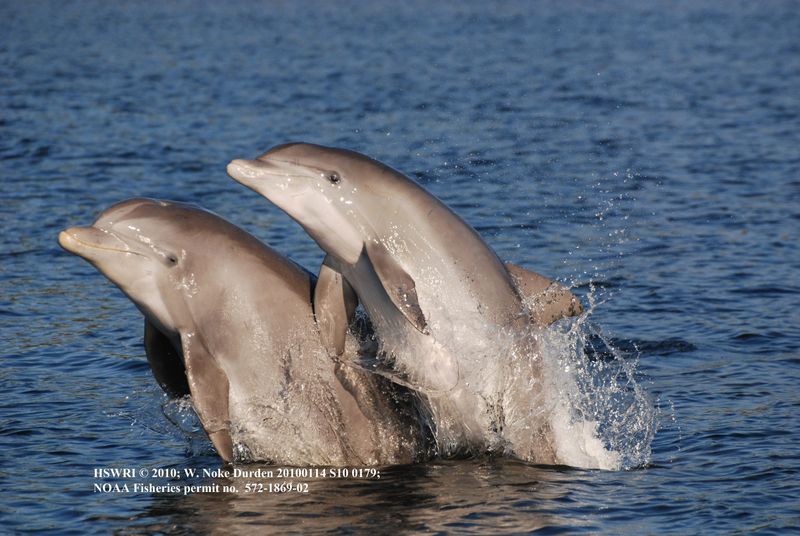
Well, so do dolphins, according to a recent study of how dolphins use sound to hunt.

What FAU biologists did
For two months, Florida Atlantic University scientists used an autonomous marine robot equipped with an acoustic recorder to listen for sounds in the waters off Florida. They captured a rare listen into the acoustic lives of dolphins along Florida’s Atlantic coast.
Their study, published in the journal PeerJ, identified distinct patterns in dolphin whistles associated with social behavior and echolocation clicks that help them navigate and find prey.
“What we’re seeing is a fascinating separation between the acoustic behaviors dolphins use for social life and those they use for finding food,” said study co-author Greg O’Corry-Crowe, a research professor at FAU Harbor Branch who’s also a National Geographic Explorer.
Also, the researchers found mismatches between fish and dolphin activity, suggesting that fish may quiet down when they detect dolphins.
“The ocean is filled with sounds that humans rarely hear, and autonomous platforms give us a way to enter that hidden acoustic world,” Laurent Chérubin, senior author and a research professor at FAU Harbor Branch, said in a statement. “A Wave Glider can travel through the ocean and listen continuously, allowing us to detect patterns that would be almost impossible to capture with occasional boat surveys. It is like giving researchers an ear that can remain in the ocean for weeks at a time, revealing a world of animal behavior that is otherwise largely unknown to us.”
Dolphins whistle and click away to find their prey
Dolphins’ “rapid-fire clicks” are like sonar, helping them navigate and find prey.
Dolphins whistled more in nearshore areas, suggesting hotspots for social activity. Meanwhile, dolphin echolocation clicks were more prevalent where sound-producing fish were abundant.
“To my knowledge, there is very little that has been done on this front in the IRL (Indian River Lagoon),” Wendy Noke Durden, senior research scientist with Hubbs-SeaWorld Research Institute, said via email, citing a lack of funding for such studies.
But she said learning more about the dolphin’s sonic-driven underwater world is important because so much of their lives unfold through sound. “Future studies could improve our knowledge of how dolphins respond to anthropogenic and environmental noise and how the ecosystem around them may be changing,” she added.
“These studies could be critically important for a dolphin population that is thought to be immunocompromised, nutritionally challenged, and has historically fed on soniferous fish.”
Contact Waymer at 321-242-3663 or jwaymer@floridatoday.com. Follow him on X/Twitter: @jwayenviro
This article originally appeared on Florida Today: Report: Dolphins “talk” differently at work than at play
Reporting by Jim Waymer, Florida Today / Florida Today
USA TODAY Network via Reuters Connect
By Jim Waymer, Florida Today | USA TODAY Network