Pensacola’s rewritten land development code promises to allow for more triplex and quadplex development as well as more “backyard apartments” or accessory dwelling units (ADUs) as part of an effort to make housing more affordable.
The Pensacola City Council is scheduled to take the first of two required votes to approve a rewrite of the city’s land development code on Aug. 14. The rewrite was one of the first things Pensacola Mayor D.C. Reeves said his administration would do. The process has played out for three years and is now coming to City Council for approval just days ahead of the mayoral election.

The city hired Orlando-based Inspire Placemaking Collective Inc. in 2023 to go through every rule of the city’s land development code and get public feedback at multiple public workshops and planning board meetings.
In July, the Pensacola Planning Board unanimously recommended approving the new code.
The land development code is the rules for what can and cannot be built in the city, and it is one of the biggest policy levers the city has to directly influence the cost of housing in the city.
Much of the rewrite is focused on making the code easier to read, clearing up ambiguity and allowing both city officials and developers to understand what the rules are when it comes to building in the city.
The code allows ADUs in residential areas of the city and sets the standards those additional buildings have to meet to be allowed.
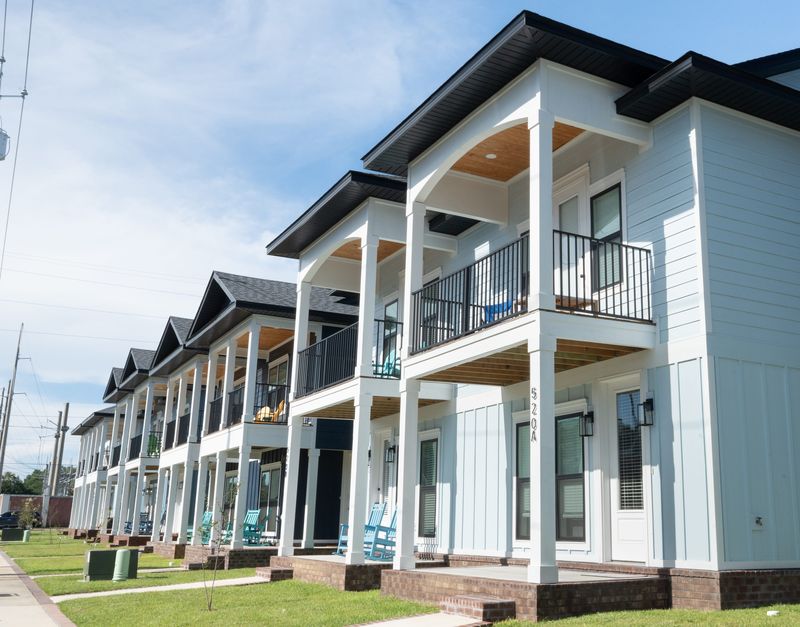
Beyond ADUs, it is allowing triplexes and four-unit townhomes in some areas of the city. Under the current code, anything bigger than a duplex is considered multi-family housing and can only be built in zoning areas that allow for apartments.
The proposed new code will allow townhomes of up to four units, or quadruplexes, in medium residential areas of the city.
City planning officials and representatives with Inspire Placemaking Collective gave a media briefing on the changes at City Hall on Aug. 10, and they noted density caps were not being increased and the caps now listed reflect the same cap that was always in the city’s future land use categories.
Low-density residential areas of the city, where only single-family home developments are allowed, remain unchanged in terms of density.
For most of the city, those land use caps are above what is possible because of minimum lot size requirements for any single building. For example, in many single-family zoning areas, the land use cap is 5 units per acre, but for many areas the practical limit ranges from 2.2 to 4.8 units per acre.
However, by adding triplexes and quadruplexes to be allowed uses in medium-density areas, there is an on-the-ground increase in what’s possible to be built.
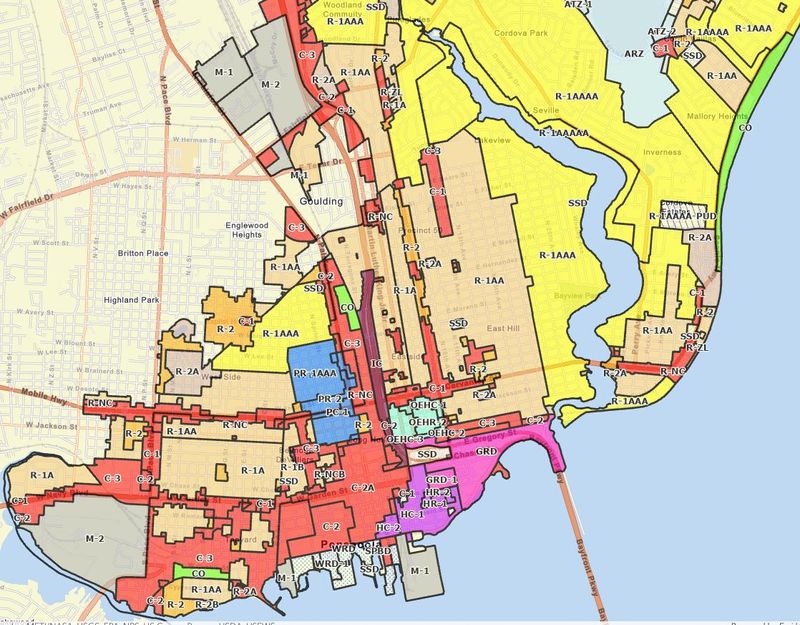
The biggest single increase is the medium residential area formerly called R-1AA, the renamed zone RM-1. Those areas will go from a practical limit of 11.6 units per acre to 17.4 units per acre thanks to the addition of triplex and quadruplex uses.
In the old RM-1, duplexes had to be on lots with at least 7,500 square feet, which gives you a unit-per-acre size of 11.6. Under the new code, triplexes or quadplexes must be on a lot of at least 10,000 square feet, which comes out to 17.4 units per acre.
Rules for single-family houses in those areas remain unchanged, with the limit at 8.7 units per acre, as they require a lot size of a minimum of 5,000 square feet.
Larger sections of RM-1-zoned areas include much of the non-commercial areas of East Hill between 17th Avenue and North Hayes Street, a large part of the East Pensacola Heights area, a corridor on the westside along West Jackson Street between A and N streets, as well as small sections of Sanders Beach and the Tanyard area.
There are other medium-density residential areas known as RM-2, formerly R-1A, that will also now allow triplex and quadruplex buildings, but the minimum lot rules in those areas already allowed for 17.4 units per acre for duplexes, and under the updated code it’s increased to an even 18 units per acre with a minimum lot size of 9,700 square feet for a quadruplex.
In an interview last month with the News Journal, Reeves said the main purpose of the code was to make the rules easier to understand for everyone, but it will also “strategically thicken” neighborhoods.
“To me, I think it’s a very surgical, nuanced ability to thicken our neighborhoods,” Reeves said. “It is not drastic. It’s not stark. It’s not going from, again, a single-family to a 10-unit apartment complex. That isn’t what’s happening.”
Reeves said for people who believe young people should be able to afford to come back to the city and start a career and a family, then more multi-family developments will be needed.
He added that before the city passed its first zoning code in 1949, triplexes and townhomes were common and he pointed to the historic buildings in North Hill that were once boarding houses and are now protected historic architecture.
“For generations, we’ve understood the value that some people need a one-bedroom, and some people can afford a four-bedroom,” Reeves said. “So this is not new. It might feel new because we built so many ranch-style houses for so long, but this is not a new concept.”
Jim Little is the City Government Accountability Reporter for the Pensacola News Journal. If you have a news tip, please send it to jwlittle@pnj.com.
This article originally appeared on Pensacola News Journal: Pensacola’s new zoning codes will increase stock of affordable homes
Reporting by Jim Little, Pensacola News Journal / Pensacola News Journal
USA TODAY Network via Reuters Connect
By Jim Little, Pensacola News Journal | USA TODAY Network