The Coachella Valley’s oldest nonprofit performing arts organization, PS Concerts, recently wrapped its 68th season. And what a season it was! In the space of just six weeks, appreciative audiences experienced four incomparable performances at the Richards Center for the Arts in Palm Springs.
It seems as though each of the PS Concerts’ seasons has certain interesting features. This year, one of them was the huge variation in the size of the ensembles: from a single performer — the legendary pianist Misha Dichter — to the 25 musicians who comprise the Southern California Brass Consortium. Another was the way the season went from Dichter’s mature mastery and ended with the exuberance of USC Thornton School of Music’s youthful players, who just might be the stars of tomorrow.

The series began with the long-awaited “return of the master,” Dichter, who first played here in 1990 near the peak of his brilliant career and just before that career was interrupted by a debilitating condition of the fingers called Dupuytren’s contracture that sidelined him for nearly 20 years. Thanks to a series of skilled surgeries, he made a triumphant return to the concert stage at Carnegie Hall in 2018 and continues stronger — and wiser — than ever at age 80.
The works on Dichter’s ambitious program progressed chronologically, starting with the only polonaise that Ludwig van Beethoven ever wrote, followed by Johannes Brahms’ Sonata No. 3 in f minor, then four mazurkas and a polonaise by Frederic Chopin and concluding with Sergei Prokofiev’s Sonata No. 7, Opus 83. His playing of these technically demanding works was stirring, mesmerizing, exhilarating, melodious and masterful, and needless to say, loud, prolonged applause and a standing ovation acknowledged the master’s return.
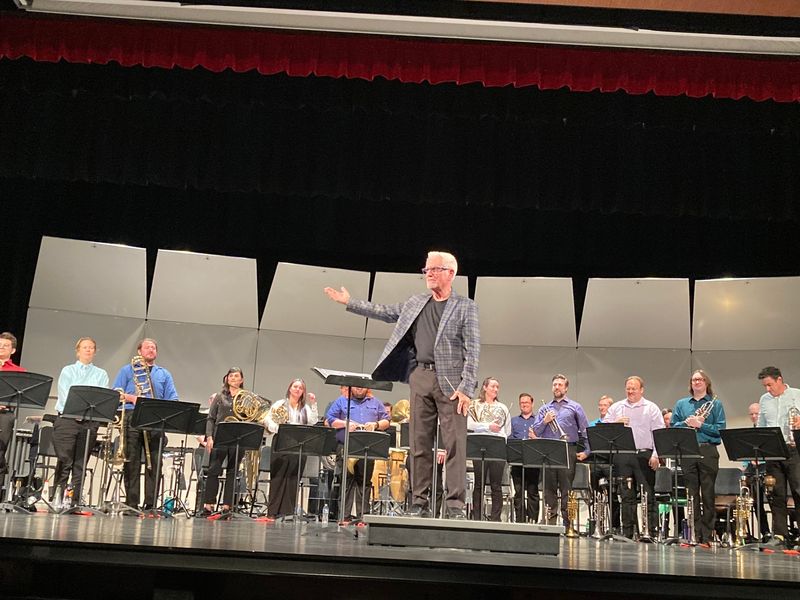
The season’s second concert featured the Southern California Brass Consortium, a group unlike any previously heard in a PS Concerts series. We’re used to thinking of large numbers of brass as something in a marching band, not on a concert stage. But there they were, 20 brass players, four percussionists and a harpist, and they’ve been playing together since 2013.
Most of the musicians played several different instruments. The brass instruments included various trumpets, the flugelhorn, French horn, trombone, tuba and euphonium. Among the rich variety of percussion instruments were several different drums, cymbals, tambourines, a gong and a xylophone. And, of course, the melodious harp that provided such a contrast with all the others.
Led by Kurt Curtis, the Consortium played 12 vibrant pieces, some from widely known composers such as Claude Debussy, Aram Khachaturian, Igor Stravinsky, Gustav Holst and John Williams — their works specially arranged for the Brass Consortium — as well as from contemporary composers whose works were actually commissioned by the consortium.
They took the audience on a whirlwind tour of the world, with stops in Asia (thanks to Debussy), the Arctic (Robert Buckley), Mount Everest (Rossano Galante), Africa (Robert W. Smith), Denmark (Frederick Magle), Armenia (Katchaturian), Spain (Ernesto Lecuona), Russia and France (Stravinsky), Great Britain (Holst), Ireland (Peter Graham) and Mexico (Carmen Dragon). No boarding pass needed.
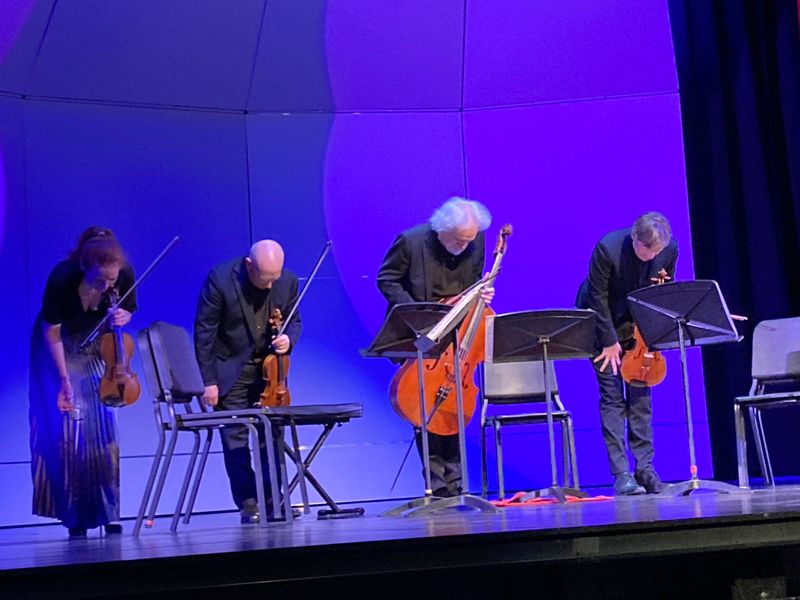
Resonantly performing the season’s third concert was another ensemble associated with Southern California: the New Hollywood String Quartet. When they came together in 2001, they were honoring the memory of the original Hollywood Quartet, America’s first string quartet founded in the late 1930s and heard on LPs and movie soundtracks through the 1950s.
Now together more than 25 years, the four are highly attuned to each other’s playing, which is harmonious and achingly beautiful. Violinist Rafael Rishik, cellist Andrew Shulman and violist Robert Brophy took their lead from first violinist Tereza Stanislav in a satisfying program that began with “La oración del torero” by Joaquín Turina.
Next came a string quartet by the prolific Franz Joseph Haydn, the “father of the string quartet,” written when Haydn was 67 and in his prime. They concluded with String Quartet No. 1, Opus 11 by Pyotr Ilich Tchaikovsky, which has an unusual 9/8 beat in the first movement and whose “jewel,” explained Brophy, is the lyrical, slow third movement.
PS Concerts’ First Vice President, Ken LaConde, said that in his view, the New Hollywood Quartet “is the finest string quartet we’ve ever had.” And judging by their enthusiastic clapping and standing ovation, the audience must have been in full agreement.
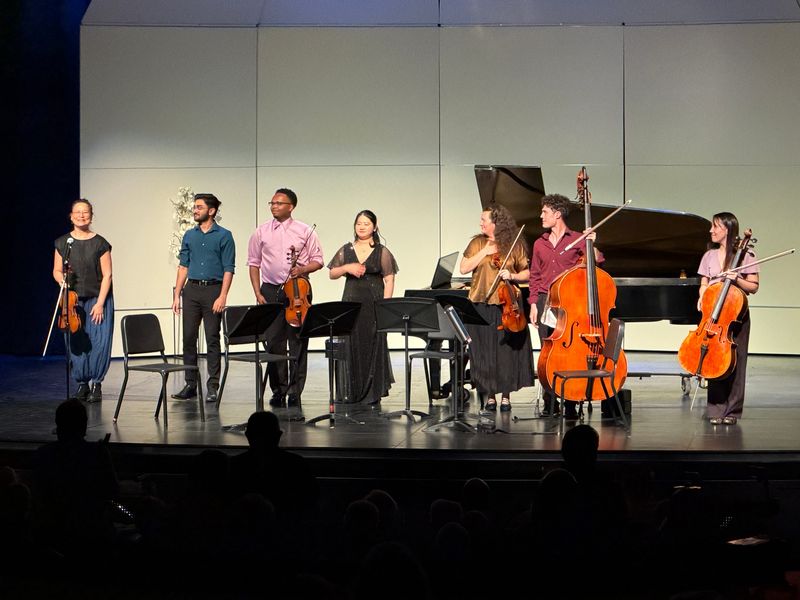
The fourth and final concert featured the USC Thornton Virtuosi. This “musical generation of tomorrow,” as they are called, was led by violinist Lina Bahn, a doctoral candidate at the Thornton School of Music at USC and current head of the school’s strings department. She has performed at Carnegie Hall, Alice Tully Hall, the Library of Congress, Ravinia and many other venues.
It was evident from the very first notes that the seven Virtuosi performers were chosen for the group for their finely tuned experience and expertise on their instruments. They performed selections by top classical composers such as Rachmaninoff, Khachaturian, Brahms and Felix Mendelssohn, as well as a few chosen pieces by lesser-known modernists.
Bahn showed her technical brilliance in a quartet by Anton Arensky, joined by Solomon Leonard, Isabelle Fromme, and Logan Nelson. After the break, the audience was treated to a trio by Brahms, in which Korean pianist Chloe Gwak was a standout performer, supported by clarinetist Ashrey Shah and cellist Fromme.
Nelson surprised the audience with a solo performance on the double bass in a piece called Motivy by Emil Tabakov, a living composer. He had everyone hopping. And finally,it was Mendelssohn’s Sextet in D Major that was chosen by the group to end the concert. In spectacular “allegro vivace” style, all seven members sent by the Thornton School at USC joined to end Palm Springs Concerts’ 2026 season with youthful flair.
PS Concerts was supported this season by four generous underwriters: the City of Palm Springs, the Champions Volunteer Foundation, the Palm Springs Rotary Club Foundation and the Woodard Family Foundation.
Nearly 100 individual donors also contributed. In the top Producers category was Kurt Glowienke and Impresarios were Marjorie Conley Aikens, Christopher Seidel and Michael Mulcahy and Robert Heeman and Dennis Ramberg.
In-kind contributors provided pre-concert meals for the performers: Gigi’s Restaurant, Manhattan in the Desert and Carousel Bakery and Café, plus Palm Springs High School Rotary Interacts.
To learn more, visit psconcerts.org.
Anita Roark is a writer/editor and public relations professional who came to the Coachella Valley in 2005. She’s been writing for Desert Scene since 2014. Here in the valley, she has coordinated PR at American Cancer Society and Gilda’s Club and been a docent at the Palm Springs Art Museum. While in Los Angeles, she was with Cedars-Sinai Medical Center, UCLA and the March of Dimes, and in San Diego, PR director at the Salk Institute.
Jim Berry serves on the PS Concerts executive committee.
This article originally appeared on Palm Springs Desert Sun: PS Concerts 2026 season brings six weeks of musical magic
Reporting by Anita Roark & Jim Berry, Special to The Desert Sun / Palm Springs Desert Sun
USA TODAY Network via Reuters Connect