

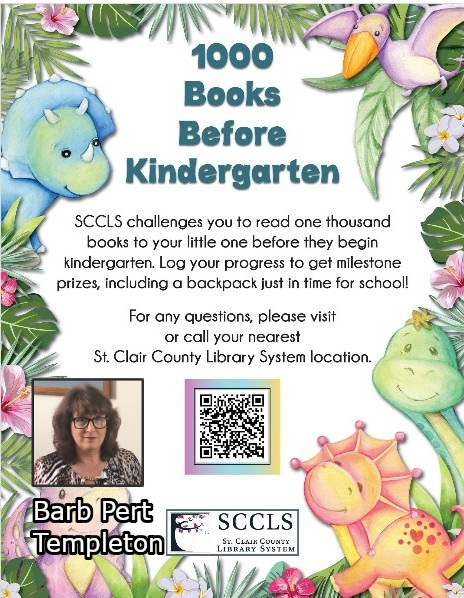
1,000 Books Before Kindergarten has caregivers reading to tots daily
By Barb Pert Templeton

Introducing young children to reading, even propping a book up in your lap along side an infant, and reading aloud, is a great way to encourage them to embrace books as a comfortable pastime.
“When a child learns from their adult that reading is a normal and rewarding way to spend free time, they are often more excited to learn to do it themselves,” Cara O’Brien, senior librarian for youth services at the St. Clair County Library System said.

Keeping that in mind the St. Clair County Library System was pleased to debut the ‘1,000 Books Before Kindergarten’ Program during the month of March, which is National Reading Month. As this first month of the program is coming to a close the library system is pleased to report they’ve had 10,000 books logged for the program in just 26 days.
“Children who are read to before schooling begins have a substantial leg up in learning to read themselves,” O’Brien said, adding that the special new program will stay in place year-round at the library system.
Blue Water Healthy Living caught up with O’Brien, via email, to find out more about the program.
Blue Water Healthy Living: What is the ‘1,000 books before Kindergarten’ program’s purpose?
Cara O’Brien, senior librarian for youth services: The purpose of the program is to encourage caregivers to read to their little ones as part of a daily routine before they reach the age of kindergarten. There are several reasons why they get an advantage from this: there is a much larger range of vocabulary and a deeper level of syntactic complexity that they are exposed to in literature (even picture books) versus everyday speech, and familiarity with these words and structures is necessary for comprehension later on. It also provides a great opportunity for dedicated bonding time, and in our world of digital diversions, we could always use more of that.
BWHL: How does the program work? Who’s eligible? O’Brien: Patrons can participate through an app/website called Beanstack, which is the same app we use for summer reading. If you still have your account from summer reading, you can sign back into that, otherwise you will have to create a Beanstack account. (If you have trouble doing so or don’t have access to the internet, please call or visit your nearest library branch; we can sign you up as an offline user.) While anyone who has logged into our Beanstack site could technically click to join the 1000 Books Before Kindergarten challenge, the program is intended for children around the age of kindergarten and younger, alongside their parents/guardians/caregivers.
BWHL: Does the library offer prizes or incentives to log the reading record with their system?

The St. Clair County Library System will host the new 1,000 Books Before Kindergarten year-round.
O’Brien: Once joined, patrons can log their reading in the app by number of books. Milestone prizes are available at registration as well as 100, 300, 500, 800, and 1.000 books logged, with the final prize being a children’s backpack just in time for the first day of kindergarten. More than one book can be logged per day, and repeating the same book is okay—repetition helps with retention, in fact. Beanstack is primarily how we will keep track of total books read, but the free tote bag at registration also comes with a cute paper logging sheet to visually track progress every five books. It’s great for putting on the fridge.
BWHL: Is keeping track of titles, authors or # of minutes of reading part of the process?
O’Brien: Keeping track of titles, authors, or number of minutes read is not necessary for this program. When logging in Beanstack, you can choose to log a book with its title and author specified—which makes it easy to log additional readings of that same book.
BWHL: What’s the ideal time frame for children/parents to begin taking part in this program?
O’Brien: It is never too early to begin reading to your child—exposing them to a greater range of vocabulary is never a bad thing, and a caregiver-child bonding routine of, say, reading nightly at bedtime is a healthy pattern to develop even as early as infancy. To read one book a night finishes the program in a little under three years, while kindergarten age tends to be around 5 years old…so it’s best to start early.
BWHL: Since this program began on March 1 to launch Reading Month is there also an end date for it or does it just continue on to the Summer Reading Program?
O’Brien: We decided to launched in March in celebration of March is Reading Month, but it is a year-round program that we will keep going for as many years as we can. It will continue to be open alongside the Summer Reading Program.
BWHL: Do local library branches see an uptick in patronage during March and/or once this program is introduced?
O’Brien: As this is our first year, we haven’t gotten enough data yet to know exactly how patronage has been affected. However, we can say that in just the first 26 days of the program’s launch, we’ve had nearly 10,000 books logged! Participating patrons are, on average, very close to logging one book per day each, which is a tremendous pace.
BWHL: What’s the period of time for a book to be checked out these days? How many books can a patron checkout at one time? Do the branches still collect fines for late returns – is that a set rate or does it vary by the item?
O’Brien: Books can be borrowed for up to four weeks, and up to fifty items can be checked out per library card. Longer “vacation loans” can also be used a couple times per year. While there is still a flat processing fee for very late items (around a month after its due date and later), we no longer charge daily or increasing fines for late returns.
