

By Jim Bloch

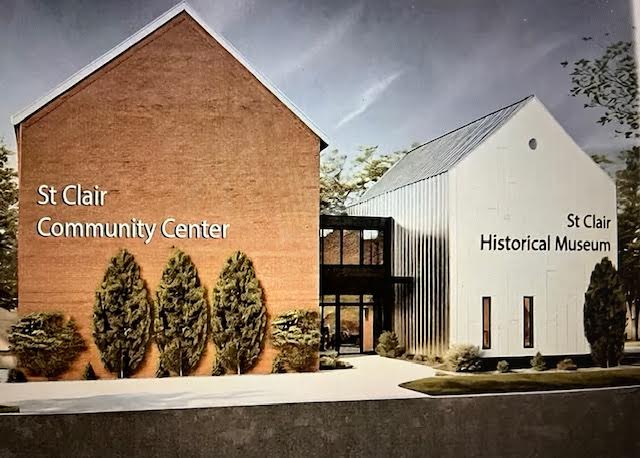
The city’s past lies at the heart of the St. Clair Historical Museum, but the future has taken on enhanced importance as the historical commission looks forward to a $1.1 million renovation.
Bob Freehan, chair of the historical commission, presented the museum’s 2025 annual report to the city council at its regular meeting Jan. 5.

“We do, probably, over and above what you think we do,” said Freehan, as heard on the CTV-Channel 6 recording of the meeting, posted on YouTube.
The goal of every museum is to promote the cities in which they’re located and to enhance the quality of life for residents and visitors.
“But we do things in a little bit of a different way,” said Freehan. “We really try to engage the community. We consider ourselves as a museum promoting the city of St. Clair and promoting tourism and promoting the quality of life and services of the people who live here. We’re not just a collection of old stuff.”
Volunteers provide museum tours and programs; improve displays; help research date plaques on homes in the city; and work to expand the museum’s collection of artifacts, photos and documents, which grew by 500 items in 2025, including a boat racing pennant from the old Oakland Hotel, which boasted a 465-foot riverside porch, about two-thirds the length of the Grand Hotel’s on Mackinac Island;.
Volunteers contributed about 2,800 hours of service at the museum.
In fiscal 2025, the museum featured five programs focusing on aspects of the city’s past, attended by 344 people: Art shows of the past, in June; “We’re in the Movies” and “The Art of Sam Crawford,” both in August; “Gliem’s Meat Market” in October and “The Plastics Industry” in November.
“A lot of small museums don’t do programs,” Freehan said. “We generate those programs ourselves.”
With the request of a $6 donation to attend the programs, they become fundraisers for the museum.
“We rely solely on donations,” Freehan said. “The city pays for the insurance and the exterior maintenance of the building and the utilities. But the internet, telephone, interior maintenance and anything we do to improve the museum, including the new build, is all donated money or grants.”
The museum had revenues of $23,482 and expenses of $18,065 in fiscal 2025.
Wayne State University paid for an intern to work at the museum for 100 hours in the summer and the board is hoping for another next summer.
Volunteers conducted three special family or groups tours of the museum, with a total of 32 visitors.
“We make ourselves available,” said Freehan. “A lot of museums don’t do that sort of thing.”
Eighty-two people participated in the museum’s annual bike parade, historical games and scavenger hunt, held in conjunction with the recreation department.
“That’s the most people they’ve ever had in the history of the bike parade,” said Freehan.
Three-hundred-seventy-two people visited the museum during its regular hours.
The museum digitized 300 obituaries and continued to build its collection of binders on local family histories, including those of freighter captains and chief engineers.
“That’s part of our mission – to help people do their family histories,” said Freehan.
In the museum expansion, there will be a dedicated research room.
“The big thing we have is launching this $1.1 million renovation of the museum,” said Freehan.
The bulk of the money comes from a single, anonymous donor, who specified a research room and an elevator. The elevator will cost $150,000 and the Moore family recently contributed $50,000 toward its installation. The museum is located on the upper floors of the former First Baptist Church, reachable only by stairs. The church was built in 1873 and registered as a Michigan Historic Site in 1991.
In September, the city council approved hiring InFuz Architects to design the expansion. The firm, owned by local resident, Vince Cataldo, laid out the renovation of the St. Clair Inn and the new Boardwalk Theatre at Riverview Plaza.
The renovation will increase the museum by 3,400 square feet and include an expanded, 350 square foot “salt room,” dedicated to an expanded history of Diamond Crystal Salt, the predecessor of Cargill among other amenities. The goal of the expansion is to transform the historical collections into an easily accessible destination museum.
The project will reenergize the museum, Freehan said.
Jim Bloch is a freelance writer based in St. Clair, Michigan. Contact him at bloch.jim@gmail.com.
