

By Jim Bloch

The number of sea lamprey, the so-called vampires of the Great Lakes, are on the rise. But the increase does not appear to be permanent.
The estimated populations of the non-native predator “are above targets in all five of the Great Lakes,” announced the Great Lakes Fishery Commission in a Dec. 17 press release.

The COVID-19 restrictions in 2020-2021 meant that field crews could not conduct their full, annual efforts to control the invasive species and now, three years later, their populations are spiking. That’s especially true in Lakes Michigan and Superior. The number of adult sea lampreys captured by investigators in 2024 was 8,619 more than the three-year pre-COVID average of 38,167, an increase of 22.5 percent.
The good news is that a return to typical levels of control suggests that the “numbers are now on their way back down,” the commission said.
Native to the Atlantic Ocean, the eel-like fish have been around for 340 million years without significant genetic changes.
They are parasites.
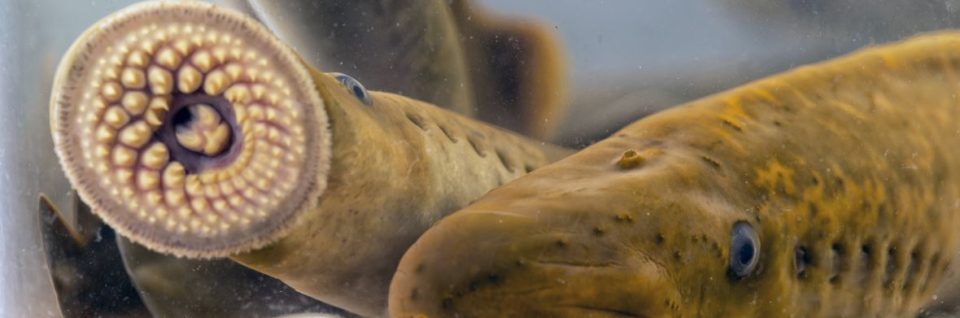
“Sea lampreys feed on the blood and body fluids of fish by attaching to them with a tooth-filled, suction cup mouth and file a hole through the fish’s scales and skin with a piston-like rasping tongue,” the commission said. “The average sea lamprey is capable of killing up to 40 pounds of fish during its parasitic stage. Before sea lamprey control, which began in 1958, the species killed far more fish than humans did, causing considerable economic and ecological damage.”
They swam into the Great Lakes via the Welland Canal which was constructed beginning in 1824 as a shipping route from Lake Ontario to Lake Erie, bypassing Niagara Falls. The fish turned up in Lake Erie in 1921, in lakes Michigan and Huron in 1936-1937 and Lake Superior in 1938,
Before their proliferation, US and Canadian fishermen harvested 15 million pounds of lake trout in the upper lakes. By the 1960s, the harvest dropped to 300,000 pounds per year due to the explosive growth of sea lamprey, the females of which can lay up to 100,000 eggs per year.
“Lampricides – pesticides selective to lampreys and the primary sea lamprey control tactic – are deployed to kill larval sea lampreys in the tributaries, while a combination of barriers and traps are used to prevent the upstream migration and reproduction of adult sea lampreys,” said the commission in one of its fact sheets.
Canada and the US created the commission in 1954 largely in response to the sea lamprey invasion. The commission began the control program in 1958 working with Fisheries and Oceans Canada and the US Fish and Wildlife Service. The commission called the sea lamprey control program one of the most successful efforts in history to control an invasive species
“After more than six decades of successful sea lamprey control, the reduced effort during the COVID-19 pandemic shows that if controls are ceased or relaxed for even a short period of time, sea lamprey populations will rebound, and the fishery will suffer,” said Jim McKane, the Commission’s vice-chair, in a statement.
Overall, the program has reduced populations of sea lamprey by 90 percent or more.
“The COVID-19 pandemic provided an unintentional, but valuable, lesson. Restricted control effort during 2020 and 2021 allowed millions of larval sea lampreys, that would have otherwise been removed, to survive and parasitize millions of pounds of valuable fish,” said Commission chair Ethan Baker, who is the mayor of Troy, Michigan. “Control effort in 2024 continued at pre-pandemic levels, but elevated and variable adult sea lamprey abundances should be expected over the next year or two before turning back downward.”
Jim Bloch is a freelance writer based in St. Clair, MI. Contact him at bloch.jim@gmail.com.
