

By Jim Bloch

“I’d never been to Beaver Island,” said printmaker Elizabeth Claire Rose.
That doesn’t make her unusual. Relatively few tourists have landed on the island even though it’s the largest in Lake Michigan.

Its remoteness helps keep people at bay. The island lies 32 miles north-northwest of Charlevoix, a two-and-a-half-hour ferry ride out of Round Lake or a 20-minute flight from the city’s compact airport. Year-round residents number just over 600.
Rose is one five artists to win two-week residencies on the island through the Seedkeepers’ inaugural artist-in-residence program. The Seedkeepers is a new group, headquartered on the island with a Traverse City mailing address, dedicated to conserving wild places and exploring their cultural significance.
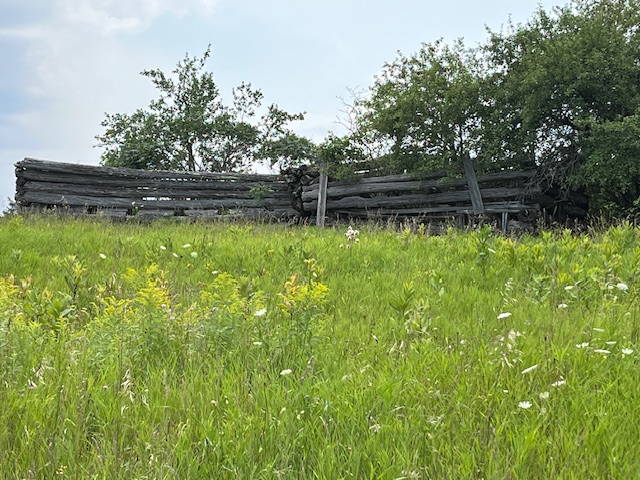
The Apple Blossom Farm.
Rose, based in Holland, Michigan, earned her Master of Fine Arts in Printmaking from the Tyler School of Art and Architecture at Temple University in Philadelphia, Pennsylvania. She majored in fine frt at the University of Montana, minoring in wilderness studies.
Love of islands
Rose has a lifelong fixation with islands.
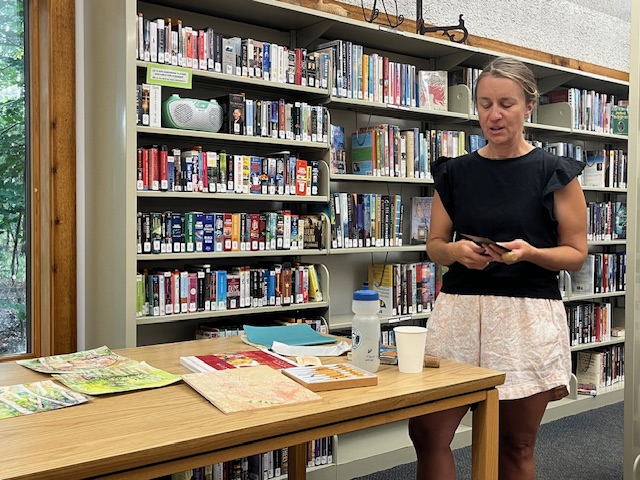
“Since I was a little kid, I’ve loved exploring islands,” said Rose, addressing a small gathering at the Beaver Island District Library, Aug. 7, her final night on the island.
Growing up in central Illinois, she and her family spent time on islands off Wisconsin – think Washington Island off the end of the Door peninsula and the Apostle Islands in Lake Superior. She spent one of her residencies on Isle Royale.
Islands often contain unique environmental qualities and Beaver is no exception.
“I’ve never seen a Lake Huron Tansy and they’re all over the beaches here,” said Rose. “I’ve seen a lot of Northern Leopard frogs and snakes.”
The tansy, with its clustered yellow flowerheads shaped like Ping-Pong balls sliced in half, dot the island’s open dunes. They’re classified as vulnerable in Michigan.
Seven kinds of toads and frogs live on the island as well as nine varieties of snakes, none of them venomous.
The residency
The Beaver Island residency provides the artist and a visitor – in Rose’s case, her husband – with ferry tickets and a tent at the edge of the woods on Apple Blossom Farm, “a 40-ace regenerative farm and native preserve leased by Seedkeepers,” according to the group’s website. And maybe a can of Off Deep Woods.
The farm includes a homestead that dates to the 1850s when the infamous Mormon King James Strang ruled the island, evicting the Irish, and creating his own paradise on earth, 1848-1856. The farm lies on the east side of Kings Highway, three miles south of the tiny port of St. James centered on Paradise Bay in the northeast corner of the island. The old house on the property contains a kitchen, shower and bathroom, all available to the artists-in-residence.
Rose and her husband rode their bicycles to the library, their only mode of transportation during their two-week stay besides walking.
You can cover a lot of ground on a bike, Rose said, but you’re close enough to your surroundings to stop and smell the wildflowers.
“I saw a loon chick at Barney’s Lake,” she said. The lake is one of seven inland lakes on the island.
Rose works in wood and copper plate, painstakingly carving or etching images that she’ll print back in her home studio. During her residency, she has returned to painting, capturing some of the island’s unique features in pen and watercolor, such as the Big Rock, a giant glacial boulder the size of a VW van in the woods off Fox Lake Road.
“I like to think about glaciers and their impact on our surroundings,” she said.
After the detail demanded by printmaking, Rose finds painting relaxing. She’ll often compose poems alongside her sketches and watercolors in her notebook.
Painters sometimes look down on printmaking as “the little brother of painting,” but Rose sees it as a way to combine publishing and fine art so that a lot of people can own a special image.
Rose typically prints 30 images from a carved wood block or etched copper plate.
Her work is grounded in realism, but she is primarily “interested in abstractions you can see in the natural world.” Her 2022 “Storm over the River,” for example, is packed with detail; the river’s surface bristles with muscular currents above strewn boulders and the inky sky bursts into view at the top left of the frame. Despite the surging detail, the print, with its three bands of action – the sky, the river’s surface and the riverbed – is strikingly abstract.
Upcoming artist talks
Artist-in-residence Valerie Mann, of Saline, a painter and sculptor, is scheduled to speak at the library Aug. 21. Kalamazoo based poet Steve Brown is scheduled for Sept. 11. Mixed media artist Lori E. Taylor, of Davison, presents Sept. 25.
As part of the program, artists are also required to speak about their residencies in their hometowns and donate a work of art to Seedkeepers. An exhibit of works from the program may be mounted downstate later this year.
Environmental vulnerability
For all of Beaver Island’s remove from the hectic holiday life of Michigan’s west coast, it is hardly immune from the environmental challenges of the 21st Century, including anthropogenic climate change expressed as shorter warmer winters, shrinking ice cover on the lake, forest fires, warming waters, and more frequent storms. Blooms of Cladophora sometimes mar the beaches. Microplastic pollution, habitat destruction and light pollution remain problems. The island is impacted by invasive species such as quagga mussels, which blanket the lake bottom and threaten the future of whitefish.
During Rose’s stay, smoke from the Canadian wildfires, driven by climate change, inundated the island skies.
“I was disappointed,” said Rose. “But even with the smoke, you can see the Milky Way. You can hear the loons.”
Jim Bloch is a freelance writer based in St. Clair, Michigan. Contact him at bloch.jim@gmail.com.
