

By Jim Bloch

Residents and visitors will soon be able to sit at outside tables and in pocket parks in downtown Port Huron and use the internet.
WZC Networking LLC, of Novi, will provide broadband equipment, install it and manage the project over the course of five years to provide free internet to residents and shoppers in Port Huron’s downtown. The equipment will be installed from Bard Street south to Water Street along Huron Blvd., the city’s main street.

The city council voted unanimously at its regular meeting Dec. 11 to hire WZC for $202,297 to perform the work.
City Manager James Freed said that providing free internet downtown has been a goal of the city council for the past couple of years.
“Especially during COVID, there were a lot of families and kids in our city who didn’t have access to broadband internet so they would end up doing homework in the Taco Bell parking lot or McDonald’s parking lot where they had access to broadband and WIFI,” said Freed, as heard on the recording of the meeting posted on YouTube. “This is phase one of what we anticipate will be a multi-year strategy for connectivity within the entire downtown and also providing connectivity in the city parks in the years to come.”
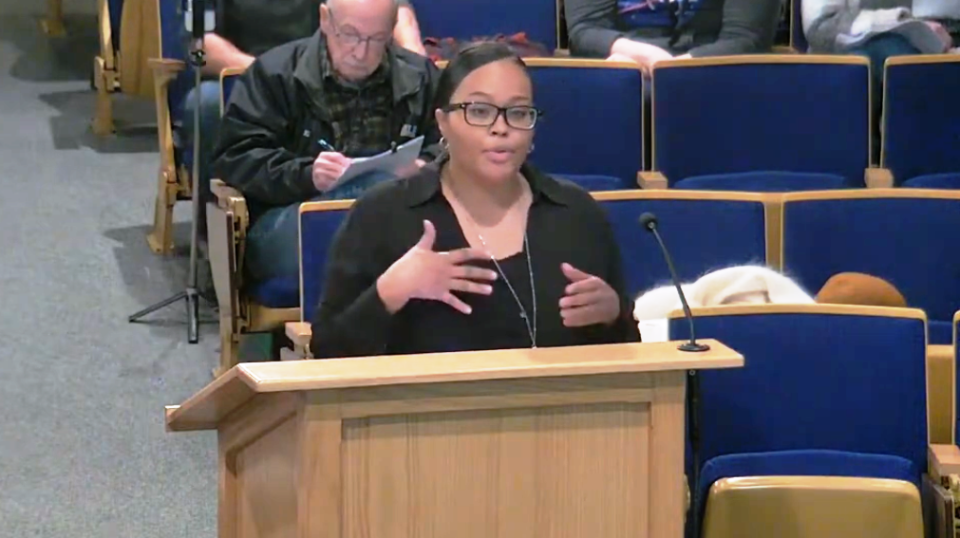
Jazmyn Thomas administers the city’s community development program and spearheaded the project.
“We received an allocation of COVID-related Community Development Block Grant from HUD in 2020 and the funding can be used for broadband connectivity,” said Thomas. “The pandemic showed that there was a lack of connectivity for children and people who need to work from home. We are helping to close that digital divide with this project. This will provide internet from Bard Street to Water Street in downtown Port Huron, with the goal of continuing that on to the whole downtown.”
The project is unique to Port Huron.
“HUD is very impressed with this project,” Thomas said. “We are the first municipality in the state of Michigan to do anything like this and use our funding for this type of project. They’ve actually asked us to come to a conference in May” to speak about the effort.
Phase one will serve low to moderate income census tracts, said Thomas. She said that the state is hoping to make additional funding available to expand the project.
The CDBG money will cover about $199,000 of the cost of the project. Thomas also landed a $25,000 grant through Huntington Bank to support the project.
A community survey conducted by Thomas showed significant need for free internet downtown.
The goal is for people to use it in pocket parks downtown and from their vehicles, Thomas said.
“We’re using city-owned light poles to connect the equipment to,” said Thomas.
“Good job,” said council member Anita Ashford.
Phase two and connectivity in the parks will be rolled out in the next two years, said Freed.
“When will this be installed?” asked Mayor Pauline Repp.
“By March 31,” said Thomas.
Jim Bloch is a freelance writer based in St. Clair, Michigan. Contact him at bloch.jim@gmail.com.
“It astounds me that the bow is sitting nearly perfectly upright on the bottom,” said Malane.
Clary collaborated with his son Don on a kind of time-lapse painting of the Bradley‘s sinking, also in 1998.
Since 2015, Clary had reserved a portion of his St. Clair gallery for the aquatic paintings of Don, who died at age 50 in a car crash Oct. 10, 2014 on Maui in the Hawaiian Islands, where he had lived and painted for two decades.
In contrast to Jim’s often dark, storm-tossed work, Don’s paintings exhibited a touch of surrealism and plenty of Technicolor — palm-studded beaches drenched in citrusy sunsets and giant sea turtles and playful dolphins easing their ways past ghostly ships marooned on the sea floor.
The painting shows an image of the Bradley breaking in two in a trough between two giant waves and another image of the ship’s bow plunging underwater toward the bottom, both painted and signed by Jim; Don painted the bow of ship marooned on the lake bottom, which he signed.
“That tells the story right there,” said Malane.
The hull of ship appears to be pebbled with rust and zebra mussels, just beginning their colonization of the bottom of Lake Michigan in 1997. But look at image just right and it’s obvious: The Carl D. Bradley is sitting on the lakebed weeping.
Jim Bloch is a freelance writer based in St. Clair, Michigan. Contact him at bloch.jim@gmail.com.
