

By Jim Bloch

A balding man in a gray suit is standing in front of a massive square painting that looks as if it could be one of Jackson Pollack’s famous drip paintings. You can’t tell the viewer’s reaction because you only see him from the back, where his hands are clasped together around a brimmed hat, umbrella and art brochure. He appears to be standing so close to the canvas that he could lick it. Perhaps he’s trying to peer beyond the colorful splatters, drips and blotches to discern the painting’s deeper meaning.
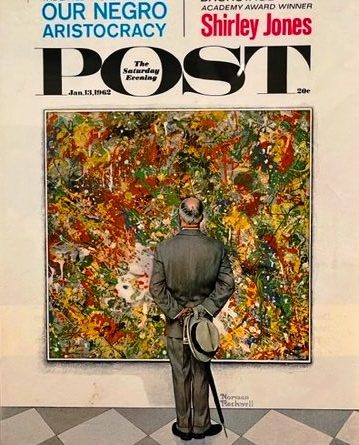
Part of the power of the painting derives from the contrast between the conservative appearance of the man and the radical appearance of the Pollock-like painting.

The painting of the painting is by America’s favorite illustrator, Norman Rockwell. It appeared on the cover of the Saturday Evening Post Jan. 13, 1962. The painting is called “Connoisseur,” and Rockwell painted it on the floor, flinging and dripping paint, the same technique used by Pollack.
In addition to the humor inherent in the contrasting elements of the painting, Rockwell took his take on abstract expressionism a step further. He submitted a study for the painting to an exhibit of the Cooperstown Art Association, signing the piece with an Italian pseudonym, where it won first place for painting. He submitted another study to a show at the Berkshire Museum, signing his middle name to the work, which won an honorable mention.
By 1962, after 15 years of popular attention to abstract expressionism, Rockwell’s realism and small town focus were at their critical low points. The awards suggested that Rockwell could have held his own in the world of abstract art. Willem de Kooning, a leading abstract expressionist, admired the Rockwell painting during its exhibit in the Danenburg Gallery in New York City.
Rockwell’s folksy realism paralleled the rise and hegemony of abstract art in America.
In 1912, he landed first paid job as an illustrator. In 1913, Armory Show in New York introduced cubism, fauvism and impressionism to American audiences.
“If I were young, I would paint that way myself,” said Rockwell in a note inside the Post.
At the age of 68, he had painted that way.
“Connoisseur” was not on display on a recent visit to the Normal Rockwell Museum in Stockbridge, MA, but two of Rockwell’s studies for the painting were exhibited as well as the Post cover.
The museum
The trees were turning yellow and red and orange as they climbed up the mountainsides and decorated the banks of tumbling rivers and glassy lakes in and around Stockbridge, the picturesque New England town tucked away in the Berkshires in western Massachusetts.
Stockbridge was the last home of Rockwell, who lived there from 1953 until his death in 1978 at age 84. The museum boasts the largest collection of the artist’s work, nearly 1,000 original paintings and drawings, all 321 of the covers he painted for the Saturday Evening Post, as well as his last studio, all on 36 rolling acres.
His work, which told stories through pictures and celebrated small town American life, is not as ubiquitous in daily life as it was the mid-1960s, just after he wrapped up his 47-year association with the Post and began a 10-year stint with Look magazine. His images were then seen on the covers of numerous magazines, in newspapers and other print ads, book illustrations, calendars, and on the walls of professional offices around the country. People framed their favorite Rockwell Post covers and hung them in their homes.
His career coincided with and helped define the great age of American illustration.
“I guess I am a storyteller and, although this may not be the highest form of art, it is what I love to do,” he said in the 1971 book “Norman Rockwell, Illustrator,” by Arthur Guptill.

Civil rights
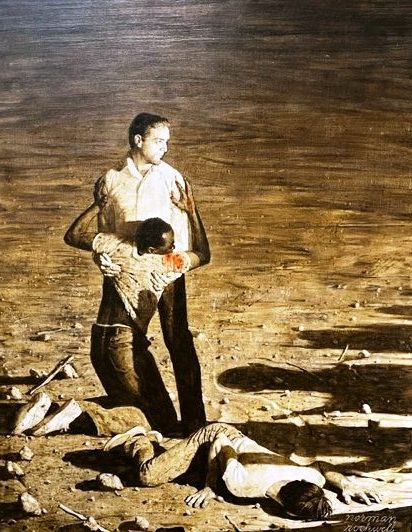
A central gallery in the museum is devoted to Rockwell’s paintings of the civil rights struggles of the 1960s, many of which he composed for Look, including 1963’s “The Problem We All Live With,” which featured six-year old Ruby Bridges being led into a New Orleans elementary school by U.S. Marshals. The big, dark, almost expressionist painting “Murder in Mississippi” details the horror the murders of three civil rights workers in 1964. The works are a powerful reminder of Rockwell’s commitment to justice for all and provide an antidote to the notion that his work was nostalgic and elementary.
Four Freedoms
A series of four famous paintings in 1942, based on FDR’s Four Freedoms speech, occupy another gallery. “Freedom from Want” portrays an iconic Thanksgiving dinner. “Freedom from Fear” features two parents tucking in their two children. “Freedom of Worship” shows a stunning amalgam of Americans praying, including a Black man, in an apparent exception to the Post’s policy of showing Black people only in subservient roles — or an oversight by the editors.
“Freedom of Speech” features a man standing above a crowded public meeting speaking his mind. As Rockwell cast about for an idea for the painting, “I suddenly remembered how Jim Edgerton had stood up in a town meeting and said something that everyone else disagreed with. But they let him have his say. No one had shouted him down. My gosh, I thought, that’s it… Freedom of Speech… I’ll express the ideas in simple everyday scenes.”
Brooks Robinson
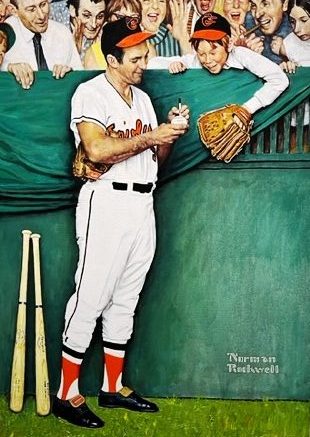
The museum is nothing if not attuned to the world at large. Brooks Robinson, the Hall of Fame third baseman for the Baltimore Orioles, died Sept. 23 at 86. The museum quickly displayed Rockwell’s 1971 portrait of Robinson, on loan from its anonymous owner. The work “Gee, Thanks, Brooks!” pictured Brooks signing a baseball for a young fan. The painting was composed as an ad for A-T-O, Inc., which owned Rawlings, the baseball equipment company. The Orioles were the world champs, having dispatched the Cincinnati Reds four games to one in the 1970 World Series.
Jim Bloch is a freelance writer based in St. Clair, Michigan. Contact him at bloch.jim@gmail.com.
