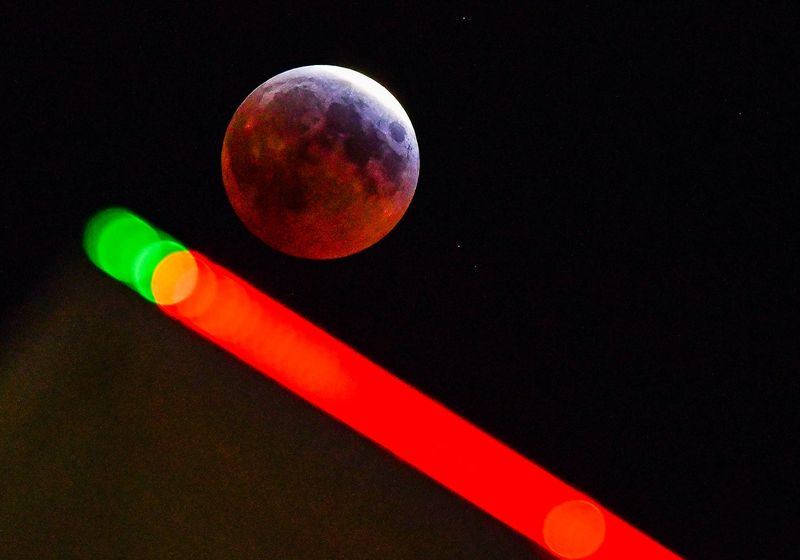
The first total lunar eclipse of the year is nearly here, but in Michigan, your viewing chances will depend on the weather.
The “blood moon” eclipse takes place during March’s full moon, which will occur in the early morning of Tuesday, March 3. The full moon’s peak and eclipse’s totality to coincide at 6:38 a.m., according to the Old Farmer’s Almanac.

Clear skies permitting, the worm moon could be visible for part of the eclipse in Michigan, with the moon to set for local viewers during totality.
However, the National Weather Service forecasts mostly cloudy skies over most of Michigan Monday night. Some regions will see partly to mostly sunny skies on March 3, so clouds could part in time to see the blood moon eclipse.
Here’s what to know about the blood moon:
When is the total lunar eclipse?
A total lunar eclipse will occur during the worm moon, March’s full moon, March 3. The eclipse will reach totality and the full moon will peak at 6:38 a.m. on March 3.
The eclipse’s blood moon phase will last from 6:04-7:02 a.m. on March 3. The moon will set during totality in the Eastern time zone.
Will Michigan see the lunar eclipse?
The total lunar eclipse is set to be visible over North America, including Michigan, with best viewing expected in western North America, along with Australia, New Zealand and East Asia, according to Space.com.
What is a total lunar eclipse?
A total lunar eclipse is when the sun, Earth and moon align so the moon is covered by the Earth’s shadow, or umbra, NASA said.
Why does the moon appear red?
You can expect the moon to take on a dramatic shade of red or orange in the night sky during the total lunar eclipse, leading it to be known as a “blood moon.” That’s because of how sunlight strikes the moon’s surface after passing through the atmosphere, NASA said.
As the moon is covered by the inner part of Earth’s shadow during the eclipse, sunlight not blocked by Earth is filtered through a thick slice of Earth’s atmosphere before reaching the moon’s surface, NASA explained.
Colors with shorter wavelengths, such as blues and violets, scatter more easily than colors with longer wavelengths, which include red and orange.
Where’s the best place to see the eclipse in Michigan?
Weather permitting, head to a clear, dark area for best eclipse viewing. Michigan is home to six dark sky state parks, three international dark sky parks and an international dark sky sanctuary.
When are the remaining eclipses in 2026?
There will be a total solar eclipse on Aug. 12, 2026, but it will not be visible in Michigan, according to Timeanddate.com.
A partial lunar eclipse will occur on Aug. 28, 2026, and will be visible from Michigan, weather permitting.
Contact Jenna Prestininzi: jprestininzi@freepress.com.
This article originally appeared on Detroit Free Press: Will total lunar eclipse be visible in Michigan? Why moon turns red
Reporting by Jenna Prestininzi, Detroit Free Press / Detroit Free Press
USA TODAY Network via Reuters Connect