Plumes of smoke from the Canadian wildfires are hovering over portions of Michigan. Reading the EPA’s Air Quality Index can help you plan your daily activity to ensure it’s manageable for your health.
“The AQI is an index for reporting daily air quality. It tells how clean or polluted the air is, and what associated health effects might be a concern, especially for ground-level ozone and particle pollution,” the U.S. Environmental Protection Agency said. “Think of the AQI as a yardstick that runs from 0 to 500. The higher the AQI value, the greater the level of air pollution and the greater the health concern.”

On July 15, officials issued an air quality advisory for these seven southeast counties: Livingston, Macomb, Monroe, Oakland, St. Clair, Washtenaw and Wayne.
In addition, an advisory is set for July 16 in west Michigan, including these counties: Allegan, Berrien, Cass, Kent, Muskegon, Ottawa and Van Buren.
While officials continue to monitor the smoke as it slowly dissipates, here’s how to read the Air Quality Index:
How do I read the air quality index?
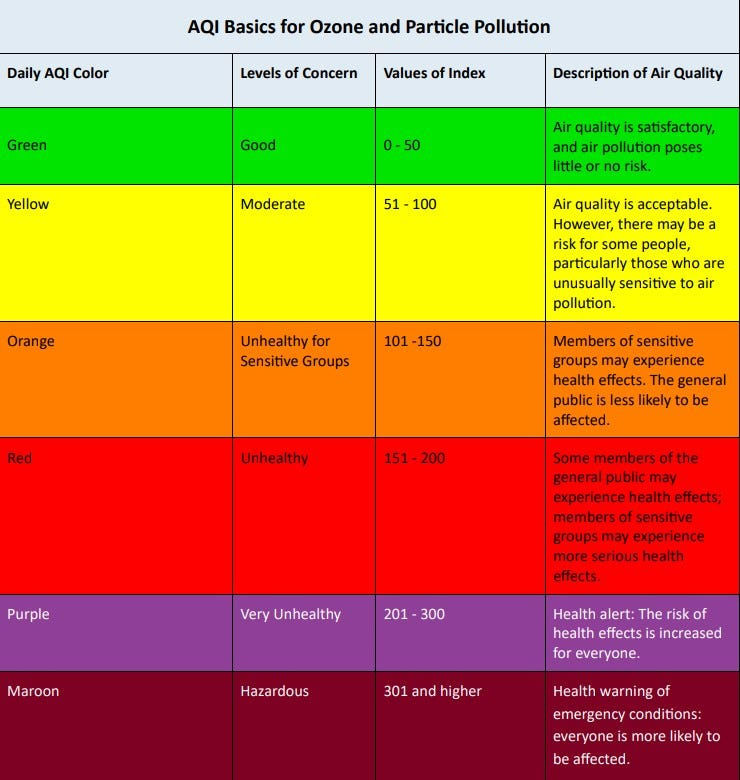
The AQI features six color-coded categories: green, yellow, orange, red, purple and maroon. Each category has corresponding values and levels of concern:
What does ‘sensitive groups’ mean on the AQI?
“Sensitive groups” identifies people who may be more at risk for breathing in polluted air than others.
According to the EPA, people who have respiratory problems (like asthma), heart or lung disease, diabetes, are a senior or child, or of a lower socioeconomic status are all considered within a sensitive group.
In addition, outdoor workers and pregnant people are within the sensitive groups, based on Michigan’s Health and Human Services Department.
What pollutants does the AQI include?
The AQI takes into account five air pollutants:
What does PM2.5 mean on the air quality index?
On the AQI, particulate matter readings, labeled “PM2.5,” range from 0-301 or higher, and measure the fine particulate matter in the air, such as, smoke, dust, soot or dirt.
The “2.5” figure means particles are 2.5 micrometers in diameter or smaller, according to the EPA — that is 30 times smaller than the average human hair, which is about 70 micrometers in diameter.
Air Quality Index: how can I check the air quality in my area?
Michigan residents can check current conditions through EGLE’s MiAir Quality Index Dashboard. The interactive map provides AQI scores for cities across the state.
Residents can also use AirNow, a part of the U.S. Air Quality Index, and check local conditions by searching their ZIP Code or city. AccuWeather also has an AQI feature that lists the current pollutants in the air.
In addition, Michigan’s HHS Department has a Facebook and X account. The department allows for residents to subscribe for alerts through the EnviroFlash system.
Contact Sarah Moore @ smoore@lsj.com
This article originally appeared on Lansing State Journal: What does the air quality index mean? How to read the AQI to navigate wildfire smoke
Reporting by Sarah Moore, Lansing State Journal / Lansing State Journal
USA TODAY Network via Reuters Connect