

State environmental officials heard concerns from the public, but few fireworks, at a hearing Tuesday evening about a proposed data center in Van Buren Township that has cleared approval from the board of trustees.
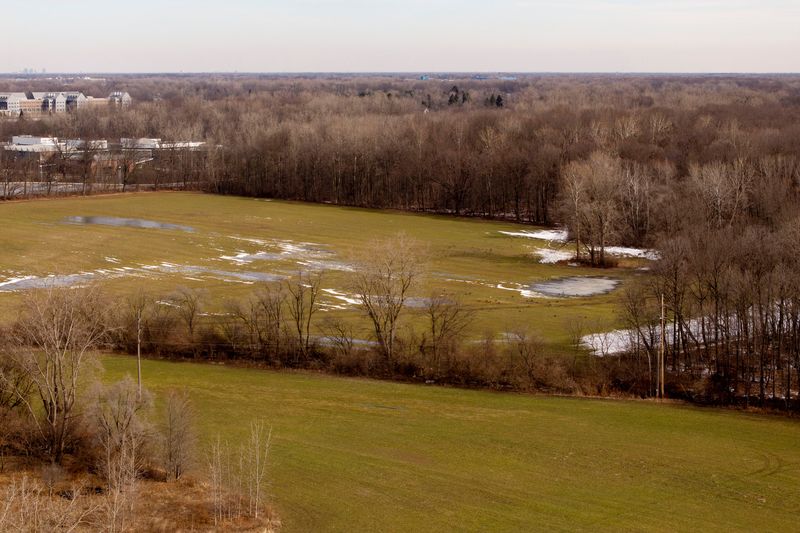
Panattoni Development Co. has applied for a permit from the Michigan Department of Environment, Great Lakes, and Energy to excavate and build in streams and wetlands on its Van Buren Township property, where it plans to build Project Cannoli, a hyperscale data center, at the northeast corner of Interstate 94 and Haggerty Road.

The company’s plans include filling 13.55 acres of wetland; and building utility towers in a wetland, six stormwater detention ponds and culverts for streams under new roads and utility crossings; and filling part of a stream.
The plan proposes five buildings sprawling over 282 acres. It’s projected to use between 2 million and 3.6 million gallons of water per day and one gigawatt of power. In May, Van Buren Township’s board approved a site plan for the data center, which is massive and powerful enough to propel artificial intelligence tools.
Five people made public comments during the hearing. They expressed concerns about issues such as reducing the land’s ability to hold floodwaters to disruptions for wildlife. More than 50 people had signed onto the virtual meeting shortly after it started.
Lauren Eaton, the monitoring manager at the nonprofit Friends of the Rouge, said Wayne County can’t afford to lose more wetlands. Wetlands also play a critical role in helping the Great Lakes region withstand more extreme swings between rainy and dry periods because of climate change, she said.
“In the Great Lakes region, we’ll increasingly have periods of intense short-term rain, coupled with periods of drought, and wetlands help the ecosystem weather those impacts. We need these natural features, such as wetlands, to help mitigate the negative impacts from flooding,” she said.
EGLE officials said while they made note of commenters’ positions, they can’t make decisions about granting a permit based on public opinion about the plan. The public comments were fewer and less dramatic than the outrage other data center proposals have met from the public in southeast Michigan.
Adam Kramer, a partner in Panattoni’s data center group, previously said the development will create jobs and he believes it will have an economic benefit for the township from tax revenue.
If EGLE grants Panattoni’s permit application, the company would have to seek another permit from Wayne County for soil erosion and sedimentation control. Once those two permits are granted, Panattoni could begin work at the site, clearing and grading, said Ron Akers, Van Buren Township’s municipal services director, in an email.
Public fury over data centers has prompted some local governments to pass temporary moratoriums on their construction.
Saline Township, however, had to backpedal on a decision late last year not to grant a rezoning for a hyperscale data center project after the data center company sued. Tech company executives, including OpenAI CEO Sam Altman and Oracle CEO Clay Magouyrk, visited the site on Michigan Avenue at the beginning of June to tout the project. OpenAI and Oracle are both expected to use the data center.
The data center site in Van Buren Township is in the Huron River Watershed, which has lost much of its historic wetlands. Panattoni has said it will buy credits in a wetland mitigation bank in the Huron River Watershed to compensate for its “unavoidable wetland impacts.”
Wetlands serve vital functions, such storage for floodwaters, filtering water before it hits drinking water aquifers or streams and as a home for plants and animals such as great egrets and the little brown bat.
Michigan has lost roughly half of its historic wetlands, CMU biology professor Don Uzarski recently said. Uzarski leads the regional Great Lakes coastal wetland monitoring program.
Pressure from home and commercial developers makes it difficult for the Michigan Department of Natural Resources and conservation groups to protect undeveloped land in southeast Michigan, despite their goals to improve access to nature and prevent the flooding that worsens by adding more pavement.
Evan Rosin said he believed the company should have more seriously considered building on a brownfield site, which is a type of property underused or abandoned because of the possibility of contaminants or pollutants. He said Panattoni “summarily” dismissed the option of building the data center on a brownfield because the nature of the type of property add complexity to developing and building on it.
“Let’s not just get steamrolled by this fervor for these massive data centers. … Let’s get real here. Put it on a brownfield, please,” he said.
In public documents accompanying Panattoni’s permit application, EGLE pressed the company to explain whether brownfield sites would be suitable as alternative sites for the data center.
“It is understood that developing a brownfield site adds a layer of complexity to any project,” said an EGLE official in the document containing questions from the agency about the data center project. “As does developing wetland sites. Brownfield site alternatives should not be approached as a collective category without specific examples to demonstrate your contention that no suitable brownfield sites exist for this project.”
Panattoni said in its written response the company looked at seven brownfield sites in Metro Detroit as possibilities, notably Detroit’s former Packard plant, the former Ford Wixom assembly plant and the shuttered McLouth Steel plant’s property in Trenton and Riverview.
Panattoni said the handful of brownfield sites aren’t big enough to accommodate the hyperscale data center. The company cited complex environmental concerns, including toxic chemicals leaching into groundwater, at the McLouth Steel site on Jefferson Avenue, although another California-based company has sought to build a smaller data center, on a portion of the property.
“We recognize that EGLE may argue that the project could simply extend its development timeline toaccommodate a brownfield location and thereby avoid wetland impacts. However, for mission‑criticaldata center infrastructure, schedule flexibility is not discretionary,” Panattoni wrote.
jcardi@detroitnews.com
This article originally appeared on The Detroit News: Van Buren Township data center draws public concerns about environment
Reporting by Julia Cardi and Carol Thompson, The Detroit News / The Detroit News
USA TODAY Network via Reuters Connect
By Julia Cardi and Carol Thompson, The Detroit News | USA TODAY Network
