

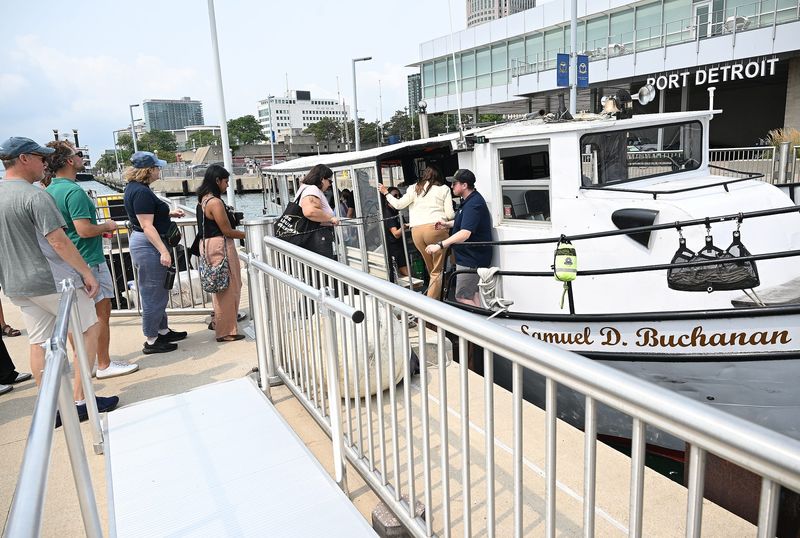
Detroit — On a sunny summer day earlier this month, dozens gathered at the Detroit Wayne County Port Authority on Atwater Street and boarded a 45-foot boat to learn more about the Detroit River and how it’s being restored after centuries of industrial use.
The tours, now in their second year, are organized by Friends of the Detroit River, a nonprofit group. Offered on a privately owned 45-foot boat, the free guided tours give a closer look at restoration projects and environmental work taking place along the river.

The tours have primarily been offered to elected officials, legislators, community partners, industries and other nonprofit organizations, but could one day expand to the public.
“We have yet to host a tour that is just for the public, but that’s not to say it’s something we won’t do. It’s just not what we have been doing so far,” said McKenzi Waliczek, director of programs with Friends of the Detroit River.
An Aug. 12 tour was funded by the Healing Our Waters Coalition and the National Parks Conservation Association, according to Waliczek, and included about 30 people.
The restoration projects can be larger than visitors may expect, Waliczek said.
“You can see some of our habitat restoration projects from space,” Waliczek said. “People think you’re planting plants, and you’re putting rocks in the water for fish spawning. But these are big projects, multi-million-dollar projects that really influence and impact the way that the river can function.”
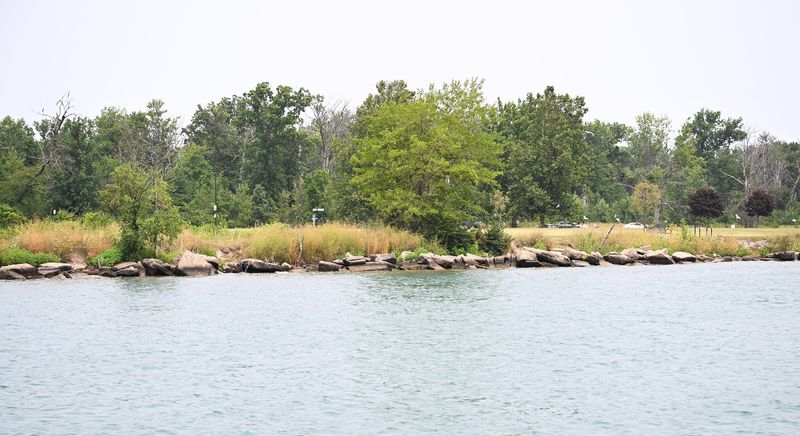
The boat tours also give participants an opportunity to see parts of the river that may be difficult to access from the shoreline.
“We have a wonderful riverfront, but there’s limited access along the full 32 miles of the river,” Waliczek said. “A lot of the shoreline is brownfields or old industry sites, and so when we can get folks out, I think that in itself is an amazing benefit of these tours.”
For Henry Wilson, director of Wayne County Commission Affairs and a Detroit resident, the Aug. 12 tour was his first Detroit River boat tour. He attended on behalf of Wayne County Commission Chairwoman Alicia Bell to observe new developments and environmental impacts.
Wilson said he wanted to see how the river has changed and what work remains to keep it clean and accessible.
“I wanted to see how we have progressed and what are the next steps, because you know Detroit is known for its waterfront,” Wilson said. “That’s its staple here in Detroit.”
Why Detroit River is important
The Detroit River is a 32-mile binational waterway shared by Michigan and Ontario. It is an international connecting channel that links Lake Erie and Lake St. Clair.
The river has played an important role in Detroit’s history. During the city’s industrial growth, it served as a major commercial waterway and industrial highway, transporting materials such as iron ore, coal and steel to local factories. Decades of industrial activity contributed to contamination and environmental damage along the river.
In 1815, the Detroit River shoreline included coastal wetlands up to a mile wide. Since then, shoreline hardening, industrial pollution, combined sewer overflow contamination, and deep shipping channel excavation has destroyed all but a few acres of this former, wildlife-rich environment, according to Friends of the Detroit River.
The habitat loss resulted in the Detroit River being named an “Area of Concern” under a 1987 Great Lakes Water Quality Agreement between the U.S. and Canada, one of 43 Areas of Concern on the Great Lakes.
For its part, the Friends of the Detroit River, founded in 1991 by a group of local citizens, works to protect, defend and enhance the river through community stewardship. The organization has worked on habitat restoration, water quality improvements and community engagement.
The organization is now working on shoreline planting, wetland creation, monitoring and data collection. Its Riverkeeper program also allows the organization to monitor the river and report on conditions.
It also offers kayak and canoe paddle tours, hiking, biking and educational programs such as the Detroit River Water Festival. The charter boat tours are currently invitation-only, but people can contact the organization to learn about other opportunities that may be available to them.
One restoration project
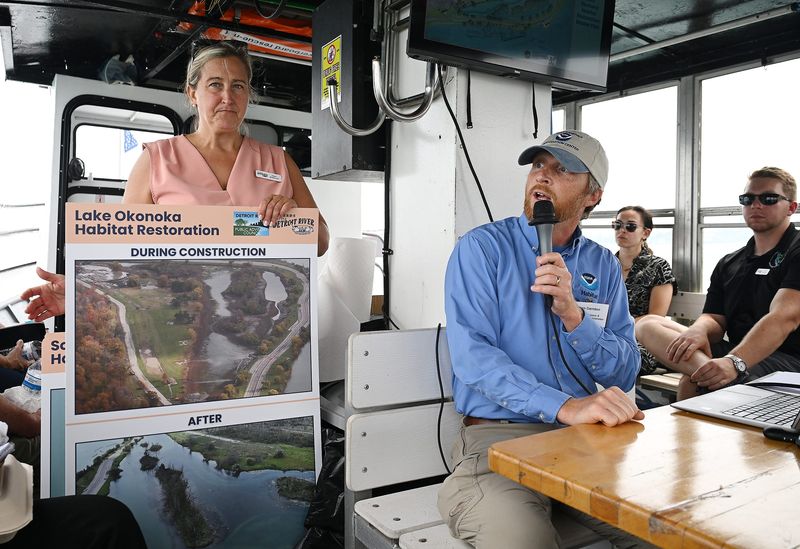
One project highlighted on the Aug. 12 tour was the Lake Okonoka Restoration Project. The guide explained how past development, including roads, trails and dredging, disrupted the area’s natural water flow and contributed to tree loss.
A canal system on Belle Isle routes through wet-mesic flatwoods, a rare plant community on Belle Isle that is, by far, the largest remaining example in Michigan, according to Friends of the Detroit River.
A $6.5 million project funded by the Environmental Protection Agency and completed in 2020 included excavating the channel for fish passage through Lake Okonoka on Belle Isle, making it more accessible to spawning fish to improve habitat at and around Belle Isle, and creating a mile and a half of mudflats for shorebirds.
Connecting with the river
For those involved with the tours, the goal extends beyond simply showing people the river. The organization hopes that giving people access to the water will encourage them to care about its future.
“Having people be able to connect to the river and being a part of that, I think is what sticks with me throughout this,” Waliczek said.
“I enjoy seeing everybody’s smiling faces when they get off the boat,” Waliczek said. “It’s a special time to just leave an urban area and be in a natural oasis.”
AThomas@detroitnews.com
This article originally appeared on The Detroit News: Unique Detroit River boat tours give officials chance to see restoration projects up close
Reporting by Aniah Thomas, The Detroit News / The Detroit News
USA TODAY Network via Reuters Connect
By Aniah Thomas, The Detroit News | USA TODAY Network
