It’s all about fattening up someone with flattery and false promises right before the slaughter. And sadly, the slaughter in a troubling “pig butchering” scam in Troy cost one poor man roughly half a million dollars.
It’s truly hard to imagine, even when you’ve written about more than a few of these scams. Yet it’s an extreme example of how deepfakes, chatbots, and other artificial intelligence tools make it far easier for scammers to sound more convincing, so convincing that some caught in their web could just keep handing over cash day after day.

The crooks view their victims as pigs that can be tempted and tricked into turning over their life savings.
It all started early this year for a Troy man when he joined a messaging group that batted around such topics as health and financial advice, according to Troy police.
Shortly after, members of the investment group claimed they had insider financial secrets through access to an artificial intelligence program that was able to accurately predict which way some stocks were heading.
Who wouldn’t want to know that?
The target was encouraged to take advantage of these tools to invest in U.S. and Chinese stocks. The crooks, of course, took advantage of their victim.
How scammers wanted another $89,700
As part of the complex scheme, the victim handed over cash and gold bars, literally, eight times in person to multiple people between March and May, according to police.
Troy detectives disclosed in court that the man had lost about $520,000 to the sophisticated scheme.
Except, like many other investment scams, the victim couldn’t withdraw any money. When he wanted to take some money out, the con artists behind the scam told him that he’d have to hand over more money before any of his money tied up in the so-called investments could be released.
The victim only recognized that something was amiss when he was asked to contribute substantially more money — another $89,700 based on police testimony — before he could withdraw any money.
Kind of weird to be asked for more cash when your investments are supposedly doing well.
What turned out to be a phony website indicated that his account had grown to more than $33 million, according to police testimony.
The story takes another twist here: The victim contacted police as he became more suspicious about the demands for more money. After he went to police, another cash exchange was set up under police watch.
A meeting supposedly to collect the extra cash was arranged at a Comerica bank on Van Dyke in Warren. Police had established surveillance around the bank building in advance.
Troy Police reported that a suspect in the case has been arrested, Yanling Xie, 32, in connection with the investment fraud scheme. He was arraigned July 25. He pleaded not guilty. His attorney Kathleen Solomon did not respond to questions from the Detroit Free Press.
Officers observed as the suspect arrived at the predetermined meeting location, according to police, where he was taken into custody without incident.
Police also testified in court that a records check revealed Xie had previously entered the United States illegally and was deported in 2023. It was unknown, according to the detective, when Xie reentered the United States but added that Xie was currently being held on an immigration hold as requested by U.S. Immigration and Customs Enforcement.
The Oakland County Prosecutor’s Office authorized one count of false pretenses — $100,000 or more — against Xie. He was issued a $100,000 cash bond.
AI is now ‘industrializing’ scams, experts say
Unfortunately, scammers know too well how to trick retirees and others into handing over huge chunks of their 401(k) money that can never be recovered or replaced.
On July 29, the U.S. Senate Special Committee on Aging held a hearing to address the growing use of AI tools to target seniors with increasing sophistication — including investment fraud.
“The central point of my testimony is straightforward: Generative AI is not replacing traditional scams. It is industrializing them,” stated Paul Benda, executive vice president of risk, fraud and cybersecurity at the American Bankers Association.
He noted that today’s scams typically are not isolated crimes committed by a lone opportunist. Instead, they are engineered by sophisticated domestic and transnational criminal networks.
AI tools further enable criminals, he said, to create a convincing voice, video, photograph, text message, ad, or online persona with little technical skill and at very low cost.
Criminals are able to imitate “a friend, family member, bank employee, government official, physician, pastor, financial adviser, or virtually anyone else whose identity may inspire trust,” Benda said.
Some even refer to “relationship investment scams” that start with scammers working to develop a personal relationship with targeted victims over weeks and months.
Benda noted that the emotional bond that scammers build with victims over time can be so strong that it makes “intervention extraordinarily difficult, even when family members or bank employees identify clear warning signs.”
Troy police warned: “Be wary of anyone promising guaranteed returns or asking you to invest using cash, gold, or cryptocurrency. Once your money is sent, it is often gone for good.”
Friendly chats turn into financial chaos
Maybe, it starts with a romantic spark found on social media. Or conversations in a group chat that turn into the next sure thing for making big money. Either way, victims begin trusting someone who shouldn’t be trusted.
The con artists often try to foster trust by sending pictures, according to an alert from FINRA, a self-regulatory organization for member broker-dealers that is responsible under federal law for supervising member firms.
Those pretending to be your new friends might chat about activities— such as volunteering — to demonstrate good character. Or maybe they’ll share stories about themselves to lull you into believing that you’ve got a lot in common.
Or you might spot an ad that looks real, perhaps impersonating a well-known celebrity or successful star in business.
In April, Michigan Attorney General Dana Nessel warned residents about the prevalence of fraudulent investment schemes proliferating across Meta platforms, including scams begun on Facebook, Instagram, and WhatsApp.
“Social media has become a breeding ground for fraudulent ads, making it hard to separate legitimate investments from sophisticated scams,” Nessel stated.
Nessel stated that most reputable broker-dealers and investment advisers “do not post specific investment advice on social media platforms.”
Scammers once pretended to be Elon Musk
Unfortunately, it is not rare for someone to lose hundreds of thousands of dollars.
A deepfake video a few years ago, for example, tricked an 82-year-old retiree into thinking billionaire Elon Musk was promoting a high-return investment opportunity online, according to a new U.S. Senate committee report.
Within several weeks, the report noted, Steve Beauchamp lost more than $690,000 of his retirement savings to digital scammers, who used AI tools to create a convincing deepfake of Musk.
Beauchamp was a widower and worked until he was 75 as a sales representative at a company in Ontario, Canada, according to an August 2024 report in the New York Times. The Times indicated that the man spotted the ad shortly after joining Facebook in 2023.
“The scammers had edited a genuine interview with Mr. Musk, replacing his voice with a replica using AI tools,” the New York Times reported.
This summer, Musk is perhaps best known for the SpaceX initial public offering and the powerful Falcon 9 rocket.
What many people likely don’t realize is that scams typically don’t take off like a rocket.
Long-term investment fraud schemes evolve over weeks or months before so-called love interests or friends introduce a fraudulent investment opportunity, according to a report called “Artificial Intelligence & Older Americans: Confronting New Threats, Unlocking New Opportunities” released in July by the U.S. Senate Special Committee on Aging.
Older victims and others often lose money in isolation.
The con artists tell their targets that they should not tell “family about the relationship or investment, framing secrecy as a sign of intimacy or financial sophistication,” the report noted.
If it’s gotta be a secret, though, it’s gotta be a scam.
What is ‘pig butchering’?
Those scammers behind “pig butchering” scams might use other information available to them on the dark web to target potential victims, who have built up savings and might be more vulnerable or willing to engage with a stranger.
FINRA advises that you should not trust an unexpected text or direct message from a stranger, as it easily could be the first step in a “pig butchering” scam. The same is true if you think that direct message is coming from a celebrity that you follow on social media.
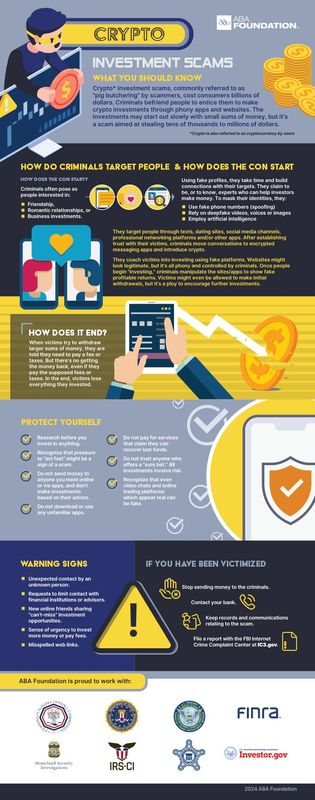
The objective of the scam is to slowly fatten a pig before the financial slaughter. Scammers will gain your trust before ultimately manipulating you into putting your money into phony deals or investments, FINRA warns. Maybe, scammers flatter you with thoughts of romance. Maybe, they tempt you with promises of big investment gains.
The move on your money is likely to start out small, experts say, maybe with a modest investment that boosts your confidence enough that you feel safe investing even larger amounts of money.
Ultimately, individual investors have lost tens of thousands — and in some cases, millions — of dollars, according to FINRA.
Once the crooks have gone in for the kill, you’ll spot some very disturbing twists and turns. For example, FINRA warns the new crypto platform you recently moved your assets into might suddenly become inaccessible.
Or, as in the Troy case, you might not be able to withdraw money until you hand over substantially more money.
The crooks then disappear with the cash.
Scammers hide behind names you’d trust
In spite of a long list of efforts to build consumer awareness, imposter-based fraud might not be top-of-mind for many people, according to a survey released in July by the FINRA Investor Education Foundation.
Only 14% of respondents indicated awareness of imposter-based fraud by mentioning this type of fraud as part of a survey of a nationally representative sample of 1,509 U.S. adults about their fraud experiences. Half of respondents referred to identity-based fraud.
Among the sample, 72% said they had been targeted by a fraudster at some point.
“While people who didn’t mention a fraud type may still be aware of it, the fact that these schemes aren’t top-of-mind could leave them vulnerable to fraud,” according to the report issued by the FINRA Investor Education Foundation.
Cryptocurrency and other investment-related scams are generating huge losses for targets who have built up substantial savings in their retirement and savings accounts.
Many of these scammers impersonate someone else to gain our trust or catch us off guard — a romantic interest, a bank’s fraud department, a couple of teens pretending to raise cash at a supermarket, authorities calling about missed jury duty and much more.
The longer that scam continues, the better the odds that the scammers can snag big bucks.
Consumers should step back and do more research before handing over money to anyone. A glaring red flag: Scammers claim that an investment promises a high return, but the con artists put the pressure on you to act quickly.
Best bet: “Be suspicious if a new online friend or romantic connection starts asking about your personal finances, and consider putting the brakes on the relationship,” according to the FINRA alert.
You also can use FINRA’s BrokerCheck to see whether the promoter is, or was at one point, a registered investment professional and to check for any disciplinary history.
We’re all searching for answers, maybe even new relationships and a sense of community online. Unfortunately, crooks impersonating people with an inside secret on how to invest in foreign stocks or cryptocurrency know this all too well.
And boy, do they play us to steal every dollar that they can.
Contact personal finance columnist Susan Tompor: stompor@freepress.com. Follow her on X @tompor.
This article originally appeared on Detroit Free Press: They pushed for even more money in this scam. The cops were waiting.
Reporting by Susan Tompor, Detroit Free Press / Detroit Free Press
USA TODAY Network via Reuters Connect
By Susan Tompor, Detroit Free Press | USA TODAY Network