Newborn deaths in Flint plunged after moms and babies began receiving no-strings-attached cash, new findings show.
A research paper, published this week, looked at what’s known as neonatal mortality — the number of infant deaths within 28 days of life — before and after Rx Kids, a rapidly expanding Michigan cash aid program, which aims to improve maternal and infant health by alleviating financial burdens for families during what can be an economically vulnerable time period. The number of infants that died during the first month of life plummeted so much that researchers say Flint’s neonatal mortality rate is now closer to the rate in the rest of the state, basically eliminating that disparity.

“The rate of neonatal mortality in the city of Flint dropped by 50%. It cut in half,” said Dr. Mona Hanna, a pediatrician and the director of Rx Kids at a news conference on Wednesday, June 25 in Flint, where babies are more likely to be born early and small and admitted to the NICU.
Flint’s neonatal mortality was “excessively high” for a long time, she said. That’s due to decades of economic disinvestment, racism, environmental injustice and higher rates of poverty, all of which can lead to riskier pregnancies and worse birth outcomes, she said.
“Rx Kids started in Flint in 2024, and we had more mamas go to prenatal care and we had improvements in housing stability and we had better nutrition for mamas and we saw these improvements in birth outcomes. We expected that we would see a decrease in neonatal mortality, so this is a really big deal,” Hanna said.
The findings represent the latest examination of Rx Kids, which offers Flint families $7,500 in total — mid-pregnancy and then for the first year of their child’s life, and as researchers across the country continue to study the effectiveness of cash aid. Rx Kids originally kicked off in Flint and has since reached nearly 50 communities across Michigan. The study, co-authored by Rx Kids founders, has not been peer reviewed yet.
What the study found
From 2021 to 2024, an average of 10 newborns died for every 1,000 live births in Flint — much higher than the four deaths per 1,000 live births across the rest of Michigan, according to the study.
In 2025, that changed.
The neonatal mortality rate declined by 50% in Flint, compared to the previous four years, down to 5 deaths per 1,000 live births. Meanwhile, the number of infant deaths remained about the same for the state.
“That longstanding disparity, that babies in Flint were not as likely to survive until their first month is not there anymore,” Hanna said. The sample sizes for the study are small since not many babies die during the first weeks of life, but every death makes a difference in the statistics, she said.
Earlier surveys and research of Rx Kids has shown that families are more financially stable and there are fewer evictions, Hanna said. Moms from Flint are getting prenatal care earlier and more often, an important step to ensure babies are born healthy, she said. Researchers also found less smoking in pregnancy, another risk factor for having small babies and birth complications. Moms had reported feeling less stressed as well.
A June study in the Lancet Public Health journal found a 18% reduction in preterm births and a 27% decline in low birth weight in Flint. Researchers also identified a 29% decrease in NICU admissions. Researchers evaluated about 4,500 births in Flint from 2021 to 2025, before and after Rx Kids launched, and compared outcomes with similar cities without the program.
Rx Kids offers $1,500 in cash assistance mid-pregnancy and then monthly $500 payments for six or 12 months after birth, depending on the location. The program is funded with a combination of state, local, private and philanthropic dollars.
Rx Kids Mom: ‘It has been a godsend’
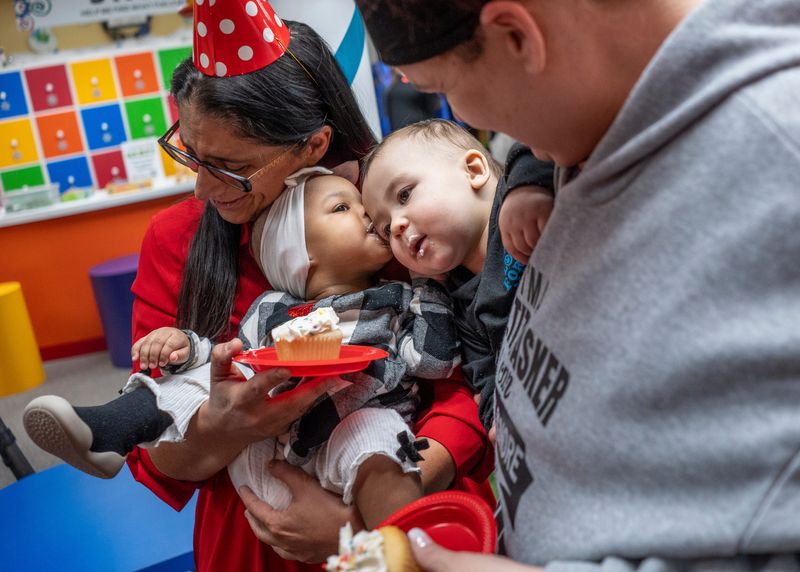
Heather Schmalz, a first-time mom and math teacher, said Rx Kids made motherhood a financial reality for her. She signed up while she was pregnant and used the money to pay off debt. After her baby was born in March, Schmalz signed her up for health insurance — nearly $600 a month.
“Rx Kids doesn’t cover everything, but it has been a godsend,” Schmalz, 34, said during the news conference. The cash aid alleviated stress and gave her breathing room, a sentiment echoed by other Rx Kid moms.
Though Rx Kids has received bipartisan support, and raised tens of millions of dollars, several legislators raised questions about the program. Earlier this month, Republican lawmakers grilled Hanna about Rx Kids’ long term goals and sustainability, if participants had abortions while enrolled, how families are spending the aid and if taxpayer dollars are going to undocumented immigrants.
The new findings add to a growing body of research about Rx Kids and other cash aid programs. Outcomes have been mixed.
Researchers of the Baby’s First Years study, for instance, didn’t find differences in several child development outcomes between low-income moms who received $333 a month and those who got $20 a month for the first years of their children’s lives. Though they note that could be because of the size of the cash aid and moms getting payments during the COVID-19 pandemic — explanations Hanna has also raised.
Rx Kids is “very different” from Baby’s First Years, she told lawmakers earlier this month. The study took place during the pandemic, when there was an infusion of cash supports. Families received payments after birth (not during pregnancy), were given less money than Rx Kids and it tested a small sample size of 400 people. So far, Rx Kids has distributed $44.9 million to 13,154 families.
Rx Kids is led by the Michigan State University College of Human Medicine, where Hanna is an associate dean of public health, and administered by GiveDirectly, a nonprofit that specializes in cash delivery programs intended to alleviate poverty. The University of Michigan is a research partner.
Reach reporter Nushrat Rahman at nrahman@freepress.com.
This article originally appeared on Detroit Free Press: Study finds fewer Flint newborns died after Rx Kids started
Reporting by Nushrat Rahman, Detroit Free Press / Detroit Free Press
USA TODAY Network via Reuters Connect
By Nushrat Rahman, Detroit Free Press | USA TODAY Network