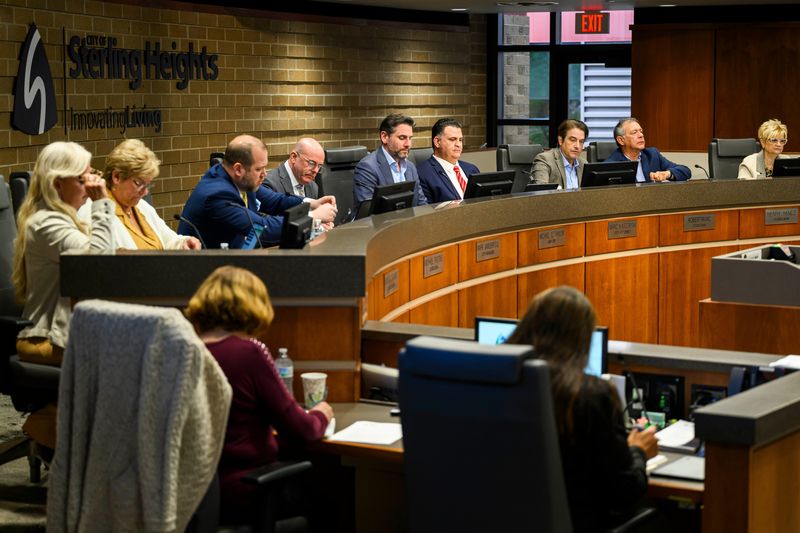
The Sterling Heights City Council is set to consider a resolution Tuesday evening opposing tax policy bills in Lansing that one councilmember contends put every municipality “at risk.”
The Michigan House voted in May to pass several bills that would slash property taxes across the state, but skipped a vote on a bill needed to replace some of the more than $5 billion in lost tax revenue.

At its Tuesday evening meeting, Sterling Heights City Council is slated to consider the adoption of a resolution opposing Michigan House Bills 5872 through 5879 due to “their potential negative impact on local government revenue, financial planning, and administrative operations,” a city document said. Sterling Heights City Manager Mark Vanderpool said the city would lose about $5 million in annual revenue from the bills. He said there’s no “guaranteed replacement” for the lost revenue, and the city would need to cut services, he said.
“So we’re deeply concerned about that,” he said.
The House’s sweeping tax cuts can’t be implemented without the passage of a separate bill levying a loosely defined 6% sales tax on services that has yet to be revealed. Republicans who control the House did not hold a vote on the sales tax hike bill, which remains in committee.
All combined, the four property tax cuts passed by the House are estimated to result in a tax revenue loss that could progress from $5.5 billion to $7.5 billion a year, according to a series of nonpartisan House Fiscal Agency analyses.
Vanderpool, the Sterling Heights city manager, said he wants the state Legislature to work “hand in hand” with cities, townships and villages to come up with a solution for “guaranteed revenue replacement.”
“We are more than willing ― I think our reputation precedes us ― to work with our state legislators hand in hand to come up with viable solutions that … may reform property taxes without harming communities across the state,” he said.
Sterling Heights Councilwoman Barbara Ziarko said the legislation reduces the city’s revenue without a guarantee of what it will be replaced with. She said that in the future, the legislation could prevent the city from maintaining positions that it has promised residents it would maintain, including public safety roles.
“When they put the burden on our local government, they’re actually putting it on the residents of whatever community it is,” she said.
State Rep. Steve Frisbie, a Calhoun County Republican, previously said that Michigan residents need to see tax relief immediately. He noted a ballot proposal collecting signatures last year would have eliminated all property taxes in the state. That citizens’ initiative, known as AxMiTax, fizzled out and won’t be on the ballot this fall.
“They realized that our property taxes are too high and they demand that we take action now,” Frisbie said.
More on the bills
The cuts passed by the House in May would eliminate the 6-mill State Education Tax and eliminate the 0.75% real estate transfer tax assessed on the sale price of real estate.
House Republicans also signed off on eliminating the personal property tax. That bill, largely intended to benefit utility companies, is tied to separate legislation that requires utilities such as Consumers Energy and DTE Energy to pass on personal property tax savings by cutting electric and gas rates for their residential customers. It also requires utilities to freeze rates for two years.
Jennifer Varney, Sterling Heights’ finance and budget director, said the elimination of the personal property tax would result in a $4.3 million annual revenue loss for the city. She said the personal property tax refers to the taxes that businesses pay on their assets, such as their machines and vehicles.
Another tax on the chopping block is the so-called “pop-up tax,” an increase in a property tax bill that occurs when a house transfers from one owner to the next in Michigan, uncapping a constitutional limit on the property tax increase on a home’s taxable value.
Under the state Constitution, a property’s taxable value cannot increase by more than the rate of inflation or 5% each year. But when a property is sold, that cap lifts and is reset at a new, often higher taxable value, resulting in a “pop-up” in property taxes.
Varney said the “pop-up” is the only way cities “recapture” the true value of a home. Michigan also has the Headlee Amendment, a state law that requires local governments to roll back millage rates if taxable property values rise faster than the rate of inflation.
“If you take away the pop-up … and you keep the rollback of the millage, you’re basically limiting any kind of growth in taxable base for municipalities,” she said.
Staff Writer Beth LeBlanc contributed.
asnabes@detroitnews.com
This article originally appeared on The Detroit News: Sterling Heights to consider opposing Michigan House tax policy bills
Reporting by Anne Snabes, The Detroit News / The Detroit News
USA TODAY Network via Reuters Connect