Earlier this month, President Donald Trump announced a “crime emergency” in Washington D.C. He then militarized the D.C. police department and deployed hundreds of National Guard soldiers, sparking protests, public safety concerns and legal challenges.
As Trump threatens similar actions in other Democratic-led cities, some Michigan lawmakers are pushing for legislative safeguards to prevent a similar situation from happening here.

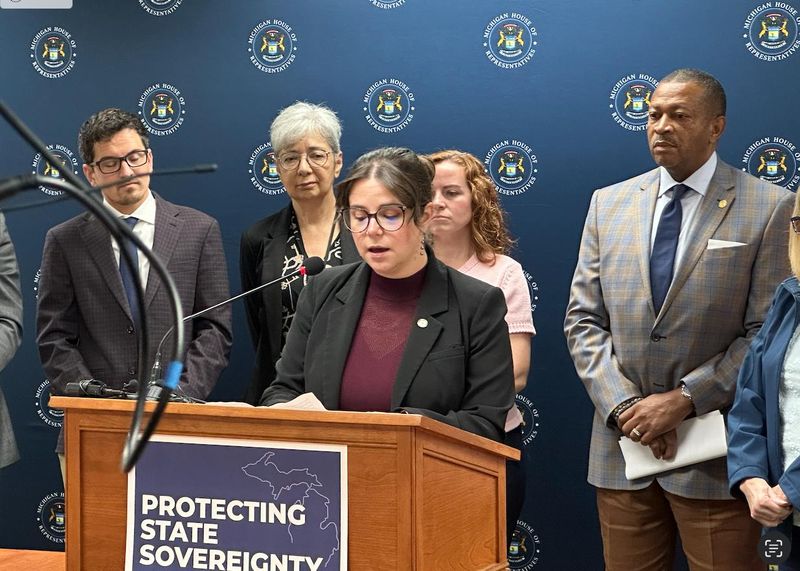
“The federalization and deployment of National Guard troops into L.A. and Washington D.C. represents an unprecedented abuse of executive power,” Michigan House Rep. Laurie Pohutsky, D-Livonia, said at a news conference on Thursday, Aug. 21.
“As elected leaders, we cannot allow these actions to go unchecked.”
State Rep. Tyrone Carter, D-Detroit, and Kyle Zawacki, the Legislative Director for the ACLU of Michigan, joined Pohutsky at the news conference to introduce House Bill 4796. The bill sets out to “reaffirm state sovereignty” by requiring permission from Michigan’s governor before the military can be deployed in the state.
While the bill does not expand or limit any existing powers, said Pohutsky, it does enable state courts to litigate the issue, rather than relying on federal courts to determine the legality of the President’s actions.
“This bill […] reiterates federal law into state law, giving our state and our courts one more avenue to push back on the President’s unlawful and, arguably, unconstitutional actions, should he attempt to deploy troops in Michigan,” said Pohutsky.
Rep. Carter, a former lieutenant with the Wayne County Sheriff’s Office, warned that the deployment of troops to American cities “will not bring public safety.”
“Good policing is about protecting the civilians we serve, not treating them like enemies on the battlefield — that’s the role of the military,” said Carter.
When asked if she thought it was a realistic concern that troops would be sent to Michigan cities, Pohutsky cited reporting from the Washington Post and The Guardian that the Trump administration has already signaled its “plans to expand these actions” across the country.
“I think that it’s important to supply that safeguard whether it’s an acute threat to Michigan or not,” Pohutsky said.
She also said she worries that similar policies to the ones in Washington could be “weaponized” in cities like Ann Arbor that have been vocal about their opposition to many of the current presidential administration’s actions.
In addition, Pohutsky said she has “very serious concerns” for Detroit, a city that Trump has repeatedly criticized in public comments, and whose population is 74% Black.
“Based on the cities that [Trump] has targeted and the areas that he is choosing to have occupied, I absolutely think that race is playing a role,” Pohutsky said. “Which again creates some concern about areas of our state that may be unjustly targeted using these policies.”
Throughout the news conference, all three speakers described the President’s deployment of troops as “authoritarian,” with Zawacki warning that it was another step down a dangerous path, and Pohutsky calling on her father’s experience as a soldier in WWII to warn constituents to pay attention to history.
“We keep saying ‘unprecedented,’ and in a way it is because it’s unprecedented here. But worldwide, it is not unprecedented,” said Pohutsky. “It’s very, very frightening.”
Violent crime rates in both Washington D.C. and Detroit are currently the lowest they’ve been in decades. In 2024, the city of Detroit reported a 19% decline in homicides.
Earlier this week, however, Detroit Mayor Duggan sparked controversy over an interview with CNN in which he partially credited the Trump administration for helping Detroit’s violent crime reduction.
Pohutsky acknowledged the limits of the legislation, saying that preventing the Trump administration from “engaging unlawfully is not reality.” However, she ended by emphasizing her goal is to give state courts the power to litigate and fight back against such actions.
The bill must be approved with a majority vote in both the Michigan House and Senate and then signed by Gov. Gretchen Whitmer before it can become law.
Pohutsky said that while she doesn’t expect the bill to move out of the House or for the Speaker of the House, Rep. Matt Hall, R–Richland Township, to put the bill up for a vote, she does see it as an important first step towards raising awareness on the issue and a “long term goal” to pass the legislation in the future.
Aurora Sousanis is a politics intern at the Detroit Free Press. You can contact her at asousanis@freepress.com.
This article originally appeared on Detroit Free Press: State reps push for safeguard against Trump deploying military to Michigan cities
Reporting by Aurora Sousanis, Detroit Free Press / Detroit Free Press
USA TODAY Network via Reuters Connect