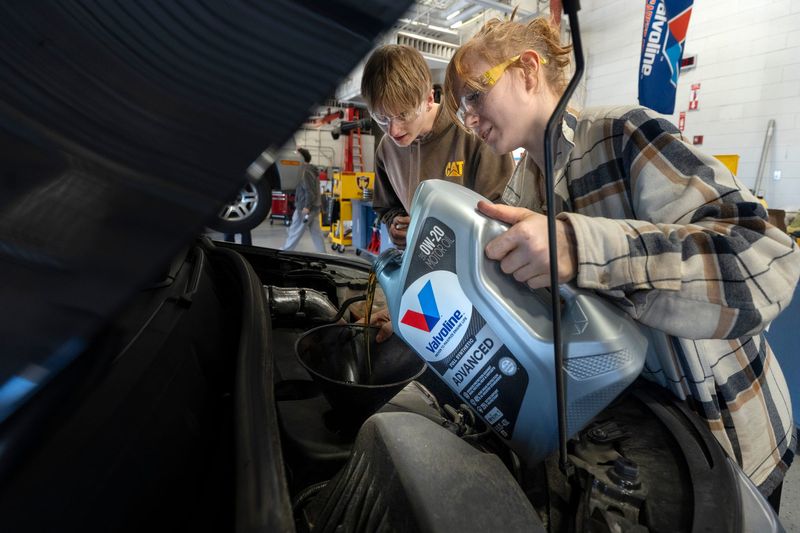
Tiffany Goldstraw had just finished her first oil change.
It wasn’t the only job she’d completed in her automotive repair class at North Farmington High School or the hardest, which involved a serpentine belt. The oil change was “relatively cut and paste” based on what she’d been taught.

As the high school junior checked the other fluid levels before turning the car over to its owner − a retired Spanish teacher now subbing at the school − she thought about her future and what she now thinks she’d like to do.
“I like to read and write, but I couldn’t see myself doing that for a living,” she said. “But I could see myself waking up every day and fixing somebody’s car or just changing somebody’s oil. I could see me doing that every day for the rest of my life.”
Automotive technicians are in demand – an estimated 400,000 are needed by 2028 – but as Goldstraw’s example illustrates, exposure in high school might be one way to get more students considering this particular field as a career, perhaps an alternative to forging on into a university with expensive tuition bills.
In Goldstraw’s case, it was an accident she’d ended up in an automotive class in the first place.
Then a freshman, Goldstraw wanted to ditch the advanced placement history class she’d been assigned. The first year automotive class was the only option with open seats, but one that provided an unexpected reward.
“Something about it, it just made my heart feel better, it made me feel like I could actually like see myself learning,” she said, crediting her automotive instructor, Sean Reisdorf, whom she and others call Mr. R, with pushing her to be better.
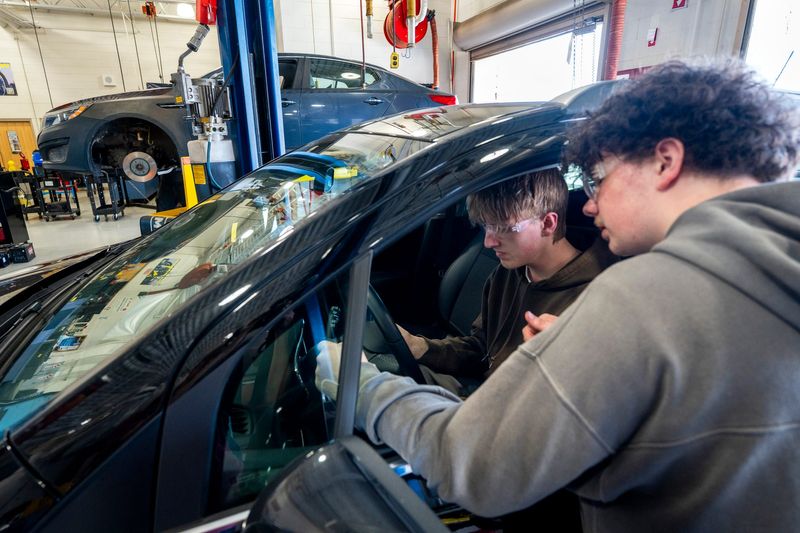
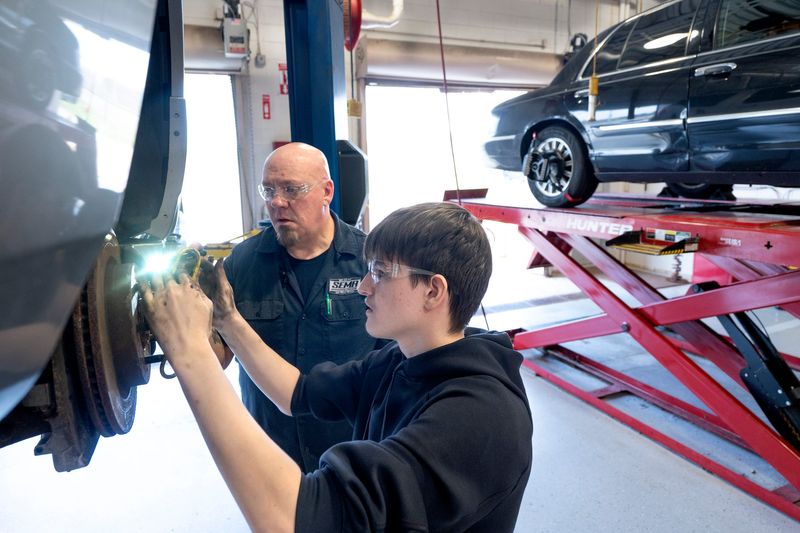
On a weekday before the end of the school year, Goldstraw and a handful of other students were busy working on different vehicles, at times hoisted on lifts, in Reisdorf’s advanced class, for those in their third year of automotive instruction.
Not everyone in the class intends to pursue automotive work. Clayton Gross, Goldstraw’s partner on the oil change, said he’d prefer to be a music producer but likes the class and sees value in taking it.
“I know a trade now. If my other career plans don’t work out, I can always come back to auto and I know the basics, and I know how to get back into it,” said the junior from West Bloomfield.
Reisdorf, for his part, was one of those kids who didn’t initially see automotive repair as a possibility when he was growing up.
“I got into this backwards,” he said.
He’d been working in retail management, thinking “life was grand,” until his 2-year-old car wouldn’t start one day. It was out of warranty because it was over the allowable mileage. It cost $500 to change a timing belt, a $50 part, although, he noted, it was an eight hour job. That helped shift his thinking, leading him to industry and eventually teaching, which is what he’s been doing now for 20 years.
Reisdorf takes issue with some of the assumptions about automotive repair careers. The U.S. Bureau of Labor Statistics put the median annual wage for automotive service technicians and mechanics as of May 2024 at $49,670, but Reisdorf and others see it differently.
“A student who graduated two years ago is already making over $100,000,” he said, noting that another student of his from 20 years ago is making more than twice that, moving through the dealership ranks to the corporate level. Most students start in the $15 to $20 an hour range, Reisdorf said.
What’s often overlooked about automotive work, he said, is the potential complexity. Automotive work involves topics that might not appear obvious from the outside.
“Most kids that think about taking auto aren’t thinking I need physics and chemistry and biology to take auto, but this is where we’re at,” Reisdorf said,
He offered the example of the Chrysler Pacifica Hybrid, a minivan.
“You’ve got 60 to 80 computers on that thing, 55 miles of wires, everything’s electronic. The ability to think critically and understand what’s going on is that level of student that we need that’s, you know, like an AP student,” Reisdorf said, referencing advanced placement, or higher-level classes. “The kids that do well are really smart and just have a knack for it.”
Reisdorf is intent on breaking assumptions about automotive repair as a career.
“People have no idea how … complicated this business is but how rewarding it can be if you’re really good at what you do. And how do you know if you’re good at what you do unless you do it?” said Reisdorf, whose not-so-secret other passion is jazz. He sports a tattoo on his arm featuring a trumpet, an instrument he plays, although he’s humble about his talent.
One of the issues Reisdorf said students face in weighing whether to take his automotive classes, which are part of an area known as Career and Technical Education, involves the time crunch at school.
“They can’t fit it in their schedule. They’ve got all this other stuff they’ve got to do, you know, the English requirements, the math requirements, the gym requirements, that they don’t have time to fit” it in, Reisdorf said.
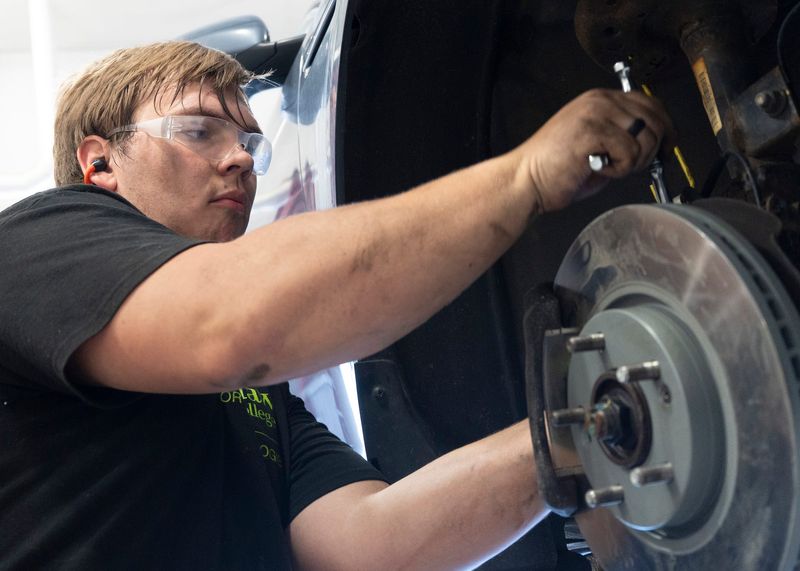
Owen Varva, a senior at North Farmington, is one of Reisdorf’s students who intends to pursue a career in automotive work. He’s already earning a paycheck fixing buses for the school district and said he expects to go full-time after graduation.
“This class has taught me way more than any class I could have taken,” he said.
Varva, who’s also kept busy during high school with various sports, including football, wrestling and track and field, was completing a front brake job on his own car, a Kia Optima, on the day the Detroit Free Press visited. It was a family car that had been wrecked before he got it, but Varva put his skills to work rebuilding it.
“Now, it’s the most reliable Kia you’ll ever find,” Varva said, noting that he made sure everything was done to the proper specifications.
Not every high school in Michigan has an automotive program like North Farmington does.
Some funnel students interested in automotive repair or other trades elsewhere.
Mark LaFollette has been in charge of the automotive program at the Lenawee Intermediate School District Tech Center in Adrian since 2009. The center serves students from a variety of public and private schools.
LaFollette said he treats the program seriously and expects the same of the students.
We “don’t do any cutesy stuff. This is a pro shop,” he said, noting that students get a daily grade and have to document their time. Students are treated like employees. They call LaFollette “boss.”
Some high school programs service staff and student vehicles or shop vehicles. LaFollette extends the service to members of the public, too.
“Everything goes out of here 100% accurate,” he said of the repairs. The range of work performed includes maintenance, tires and wheels, brakes, steering, suspension as well as engine tuneups and performance.
LaFollette said the students don’t have difficulty finding work after they finish his program.
“Everybody wants my students because they’re trained, they’re prepared, they’re licensed,” he said.
LaFollette, who started wrenching professionally in 1978, has noticed something about the students that do well in his program, most of whom enter as juniors and seniors.
A lot of times when they come to my (program) in their junior year, this is the first time they’ve been successful in high school. They’ve struggled along,” he said. In this program, “they find their niche, find their worth.”
LaFollette has some thoughts on why more students might struggle now than in the past.
“I believe we did a disservice to a good share of the student population when we eliminated shop class in high school and middle school,” he said, of a general shift away from having such programs widely available as compared with decades ago. “We’ve underserved those students who are hands-on, who are proud of their hands-on skills.”
Some students learn by working with their hands and gain self-esteem in the process, LaFollette said.
He’s not alone in questioning the shift in educational focus in Michigan.
Chandra Madafferi, president and CEO of the Michigan Education Association, a union representing teachers and others in the state, pointed to changes in standards 30 years ago, with the introduction of the Michigan Merit Curriculum, as a key reason fewer schools have their own automotive programs.
The curriculum shift, according to Free Press reporting in 2007, was significant:
“The graduation rules are getting tougher because of a 2006 state law that took Michigan from being a state that required only a civics class to graduate −and left it up to local school districts to require more − to a state mandating classes in math, science, English, social studies, arts, physical education and health, and online learning. Math is a particular focus.”
Supporters at the time viewed the intent as helping students meet the challenges of a changing workforce, with a goal to prepare them for college.
Many schools couldn’t afford to meet the new requirements and to maintain other types of programs because it would mean, among other things, hiring additional teachers, Madafferi said. Automotive programs, in particular, can be expensive to run.
That’s meant fewer students gaining exposure to automotive and shop programs, which used to be more prevalent in Michigan schools, she said.
“We also know that less students today, especially in metro Detroit, are opening up cars and working on them with a parent or buying an old junker and rebuilding it, so it is a need,” Madafferi said.
She noted that her husband is an engineer for an automotive group who’s described seeing fewer engineers coming into the industry who “have had their hands in a car.”
Madafferi is vice chair of a group called Launch Michigan, a self-described “cross-partisan, nonprofit organization,” focused on changing the state’s curriculum. That project is centered in an effort called the Michigan Education Guarantee.
Career-focused education and flexibility “in the educational journey” are among the components of the effort, along with rigorous academics, described in the group’s literature. A white paper released by the group says the four-year college preparation “pathway remains important, but it isn’t responsive to the needs and futures of all students.”
More flexibility would allow high schools to bring back more shop and automotive classes and “take the handcuffs off” requiring all students to take subjects like Algebra 2, she said.
The Free Press requested information about current high school automotive programs from the Michigan Department of Education, but the department did not provide it.
Dan Klecker is field manager in Michigan for the ASE Education Foundation, which offers school automotive program accreditation. He estimated the number of automotive programs in the state’s schools at between 200 and 250.
Accreditation had been the standard in Michigan, but the state is no longer requiring it, so Klecker expects the number of accredited programs to shrink.
Both Reisdorf and LaFollette, however, remain enthusiastic supporters of ASE accreditation even as some schools might find the requirements challenging. The Michigan Department of Education, through a spokesman, was also asked about the decision to drop the accreditation requirement but did not provide responses to Free Press questions.
Eric D. Lawrence is the senior car culture reporter at the Detroit Free Press. Send your tips and suggestions about cool automotive stuff to elawrence@freepress.com. Become a subscriber. Submit a letter to the editor at freep.com/letters.
This article originally appeared on Detroit Free Press: Shop classes disappearing in Michigan despite shortage of auto techs
Reporting by Eric D. Lawrence, Detroit Free Press / Detroit Free Press
USA TODAY Network via Reuters Connect
By Eric D. Lawrence, Detroit Free Press | USA TODAY Network