General Motors is tapping sodium-ion as a potential energy source for battery technology used for storage, relieving considerable expense and resourcing issues that exist with its current chemistries.
The Detroit automaker said June 9 that it is working with partner Peak Energy to develop and build the batteries intended for large-scale energy storage systems with enough energy to power future data centers and support the already strained United States electrical grid.

But what other chemistries has GM investigated for battery technology? Quite a few, and each come with their own pros and cons.
The reason for the endless pursuit of cost reduction while boosting energy efficiency is quite clear. According to GM, batteries represent at least a third of the cost of an EV and have to compete against the range performance of internal combustion engine vehicles.
Kurt Kelty, vice president of Battery and Sustainability at GM, said in a statement that the automaker pursued battery chemistries in the past to improve metrics most desired for electric cars ― energy density, high power, and faster charging.
But rising electricity demand and power-ravenous data centers pulling more from the United States grid offers the automaker new ways to use materials for other types of batteries.
“At GM, our core philosophy is matching the right chemistry to the right job and then executing better than anyone else,” he said. “We start with what customers need, then engineer backward from there.”
Here are some of the types and uses:
Lead acid, nickel-metal hydride
In the 1990s, in the very beginning of GM’s battery journey, the automaker used lead-acid batteries in its first-ever electric vehicle, the EV1. The rechargeable battery made with lead plates is still in vehicles today as the most common chemistry used for 12-volt vehicle starter batteries. The limitations as an EV battery were clear even at the beginning, with the EV1 boasting a range of just 95 miles under perfect conditions.
GM first experimented with nickel-metal hydride batteries in the second generation of the EV1. The chemistry change increased the vehicle’s range to 135 miles on a full charge. The next generation used nickel-metal hydride batteries, commonly used in computer and medical equipment.
Nickel-metal hydride batteries became popular for hybrid vehicles but have been largely replaced by lithium-ion due to their high cost, high self-discharge rate, heat generation at high temperatures, and overcoming the need to control hydrogen loss.
Lithium-ion batteries
Lithium-ion batteries started small, used in laptops and cell phones, before being considered for automotive applications. Nissan helped develop the first lithium-ion in collaboration with Sony in 1992, before launching 30 units of its Prairie Joy electric vehicle in 1996.
The technology is now in almost every EV on the market in some form or another and in every battery chemistry except for sodium.
According to the U.S. Department of Energy, lithium-ion batteries can produce high power relative to their weight, are energy efficient and perform well in high temperatures. Most components of lithium-ion batteries also can be recycled, but it is costly compared to recycling the parts of a gas-powered engine.
Except the EV1, every GM-made battery branches from the lithium-ion technology.
Lithium-iron phosphate
When the goal is keeping costs down, lithium-iron phosphate (LFP) is currently the best route for EV batteries.
About half the global market relies on LFP mainly because of how its favored among Chinese automakers. According to the International Energy Agency (IEA), three-fourths of EVs sold in China in 2024 used LFP battery chemistry, compared with 10% in Europe. The IEA is a Paris-based multinational agency created in 1974 to ensure the security of oil supplies that has since expanded to the global energy industry.
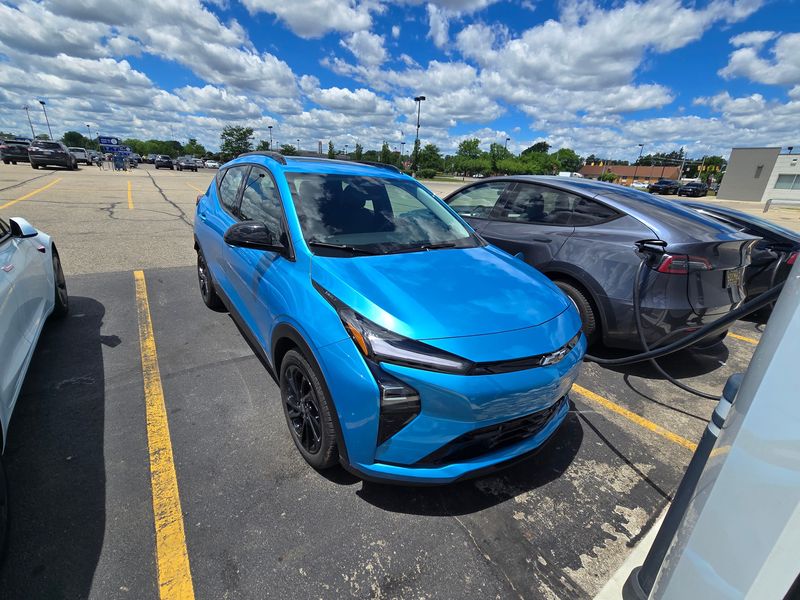
GM reportedly imports lithium-iron phosphate batteries from the Chinese company CATL, the world’s largest battery manufacturer, for the limited-run 2027 Chevrolet Bolt.
The battery chemistry also has safety benefits. Unlike other types, LFP doesn’t rely heavily on nickel, a costly component that increases the potential for thermal runaway, according to Sam Abuelsamid, vice president at Telemetry, a brand journalism firm based in Novi. Once a fire forms in a battery, it propagates rapidly, moving from one cell to the next at such high temperatures that it is what makes EV fires so dangerous.
“Anything with nickel and cobalt generates its own oxygen for a fire. With LFP, that’s not the case,” Abuelsamid said. “So you can pierce an LFP battery and it can momentarily sizzle, but you’re not going to have thermal runaway.”
A downside of LFP is lower cold-weather performance and the fact most of the production capability is based in China. Until the United States builds its own processing facilities, automakers need to import the technology.
GM is making LFP batteries for energy storage systems out of its Ultium plant in Springhill, Tennessee. However, those batteries require heating and cooling systems built-in to maintain effective charging and energy output, which can raise their cost.
Nickel, manganese, cobalt, and aluminum (NMCA) batteries
This is the most common battery type used in North America.
Still using lithium-ion, the nickel, manganese, cobalt and aluminum (NMCA) batteries use expensive materials with high rewards. Cobalt and nickel, in particular, add costs to the cathode, Abuelsamid said, but it’s a trade-off to increase energy density and stability that has improved the range of GM’s EVs over time.
Produced alongside South Korean LG Energy Solutions at the jointly operated Ultium Cells facilities, GM uses NMCA batteries in the likes of the Cadillac Lyriq, GMC Hummer EV, Chevrolet Silverado EV and Chevrolet Blazer ― every EV except the Bolt.
Sodium-ion batteries
GM said on June 9 that it began research and development on sodium-ion batteries in 2025 as a low cost and easily attainable alternative to its current battery technologies.
Though close to lithium on the periodic table of elements, the size and heft of a sodium-ion battery is what makes the technology more ideal for stationary energy storage systems than moving vehicles. Without using cobalt or nickel, it is more stable and cheaper to boot. Plus, sodium-ion doesn’t require the thermal management systems like LFP because it operates the same regardless of temperature and lasts a lot longer.
GM projects a sodium-ion battery could be completed by 2028 with the potential to bring to market by 2030.
Lithium-manganese rich batteries
Not available yet, but GM and rival Ford Motor Co. are both testing the tech with hopes of using them in electric vehicles. GM is pursuing lithium-manganese rich (LMR) batteries that would use the same supply chain as GM’s current footprint sourced in the United States but with a battery chemistry that uses more of the cheaper materials — such as manganese, mainly. Cobalt is the most expensive, nickel is the second most expensive — while still retaining high-performance. GM has already scaled domestic production of lithium, graphite and manganese.
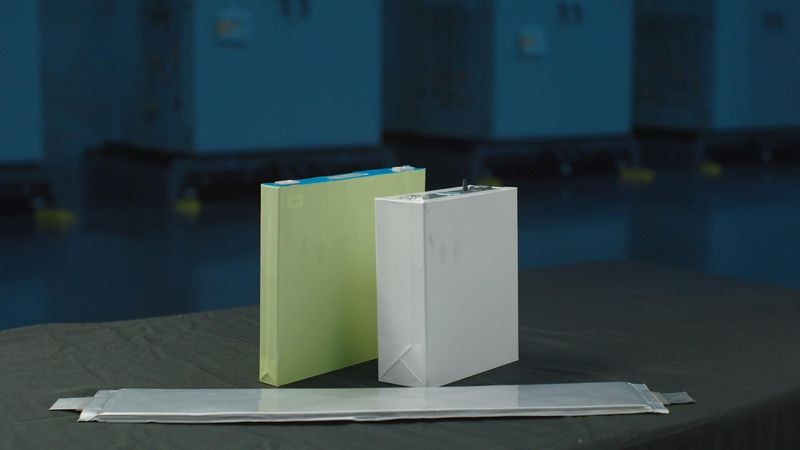
GM said LMR gets most of the energy density of a nickel-rich chemistry but at a lower cost than LFP. LMR is also configured with a new “prismatic” battery cell, meaning it is stored in a more efficient rectangular shape instead of a pouch, that GM said performs at a 33% higher energy density than the best-performing LFP.
Manganese in higher quantities than the costlier cobalt and nickel lets GM control costs. The chemical composition of a high-nickel battery includes roughly 85% nickel, 10% manganese and 5% cobalt. The composition of LMR cells is only 35% nickel, 65% manganese, and virtually no cobalt.
High energy density with low cost means that LMR batteries could replace the current chemistries and reduce GM’s reliance on foreign countries for materials. Development is on track for GM to produce these batteries by 2028.
Jackie Charniga covers General Motors for the Free Press. Reach her at jcharniga@freepress.com.
This article originally appeared on Detroit Free Press: Salt is just the latest battery tech explored by General Motors
Reporting by Jackie Charniga, Detroit Free Press / Detroit Free Press
USA TODAY Network via Reuters Connect
By Jackie Charniga, Detroit Free Press | USA TODAY Network