Oak Park — Devin Gardner grew up in Detroit, was a starting quarterback at Michigan and a captain in 2014, and now works as a college football analyst on Fox Sports.
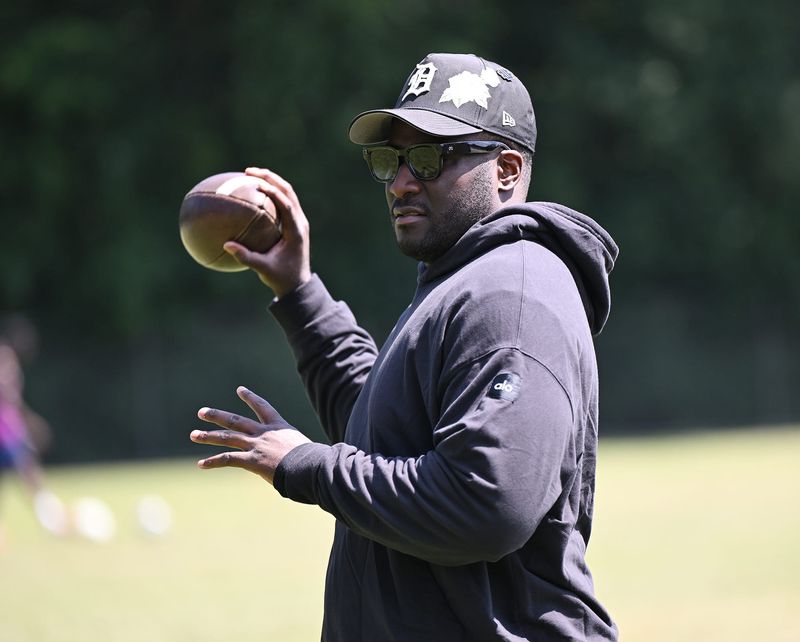
The four-time Emmy Award winner also spends time giving back to the community through the “Young Go Getters,” a conditioning and quarterback/receiver training program he created to help young football players develop their skills while also learning how to carry themselves off the field. Among the local talent that has come through Gardner’s “Young Go Getters,” for which he foots the bill, is current Oregon starting quarterback Dante Moore, the former Detroit King standout.

For Gardner, known to his young students as “Dev,” this is all about developing their love for the game and understanding the lessons they can learn from football. Consequently, Gardner said working with this group and teaching them the game in ways that are easy to understand has translated to how he shares his thoughts during games, simplifying complex plays while working next to TV partner Tim Brando.
Gardner shares his thoughts with The Detroit News on the “Young Go Getters,” the upcoming seasons for Michigan and Michigan State and college football. Some answers have been edited lightly for brevity and clarity.
Question: Why did you come up with the ‘Young Go-Getters?
Answer: It actually started with Dante Moore. I was still playing at the time, and I’m just seeing this kid kind of walking around and people not being very kind to him. I want to see what he’s got. I put him through a workout. He’s throwing, he’s doing these things, and he wasn’t perfect, but I can see he’s like there’s something in him. I was like, I think I want to help him out. I helped him, and then Dequan Finn and Ahlon Mitchell, whose grandfather was my very first coach. It started with those three kids, and then from there, just started to build out. And then Austin Mitchell came along. He was 7 years old. Didn’t like how he was being treated on his team, so it’s like, well, I guess I’ll teach him how to play. His grandfather was my pastor. And so now you build out this group of kids, and it’s been amazing for me.
Q: You don’t charge for this?
A: Obviously, since I’ve been with Fox, I’ve gotten to a place where I can just do it all the time, and they don’t have to pay. It’s been really good to be able to give back and transform the future of the game of football. But not only that, just humans in general. You see so many people that are playing sports, and they think it’s just all about becoming a pro, and it’s not really about that. It’s about becoming a pro in life. And I learned that through college and all those different things. And so it’s just been really cool to be able to do that now, and they can just come here, and their parents won’t have to have any stress, especially in the summertime when you know they want them out of the house.
Q: Did you have this outlet when you were a kid?
A: I didn’t have this exact type of thing. I didn’t have one specific person that had been through what I was trying to become, but I did have a lot of different mentors, men who helped me with no father. My older brother, everybody kind of pouring into me, and my favorite quote is, ‘Service to others is the rent you pay for the room here on Earth.’ And so for me, this is me paying my rent getting a chance to help others and serve others, because as you know, social work is where I kind of cut my teeth in college, and I always knew that I wanted to help others.
Q: How does this help your broadcasting career? We’ve talked about how you have to simplify things for young kids and also for your television audience.
A: Oh 100% because contrary to popular belief, most people watching games are not football coaches or football players. They actually have something to do on the day the games are being played, right? It’s normal people who don’t really truly understand the nuance all the time of football, and so when you start to talk over their head, they can’t enjoy the game. Someone’s Grandma doesn’t know what a 3-technique is, right? They don’t know what quarters coverage is, right? But if I get a chance to learn how to explain to these young kids, I feel like I can explain it on television in a concise way to help everybody enjoy the game, rather than just the football heads that love football.
Q: Do these kids react to you being on television?
A: No, they don’t care. They don’t care at all. I mean, they see me sometimes, but one kid, like a year ago, was like, “I thought you did high school games.” It’s like, dude, what are you talking about? I’m like on my second contract at Fox. So it’s kind of like a humbling experience as well, where you’re not that big. The kids that you work with think you’re just this regular dude.
Q: Do you need to be humbled, Devin?
A: Of course. You know that. You’ve known me for a very long time. Humbling experiences are the best thing for you, and everybody should experience that, not just me.
Q: You got the contract extension with Fox three more years. You’re working with Tim Brando and doing a lot of college football games. What do you hope to achieve?
A: My goal is always to get better. I work with Jeff Byle, who gave me my first start doing high school games, and even still, second contract, three more years, I still go to his house on Mondays after my games, and we watch film, and he tells me how bad I am, right? And I try to improve every single week, and I think that’s the thing that’s kind of missed in my kind of ascension. People don’t understand how hard I’ve worked and how those Mondays after games, when I think this game is so great or I think this game is so terrible, getting a chance to watch the film, just like when I was an athlete and figure out the things I can do better, that’s what’s allowed me to ascend so quickly and get to the place I am now.
Q: How would you define your broadcasting styles?
A: Well, my style is fun. It’s fun. It’s enjoyable, but it’s also knowledgeable. I love when people tweet me or send me direct messages and say, “Man, the game was so fun to listen to, and I learned a lot.” I don’t want to be just football, football, football, where nobody can have fun, and I don’t want to just be a fun clown show, you know what I mean? You want to be somewhere in between, and then when the game gets tight, you want to nail those moments. And that’s what I’ve worked on the most, and that’s what I’m getting better at.
Q: You’ve talked about not having your dad around while growing up, but having your older brother and your community. How tough did that make you?
A: So I grew up in the projects. People don’t understand that or know that, but I grew up in the projects, the Smith Homes on Evergreen and Linden in Brightmoor, and then when we moved to the East Side, which wasn’t much better. But growing up and understanding that sacrifice had to be made, I had to learn about sacrifice. My mom had to sacrifice a bunch for us, me and my other brothers and sisters, four of us. And then, it was kind of a little bit of envy, seeing other kids with their dads at practice, and everybody’s so invested in them, and it’s just like that kind of builds a fire in you of like, I want to make sure that I can be everything I can be without anyone. I don’t need anyone. But I did have a bunch of coaches and mentors that really helped me out, that took the place of that father figure, so I almost got a little more than others because I didn’t have a father. So now I got like 15 dads that are all helping me in different walks of my life, and it was really important for me growing up.
Q: What was it like growing up in your neighborhood?
A: Oh, it was terrible. I mean, it was character-building for sure. Getting into fights and having to be very aggressive all the time. A lot of kids now aren’t very aggressive. When you want to play football, that’s difficult, and so it’s hard to teach someone to be aggressive. But it’s much easier for me to pull someone back because I was the guy that had to be pulled back some with the aggression and understanding how to help others and being a good teammate and different things like that. Those are the things that I learned growing up that I didn’t have initially, just because of how I grew up.
Q: How hard was it for you to go to U-D Jesuit (he then transferred to Inkster before his junior year)?
A: Man, people have no idea. I was miserable. U-D was the worst experience of my life. But U-D, the experience there, personally, taught me a lot. It made me very aware of my surroundings, understanding being in a diverse situation, because I’d never been around someone of another race. And then you go to U-D, it’s so diverse there. But it was an awful experience for me coming from the projects. I’m getting in trouble. I think I got the record for JUGs, and those are Justice Under God (detentions). It was a terrible experience, but it was a needed experience, and it was a great experience for me that really set me up to when I’m in my first semester at Michigan. I can get all A’s because I know the type of diligence I need to put forward when it comes to my studies, and also I understand how to deal with the diversity that is the University of Michigan.
Q: Did that help you become a better teammate?
A: Yeah, absolutely. When you’re growing up playing in Little League, I didn’t have any White teammates. I had a couple White teachers, but I just didn’t really experience it as much, and if you don’t, you don’t know how to deal with it. Having that experience at U of D, and then going to Inkster where it’s all Black, it’s like, hey, that experience that I had at U of D was great because now I’m at Michigan. Like you can’t see the same color person two times in a row, you know what I mean? It’s just so many different people. But I’ve already experienced it, so it’s not a culture shock now, and I can just move throughout my life normally.
Q: Switching gears, what do you think of the upcoming football season?
A: I think the college football season is going to be the best one that we’ve seen yet, just because of the parity. It just continues to get better and better and better. The SEC can’t dominate everything because everybody’s getting paid, so players aren’t being stockpiled at one university. They’re going everywhere. You can see like a (quarterback) Jackson Arnold (who had been at Oklahoma and Auburn) who’s at UNLV. I have them in Week Zero against Memphis. He’s the No. 1 quarterback in the country, or No. 1. He won the Elite 11 MVP, and he’s at UNLV, because it’s like, hey, I could go somewhere and do this, but I could go here and just play. There are good players all over the country. You’re going to see some teams that aren’t supposed to beat some teams beat them. You’re going to see a Group of 5 team beat a team that shouldn’t be beat in the Power 4. The parity is incredible. Like everybody has a chance for the most part, and I’m really excited about it.
Q: You mentioned players getting paid now. What do you think you would have made?
A: I remember the (UM college paper) Michigan Daily did a kind of a study of what me and Denard (Robinson) kind of brought to the university as far as money. Now, obviously, Denard brought in more, but I would have got a cool million at least. I would have been very excited to have that type of money. Now, would I have been able to become the same man that I’ve become today because I have been essentially given something I didn’t really truly earn yet? I don’t know. And I think that I really appreciate the experience of suffering and all the different things I had to go through because now it put me in this position to help these kids and do all these different things. Would I be able to be the man I am today with that? I don’t know because giving an 18-year-old a bunch of money is, you just never know. I think it’s affecting some people in negative ways, some people in a positive way. It depends on the circle you have because having that kind of money — and they say money changes people, and it does when you’re young and you don’t understand. You think that this is how life works. Hell yeah, they just give me money, and I haven’t really produced anything yet. I think it’s setting a bad precedent. And if you don’t do anything right with the money, it’ll be gone. You won’t get a chance at the NFL, and so now you’re left sitting with your hands under your butt, kind of tied, saying, “Well, what do I do now?” Because you didn’t have to become a good person because you had money, right? People treated you well no matter what you did, and now you have to go into the world and be a good teammate to other humans, not just football players or whatever. You have to be a good teammate to the world, and you don’t know how to do that, right? Because you had always been the man, and that was the issue before you were making money, right? It’s the fact that you’re put on this pedestal from 7 years old to let’s say 22, where you can do nothing wrong, you’re the greatest thing since sliced bread, and everybody loves you. And then your phone stops ringing almost in an instant. It’s demoralizing. It’s mentally draining, and now it’s even worse because if you don’t make it, everybody’s gonna disappear, and now you have to sit with yourself, and you haven’t learned who you are, because you’ve been able to just live your life freely with money and whatever. So it’s tough. It’s a tough balance, but I think they should get paid for sure. However, I think there needs to be more things in place to make sure that they’re OK and understand the magnitude of the position they’re in.
Q: What if there was open transfer when you played, would you have considered transferring?
A: Yeah, I wouldn’t have. I could have, but I wouldn’t have. It’s just not who I am. The only reason I left U-D is because I essentially had to. I’m not the guy that wants to run away from competition. And as you, you got Denard Robinson and Tate Forcier (at Michigan). I don’t know if it’s my confidence or my arrogance, but I believed that I could play no matter what, and I didn’t feel comfortable running. Now, the one thing I did do was request that I play receiver because I was tired of sitting on the bench once I saw the writing on the wall of I’m not gonna get any opportunities at quarterback just yet. But other than that, yeah, I’m not the guy that would just transfer just because I’m not playing.
Q: What’s a reasonable expectation for Pat Fitzgerald and Michigan State this season?
A: Because of so much turnover, I think anything they do is fine. If they win three games, they win four games, five games, whatever it is, you just want to see the toughness of Pat Fitzgerald’s team, in my opinion. I took a kid up there for a camp, and Pat Fitzgerald’s in rare form, and I think he’s out to prove a lot. We know what Pat Fitzgerald does with a bunch of kids who only can get in Northwestern, right? This is before transfer portal. He competed. He fought. He made it to a Big Ten championship at one point, which should not happen before the transfer portal because it’s just so hard to get into Northwestern. So if he can do that there, I’m really afraid actually what he can do at Michigan State, where they do on-site admissions. That’s terrifying because he is a master motivator. His teams are going to be extremely tough. He’s a fire-breathing dragon, man, and it’s terrifying to see that he’s in a position where he can actually recruit players and get guys to go to a school and really compete.
Q: You’ve played against Pat Fitzgerald-coached teams. What was that like?
A: They’re violent. They may not be the most athletic in the past, just because of the Northwestern academic rigor, but they play hard, and they never quit. And you are always going to be in a dogfight, even though you shouldn’t be, right? Their players aren’t as good, and whatever the case may be, but for whatever reason, you’re always in a dogfight. So that’s what they have to look forward to when you play Michigan State now.
Q: Michigan has a new coach in Kyle Whittingham (who spent the last 21 seasons as Utah head coach). Do you know a lot about him and what this team could look like?
A: Well, so I know a lot about them because of the crossover of film because I do a lot of Big 12 games. I never had (Utah), though, but I did have New Mexico with (Michigan offensive coordinator Jason) Beck and they had Devon Dampier at New Mexico, and I thought it was incredible what they were able to do. They actually lost the game in Montana State or something like that. The game I had, however, I thought the quarterback was exceptional. I thought the coordinator was exceptional, and then (Beck and Dampier) go to Utah, and you know they played well last year. They were one of the top teams rushing the ball in the country. Devon Dampier had some injury stuff, and so they kind of were set back a little bit by that. However, it was a lot of the same thing that we saw at New Mexico. I’ve seen what (Beck’s) been able to do, and we should look forward to a team that can run the football, and that’s what Michigan is used to. So they’re going to be able to run the football, and I think it’ll be up to Bryce Underwood, his development to see how they are in the pass game.
Q: What do you make of Michigan quarterback Bryce Underwood?
A: I think he has a lot of work to do, but there’s no person in the country that’s more physically gifted or prepared. Like the physical makeup suggests that he can win the Heisman at some point, you know what I mean? Now he just has to get the rest of the pieces in order to get in that position and put himself in position. It can’t be overhauled, like everybody wants it to be — he was not very good last year, and he’s gonna be best quarterback in the Big Ten this year. That’s just not how it works. Baby steps. Incremental success and development, and if he can withstand the pressures of improving, because it’s a lot of pressure to improve. You have to do things the correct way, especially with these new coaches. If he can withstand it, I think he can be fine.
Q: What is the pressure like being the Michigan starting quarterback?
A: You’re different. You’re different than everyone else, and a people don’t understand that. You don’t get to do what everybody else does. You don’t get to go to the party. You have to be held to a different standard. And it can’t be everybody else holding you to a different standard, it has to be you holding yourself to a higher standard. The best word to describe it, it’s different.
Q: What team will be the best in the country this year?
A: I think Oregon’s going to be really, really good. I think Ohio State is going to be really, really good. I think those are the top two teams right now. It’s hard to say which one is the absolute best, but I think those two are the top two teams.
achengelis@detroitnews.com
@chengelis
This article originally appeared on The Detroit News: Q&A: Devin Gardner on Michigan, MSU football, and how Detroit shaped him
Reporting by Angelique S. Chengelis, The Detroit News / The Detroit News
USA TODAY Network via Reuters Connect
By Angelique S. Chengelis, The Detroit News | USA TODAY Network