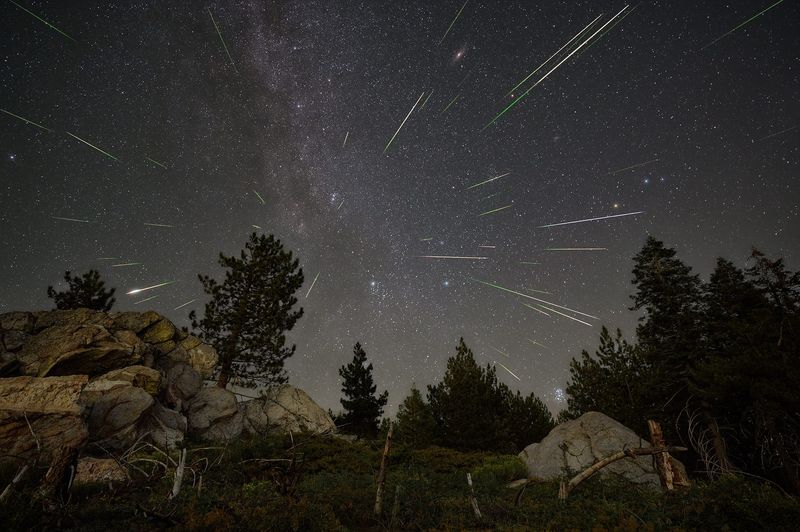
You may catch a glimpse of the year’s most popular meteor shower streaking over Michigan skies tonight — that is, if the full moon or clouds don’t get in the way.
The annual Perseids meteor shower is set to peak tonight, showcasing bursts of light and color above as meteors streak by throughout the night in the best meteor shower of 2025, according to NASA.

However, the waning sturgeon moon could disrupt viewing conditions, August’s full moon peaked three days ago, but it’s still quite bright in the night sky, experts say.
Watch out for severe weather, too; the National Weather Service predicts storms overnight in regions across the state, including mid-Michigan, southeast Michigan and northern Michigan.
Here’s what to know about the Perseids.
When do the Perseids peak?
The Perseid meteor shower peaks overnight Aug. 12 into the early morning hours of Aug. 13, according to Space.com.
What is the moon phase today?
The moon is in its waning gibbous phase, but will be 86% illuminated on Aug. 12, Space.com says.
When is the best time to view the Perseids?
The best time to watch the Perseids in the Northern Hemisphere is in the predawn hours, though meteors may be visible as early as 10 p.m., the space agency says.
What is the Perseid meteor shower?
The Perseids is a strong, fast meteor shower featuring 50 to 100 meteors per hour, NASA said. Bright meteors and fireballs, very bright meteors, frequently streak across the night sky, creating a path of light and color overhead.
The meteors appear to come from the area of the constellation Perseus in the sky, NASA says, though the meteors can be seen in any part of the night sky, the American Meteor Society says.
How will the full moon impact viewing chances?
In 2025, the shower’s peak will not meet ideal conditions because the moon will be too bright, Robert Lunsford, the American Meteor Society’s newsletter editor and fireball report coordinator, told USA TODAY.
This year’s peak comes just three days after the full moon.
What causes the Perseids?
Meteor showers occur when the Earth passes through dusty debris trails left by comets and broken asteroid bits as they orbit the sun, NASA says. The debris collides with Earth’s atmosphere at high speed and disintegrates, creating fiery and colorful streaks in the sky.
The meteors in the Perseid meteor shower come from comet 109P/Swift-Tuttle, a large comet discovered by American astronomers Lewis Swift and Horace Tuttle in 1862, per NASA. Italian astronomer Giovanni Schiaparelli uncovered the comet as the source of the Perseids in 1865.
How can you see the Perseids in Michigan?
To ensure the best chance of viewing this meteor shower, here are a few things the American Meteor Society, USA TODAY, BBC Sky at Night Magazine and Space.com recommend:
Where can you watch the Perseids in Michigan?
Look for a clear, open area to view the meteors in Michigan’s skies.
Michigan is home to six dark sky state parks, three international dark sky parks and an international dark sky sanctuary.
When did the Perseids begin?
The Perseid meteor shower began activity July 17, per NASA.
When will the Perseids end?
The Perseid meteor shower will end Aug. 23, NASA says.
How did the Perseid meteor shower get its name?
The name Perseid meteor shower or Perseids comes from the Greek Perseidai, or sons of Perseus, referring to Greek mythology, according to the Old Farmer’s Almanac.
Meteor, meteorites, meteoroids — which is it?
Those are words that sound similar, but there are important differences.
When is the next meteor shower in 2025?
The Orionids will be active Oct. 2 to Nov. 12, peaking Oct. 22-23, according to the American Meteor Society.
USA TODAY contributed.
Contact Jenna Prestininzi: jprestininzi@freepress.com.
This article originally appeared on Detroit Free Press: Perseids to reach peak tonight. Will the moon, weather allow viewing?
Reporting by Jenna Prestininzi, Detroit Free Press / Detroit Free Press
USA TODAY Network via Reuters Connect