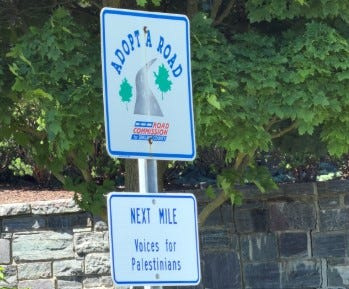
My mom recently showed me a Facebook post decrying a new “Voices for Palestinians” Adopt-a-Road sign in West Bloomfield. She thought the sign should come down. But, in addition to being a Jewish West Bloomfield native, a former Oakland County assistant prosecutor and an adoring son, I am a free speech attorney. So I feel obligated to explain why the county’s taking the sign down violated the First Amendment.
Oakland County’s Adopt-a-Road program encourages volunteers to promote their causes by erecting signs naming the sponsor. In September, a resident applied to clean up Orchard Lake Road under the name “Voices for Palestinians.” He picked up trash in April, and two weeks ago, the county put up the sign.

But that Saturday, a viral Facebook post expressed outrage and told users to “make some noise” by contacting county officials. County Executive Dave Coulter called the sign “painful,” pointing to its location two miles from the March 12 terrorist attack on Temple Israel synagogue. Coulter acknowledged the First Amendment, but urged that the Road Commission could constitutionally review the signs’ “impact on the community” and impose “content neutral” restrictions.
The road commission took it down that same day.
Coulter gets the First Amendment wrong: Protecting free speech means allowing speech that might hurt some of us to read. The Supreme Court made clear that censoring signs because of what they say is not “content neutral.” And silencing speech because some find it offensive is unconstitutional viewpoint discrimination.
A Road Commission official acknowledged that “whether the wording on the sign is offensive is a matter of opinion, and obviously, there are strong opinions on both sides.” But by shutting down one side of the debate, Oakland County violated the First Amendment.
Even when the government invites people to speak on its property, as Adopt-a-Road signs do, it still can’t exclude some speech based on viewpoint. That’s what the Supreme Court held when Boston tried to stop a Christian group from raising their flag at city hall. And that’s what the Foundation for Individual Rights and Expression — FIRE, where I work — argues should prevent states from rejecting potentially offensive vanity plates.
Oakland County has allowed people to adopt roads for local businesses and Scout troops, B’nai B’rith and the Rotary Club, churches, synagogues, mosques and the Rochester Redskins football and cheer teams.
“If there is a bedrock principle underlying the First Amendment,” wrote Justice William Brennan, “it is that the government may not prohibit the expression of an idea simply because society finds the idea itself offensive or disagreeable.”
That principle guides my work. But I’d be lying if I said some days it wasn’t hard. I’ve spent most of my life as a part of Temple Israel’s congregation, and the March 12 attack was my nightmare scenario for the antisemitism that often arises when people conflate the Jewish faith with the State of Israel. I don’t blame people for feeling uncomfortable when confronted with a reminder of that conflict.
But if the government prohibited speech every time it made someone uncomfortable, free speech would mean little. Public colleges could shut down both pro-Israel and pro-Palestinian speakers. High schools could censor students for supporting or opposing ICE. Police could throw people in jail for posting a meme about the president. The First Amendment protects all of us from all of that. Protecting our free speech rights means sometimes standing up for speech we don’t like — not demanding it be taken down.
Jeff Zeman is an attorney with the Foundation for Individual Rights and Expression.
This article originally appeared on The Detroit News: Oakland County’s Adopt-a-Road controversy is a First Amendment lesson | Opinion
Reporting by Jeff Zeman / The Detroit News
USA TODAY Network via Reuters Connect
By Jeff Zeman | USA TODAY Network