The northern lights are expected to appear over northern Michigan and the Upper Peninsula skies Monday night, Oct. 6, according to NOAA’s Space Weather Prediction Center (SWPC) forecast, but cloudy skies are likely to make viewing a challenge as the National Weather Service predicts rain on the way.
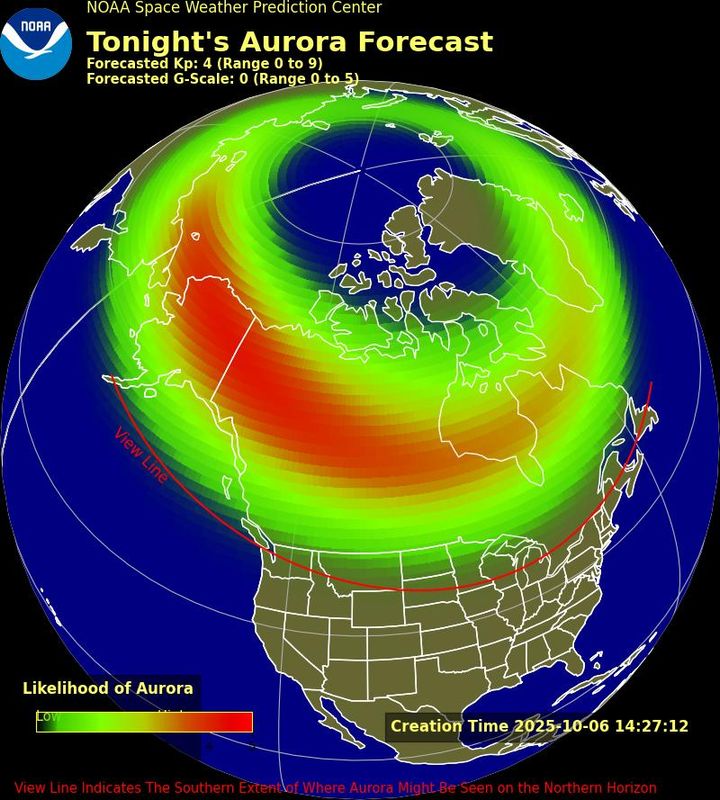
The view line on SWPC’s dashboard map shows people in up to nine states could see the northern lights, or aurora borealis, Monday night. Michiganders as far south as West Branch, Manistee and Cadillac may be able to see the shimmering lights in the night sky to the north, NOAA says.

However, local NWS offices forecast potential rain and clouds overnight, with thunderstorms possible in some regions of northern Michigan, likely dampening northern lights viewing chances.
NOAA says a G0 geomagnetic storm, a worldwide disturbance of the Earth’s magnetic field, is expected to produce a Kp index of 4.
Kp is an index used to indicate the severity of the global magnetic disturbances in near-Earth space, NOAA said. Kp ratings increase from zero to 9. An index of 5 or greater typically means the northern lights may be visible across Michigan.
NOAA is predicting minor geomagnetic storm impacts.
Here’s what to know about northern lights viewing chances.
When will the northern lights be visible?
The northern lights may be visible from the northern Lower Peninsula and UP Monday night, Oct. 6, the SWPC said.
What are the northern lights?
The northern lights, or aurora borealis, are waves of light created when the solar wind strikes the atmosphere, creating a display of moving lights in the night sky.
Auroras typically appear in a range of colors, including greens, pinks and reds, often featuring several shades of these colors.
Which states could see the northern lights?
The NOAA says the red view line marks the southernmost extent where aurora might be seen on the northern horizon.
The view line for Oct. 6 includes parts of the following states:
Why do the northern lights have different colors?
The color of the aurora depends on which gas is being excited by the electrons and on how much energy is being exchanged, NASA said.
Oxygen emits either a greenish-yellow light (the most familiar color of the aurora) or a red light; nitrogen generally gives off a blue light. The oxygen and nitrogen molecules also emit ultraviolet light, which can only be detected by special cameras on satellites.
What is the corona?
The corona is the Sun’s outermost atmosphere. The name comes from the Latin word for crown. The area of plasma, or highly ionized gas, extends thousands of kilometers above the sun’s visible surface, called the photosphere. The region is much hotter than the sun itself with temperatures ranging from 1 million Kelvin (1.7 million degrees Fahrenheit) to more than 10 million degrees K, the National Solar Observatory said.
Can’t see the northern lights? Use your phone
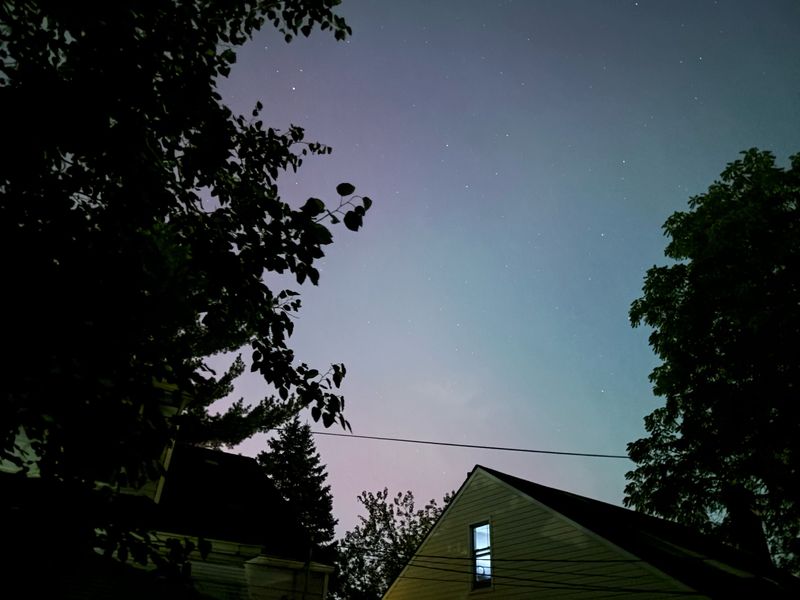
If you’re having trouble seeing the northern lights with the naked eye, try using your phone camera in night mode and hold still while capturing the photo. You might be surprised at what’s dancing in the sky.
The Lansing State Journal contributed.
Contact Jenna Prestininzi: jprestininzi@freepress.com.
This article originally appeared on Detroit Free Press: Northern lights likely Monday night. Will rain, clouds obscure the view?
Reporting by Jenna Prestininzi, Detroit Free Press / Detroit Free Press
USA TODAY Network via Reuters Connect