Harrison Township ― Lakefront condo owner Denise Johnson said she’s excited about an upcoming pilot project that will remove a type of blue-green algae from three chosen locations on Lake St. Clair, including her condominium community’s shoreline.
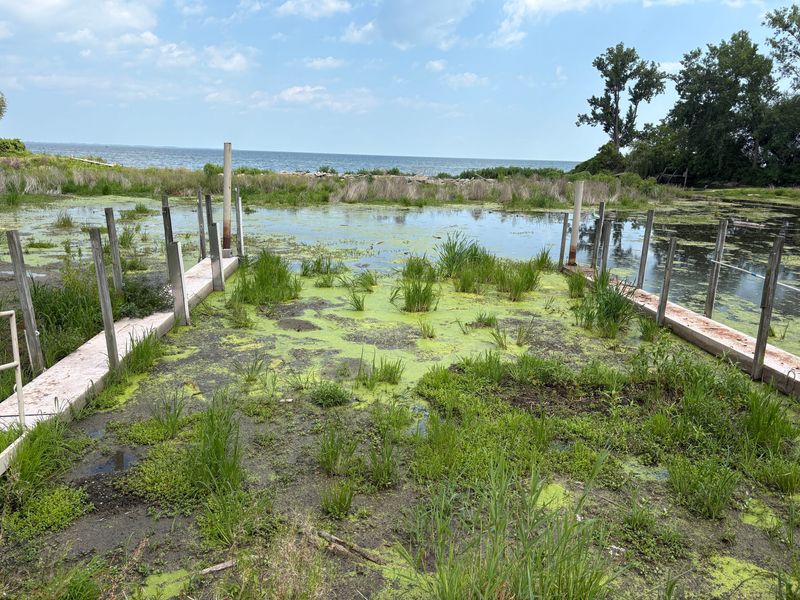
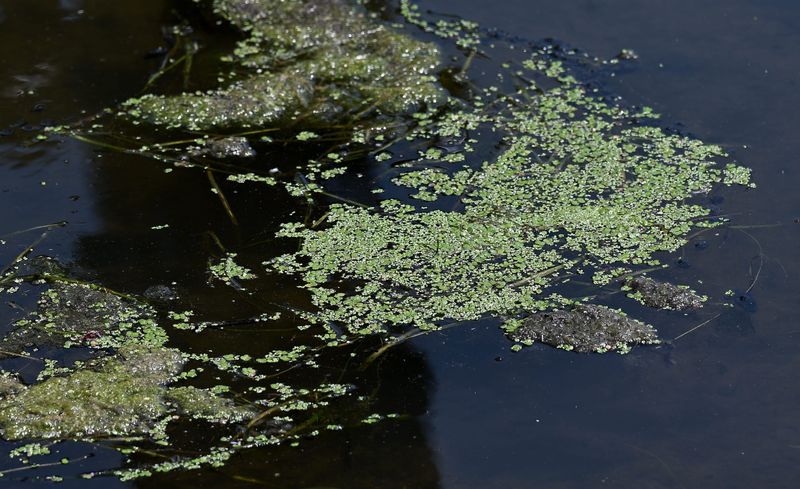
The blue-green algae, known as “the muck,” has taken up the boat wells at Johnson’s community, Hidden Cove Condominiums in Harrison Township, preventing homeowners from keeping their boats there or going kayaking or swimming.

“It’s like … hitting the lottery,” Johnson said. “I mean, we’re thrilled that we were picked.”
The Macomb County Public Works Office announced in July that it is scheduled to start a three-year field trial in the fall in which it will remove the muck from the condo community and two other locations on Lake St. Clair. The office said it hopes to learn more about how to manage the species, named Microseira wollei, over the long term. It has been growing in Lake St. Clair for more than 10 years, forming mats on the shoreline and at times emitting bad odors.
“We’re going to dredge this, and the truth is: It will come back, because we’re not eliminating it from the lake bottom,” said Macomb County Public Works Commissioner Candice Miller. “But when does it come back? Does it come back in six months? Does it come back in three years? I mean, … we don’t really know.”
The field trial is funded by an $800,000 earmark or pet project in the state budget sponsored by state Rep. Alicia St. Germaine, R-Harrison Township, and state Sen. Kevin Hertel, D-St. Clair Shores, the Macomb County Public Works Office said. The other two removal locations are Veterans Memorial Park in St. Clair Shores and Campau Bay near the mouth of the Clinton River in Harrison Township.
Freedom Boat Club of Lake St. Clair owns land that sits by the Campau Bay location, where the blue-green algae is located. The expansion of the muck puts at risk the hundreds of millions of dollars in revenue generated by the boating industry in the greater Lake St. Clair area, said Joseph DeBoyer, director of sales at the boat club. A 2023 study released by the Macomb County Executive’s Office estimated the economic impact from boating and charter fishing along the lake’s shore region at $1.6 billion.
DeBoyer said he thinks the project is “great.” He acknowledged that “trial and error” will be involved.
“There’s going to be multiple different solutions that are attempted to get rid of the muck and provide a long-term solution,” DeBoyer said. “If you dig it out and it keeps coming back, then you go up the chain and figure out: Where is it coming from, right? What’s the root cause?”
What the ‘muck’ project will do
The U.S. Army Corps of Engineers, in partnership with Macomb County, completed a study in 2025 looking at the Microseira wollei in Lake St. Clair. The Army Corps found that the muck, which is a cyanobacterium, develops in different areas of the lake, including as much as over a mile offshore, Miller previously said. It grows along the bottom of the lake, and the waves and wind push it toward the shore, she said. The blue-green algae then piles up on the shoreline.
Miller said she formed a working committee of state, local and Army Corps officials, which picked the three locations where the muck will be removed. They were chosen from 10 sites with the most significant blue-green algae mats. The committee didn’t have enough money to remove the muck from all 10 locations, which would cost an estimated $3.3 million.
The Public Works Office said the three locations include public and private sites where the geometry of the shore has less wave action than straight sections.
Miller said her office can’t be responsible for Lake St. Clair in the long run, as it doesn’t have jurisdiction over the lake or funding for it. Those who want to install a seawall on the lake need to get a permit from the Michigan Department of Environment, Great Lakes and Energy and the Army Corps, she said.
“So I believe that they are the responsible parties for something obviously of this magnitude, anyway,” Miller said.
The pilot project is meant to evaluate the removal techniques, study how long it takes the wind and waves to redeposit the blue-green algae on the shore, and remove it from the lakebed to examine its potential regrowth or migration, the Public Works Office said.
The office is awarding contracts to two contractors for the project ― Mount Clemens-based Dean Marine and Excavating as well as Harrison Township-based Sediment Lakes Aquatic Management ― and the work is expected to start in September.
What local people say about the muck and the project
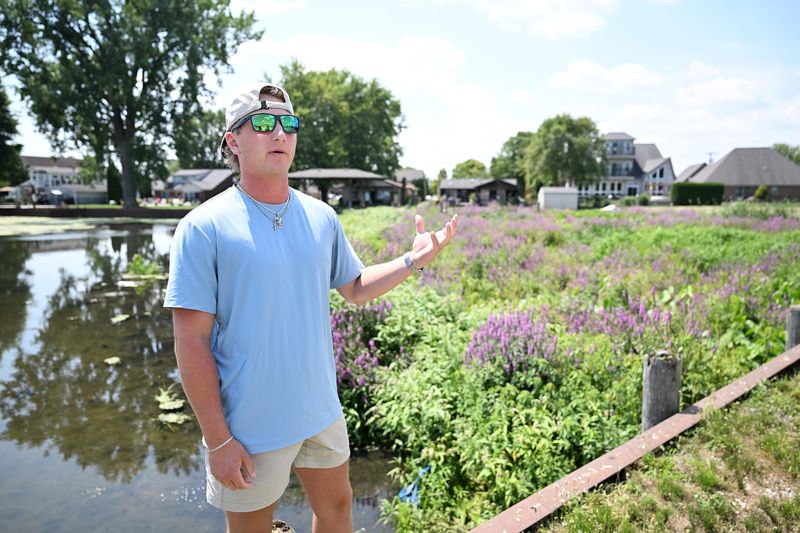
Muck has accumulated in the water by the Freedom Boat Club of Lake St. Clair’s property on Campau Bay. Vegetation, including green leafy plants and purple flowers, grows on the muck, masking it from view.
DeBoyer, the boat club’s sales director, said the club would also normally use the pilings by its seawall to dock boats, but that isn’t an option anymore because of the muck. He said the aquatic growth is “a headache.”
“All this frontage here that we have is unusable ultimately because of the buildup of sediment and muck that we have to try to battle against,” said DeBoyer, 23, “but there’s so many hoops to jump through that … it’s an uphill battle.”
Freedom Boat Club boats can still dock at the club’s property on the other side of South River Road. That property, which is on the Clinton River, isn’t affected by the muck.
Meanwhile, the cyanobacteria have made the boat wells at the Hidden Cove Condominiums in Harrison Township unusable. Johnson, who serves as the treasurer of the homeowners association for the community, said that in the summer of 2019 ― her first summer there ― a few of her neighbors kept their boats in the wells. Her friends would also visit her on their boats.
There was some muck in the water in 2019, but it has since grown a lot, Johnson said. She keeps her kayak and raft stored because she can’t use either of them.
“You can’t get in the water,” Johnson said.
Caroline Perron, the president of the community’s homeowners association, said she is “elated” about the project and “extremely grateful.”
“I really think that if … they do a thorough cleanout, that’s the only way we’re really going to know if we’ve got a shot here,” said Perron, 59.
She said the muck comes “with a vengeance.”
“Once we have it back to a manageable position,” Perron said, “then we can maintain it.”
asnabes@detroitnews.com
This article originally appeared on The Detroit News: Muck that ‘comes with a vengeance’ targeted on Lake St. Clair
Reporting by Anne Snabes, The Detroit News / The Detroit News
USA TODAY Network via Reuters Connect
By Anne Snabes, The Detroit News | USA TODAY Network