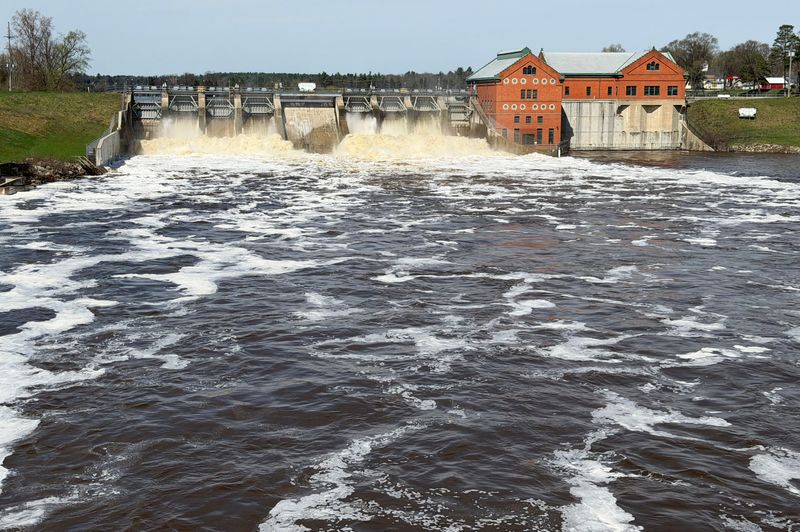
“Never let a good crisis go to waste.” A quote attributed to Machiavelli, Winston Churchill and Saul Alinsky applies to Michigan’s “slow motion catastrophe,” as one state senator called the half-dozen dams here now threatening to fail and drown their surrounding communities.
State Sen. John Damoose, R-Harbor Springs, was referring to recent heavy rains that have caused water levels in the rivers adjacent to these dams to rise to dangerous levels, including at Cheboygan Dam in northern Michigan.

But this crisis has been years, not weeks, in the making. Six years ago, another bout of spring rainfall precipitated (yes!) one of the worst dam failures in Michigan history. On May 19, 2020, the Edenville and Sanford dams collapsed, sending a wall of water that flooded downtown Midland and other mid-Michigan communities, forced 10,000 people to evacuate their homes and cost an estimated $250 million in damage.
Subsequent investigations revealed that many of Michigan’s 2,600 dams were in poor condition, and some posed a serious threat to human safety and the environment.
Moreover, federal and state regulators had been warning about these risks and struggling for decades to get those responsible for the dams, usually private companies, to bring those dams into compliance with federal and state regulations.
But despite a report detailing the condition of Michigan’s dams, and practical recommendations for how to improve dam safety, both the U.S. Congress and the Michigan Legislature have failed to take meaningful action.
No oversight, no investigation
History is full of examples of how a disaster ― natural or otherwise ― triggers public outcry, a legislative investigation and hearings to shed light on causes of and solutions to the problem, and, finally, reform supported by a public willing to bear the costs of ensuring the scourge never returns. Examples range from the Great Depression birthing Social Security to carnage on America’s roads triggering mandatory seat belts and vehicle safety standards.
Michigan got its dam crisis in 2020, after which Gov. Gretchen Whitmer appointed a Dam Safety Task Force that issued a report in 2021, laying out a detailed account of the problems facing Michigan’s dams and making 86 recommendations covering everything from how to fund dam maintenance, repair and removal, to boosting emergency response. It even included model legislation. Neither the U.S. Congress nor the Michigan Legislature conducted an in-depth oversight investigation.
What happened next helps explain why the crisis of 2020 in mid-Michigan did not produce enduring change that could prevent an eerily similar calamity from unfolding at the Cheboygan Dam and half-dozen others in 2026.
Dwindling funds for dam safety
As my Wayne State colleague, political scientist Kristin Taylor, and I argued back in 2020, “without public engagement and government accountability, meaningful, lasting solutions to dam safety and other infrastructure problems will be hard to achieve.” That is what legislative oversight is supposed to provide.
Instead, state administrators beefed up dam safety enforcement, funding for dam infrastructure was increased for a few years and lawmakers in Washington D.C. and Lansing introduced bills to implement many task force recommendations, some of which carry a hefty price tag.
None of those bills has received a hearing.
It is hardly surprising that such far-reaching legislation has not been enacted when you consider how little effort Congress or the state Legislature have put into educating themselves or, more importantly, the public about this knotty problem, and the costs and trade-offs associated with making Michigan’s dams reasonably safe.
A Levin Center review shows that neither Congress nor the Michigan Legislature held a single hearing to explore the implications of the Dam Safety Task Force’s report, much less lay out for the public reasons for the regulatory changes and large public investments proposed by the report.
Solving hard problems takes work
The Michigan Legislature lately has been passing very little legislation ― only seven bills this year as of the end of March ― and yet the body devotes a large share of its resources and most talented staff to writing bills.
In the House, for example, 50 staff members, including 22 attorneys, spend their days drafting legislation. Some of this well-trained staff could do fact-finding, and develop meaningful hearings to educate the public and build consensus about practical solutions to vital problems.
Instead, most oversight hearings in Lansing focus on highly partisan themes aimed at embarrassing political opponents.
Of the 129 hearings held in the GOP-controlled House Oversight Committee and subcommittees since 2025, not one focused on the condition of Michigan’s infrastructure.
The Democratic Senate’s oversight panel, ostensibly with little to oversee while its co-partisan occupies the governor’s mansion, has not even met this year.
If we want to solve hard problems, lawmakers have to embrace the hard work of performing their fundamental job as representatives of the people: informing the public and building momentum for enduring change.
Until then, the crises will come, but effective solutions will remain elusive.
Jim Townsend is director of the Carl Levin Center for Oversight and Democracy at Wayne State University Law School and former member of the Michigan House of Representatives where he was vice chair of the Oversight Committee. Submit a letter to the editor at freep.com/letters, and we may publish it online or in print.
This article originally appeared on Detroit Free Press: Michigan studied its dam crisis, then shelved the solutions | Opinion
Reporting by James Townsend, Op-ed contributor / Detroit Free Press
USA TODAY Network via Reuters Connect